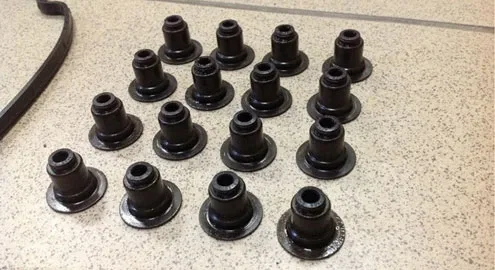
Replacing valve stem seals on a Peugeot is considered one of the rather costly procedures. This service is not cheap, and the need for it can arise even with careful vehicle operation and relatively low mileage. By what signs can you determine that it is time to replace these parts, and how does the operation itself go?
Peugeot engine and oil change intervals – why is timeliness so important?
Having bought a new Peugeot car, many drivers notice over time that oil consumption begins to increase. While the car is under warranty, this indicator usually does not exceed 1 liter per 15 thousand kilometers, but already at a mileage of 40–60 thousand kilometers the situation changes: consumption can exceed 1000 ml per thousand kilometers.
While the car is under warranty and is serviced by an official dealer, owners often do not control the oil level, although it happens that there is not just little oil, but almost none at all. Where does it go?
- It leaks through the valve stem seals.
- It escapes through the valve cover gaskets if they are leaking.
- It burns in the cylinders.
- It seeps through the vacuum pump.
Often oil also leaks through the oil pump solenoid valve. There can be many reasons, and this does not end well. If you notice that oil has begun to disappear faster, first of all it is worth eliminating the listed leaks. If consumption does not decrease after that, most likely, repair of the cylinder head (cylinder head) is ahead.
What threatens a lack of oil or its rare replacement? First of all, the cylinder head and the gas distribution mechanism suffer. Engine parts wear out accelerated, oil channels become clogged with resinous deposits, and the composition of the fuel-air mixture is disrupted. The engine begins to work intermittently, catalysts and oxygen sensors fail. However, all this can be avoided.
If your Peugeot has crossed the 50 thousand kilometer mark, it is worth checking the oil level with a dipstick at least once a week yourself or entrusting this to a specialist. The procedure is simple and takes only a few minutes, but your car will work properly longer.
What will be offered at the service station?
At the service station, you will most likely be recommended to replace the valve stem seals. The procedure is not cheap, plus you will have to buy special bolts and a cylinder head gasket. Also, technicians may offer to replace the timing chain.
The specialist has all the necessary tools and devices for such work. In time, it takes about 7–10 hours.
Replacing caps without removing the cylinder head
There is also a more budget-friendly option to solve the problem. Valve stem seals can be replaced without removing the cylinder head. This is significantly cheaper and faster solves the main task – oil consumption noticeably decreases. And such a replacement takes less time than at the service station.
True, there are some nuances. A working valve seal itself removes excess oil from the stem. If the caps are worn, the oil burns, and carbon deposits form on the valves. It grows and eventually puts them out of action.
If you replace only the caps, this will not solve the issue of correct operation of the timing mechanism. Therefore, specialists still advise not to save money and remove the cylinder head – this will allow for defect detection of the valves.