

Auto Parts Logistics: How Service Station Networks and Distributors Save on Delivery
An auto part is not a kilogram of buckwheat. It cannot be delivered "whenever convenient": the mechanic is standing by the lift, the customer is waiting, and the needed part is not in stock. That is why logistics in the automotive business is not just about money, but about reputation. One missed deadline — and the customer goes to a competitor.
Service station networks and parts distributors face tough math every day: delivery costs eat into margins, suboptimal routes multiply mileage, and manual order management generates errors. Those who survived and scaled up have long moved from "driving as usual" to systematic work with logistics.
Why Parts Logistics Is More Complex Than Regular Logistics
Most logistics systems are tailored for large shipments with predictable demand. Auto parts are a different reality.
First, the nomenclature. A large distributor has tens of thousands of SKUs of varying size, weight, and storage requirements. A bearing and a windshield, an oil filter and a bumper — different packaging and transport requirements.
Second, urgency. A significant portion of orders is "needed today" because the car is down. This forces frequent small-batch deliveries instead of rare large ones.
Third, geography. A service station network with 20–50 points across a region means dozens of addresses with varying demand and the task of building an optimal route for each driver daily.
Where the Main Costs Hide
Suboptimal routes. The driver drives "as usual," not as efficiently. Two locations in the same area are served by different trips. According to experts, route optimization alone reduces mileage by 15–30%.
Incomplete vehicle loading. The vehicle leaves at half capacity because orders are not consolidated. Every extra trip is fuel, driver time, and depreciation.

Returns and resorting. An incorrectly selected part is returned. Delivering a mistake costs twice: there and back, plus processing time.
Manual planning. Every morning, the dispatcher manually assigns orders to drivers based on experience and intuition. This is slow, error-prone, and does not scale with network growth.
Lack of control. Where is the driver now? Why is he late? The customer calls — the dispatcher does not know the answer.
How Service Station Networks Solve the Inventory and Delivery Problem
An efficient service station network has long stopped keeping a full parts warehouse at each location — that is frozen capital. Instead, a proven model looks like this.
Centralized warehouse and daily distribution. The main stock is stored at one or several regional warehouses. Daily — one or two trips to points based on pre-orders. Mechanics order what they need in the morning and receive it by noon.
Emergency deliveries via a separate channel. For urgent parts — an agreement with a local distributor or an "emergency" driver. Such deliveries should be minimal: they are expensive.
Real-time inventory tracking. The system automatically signals when an item approaches its minimum. Orders are formed proactively, not after the part is missing.
How Distributors Cut Delivery Costs
For distributors, the task is broader: they serve dozens or hundreds of points with varying volumes and order frequencies.
Delivery zoning. All customers are grouped into geographic zones with fixed days. The customer knows: order by Tuesday — receive on Wednesday. This consolidates shipments and minimizes trips.
Differentiated terms. Large customers receive daily delivery, small ones — twice a week or pickup. This eliminates the situation where a vehicle crosses the city for a single part.
Driver performance tracking. How many points per shift, how many kilometers, whether the time standard per stop is met. This data allows objective comparison and bonuses.
The Role of Software: From Excel to TMS
A few years ago, most distributors built routes in Excel or "in the head" of an experienced dispatcher. With 10–15 points, this worked. With 50+, it stops.
Modern TMS-class logistics software automatically solves: how to optimally build a route considering road congestion, how to distribute orders among drivers according to vehicle capacity, how to track execution in real time and signal deviations.
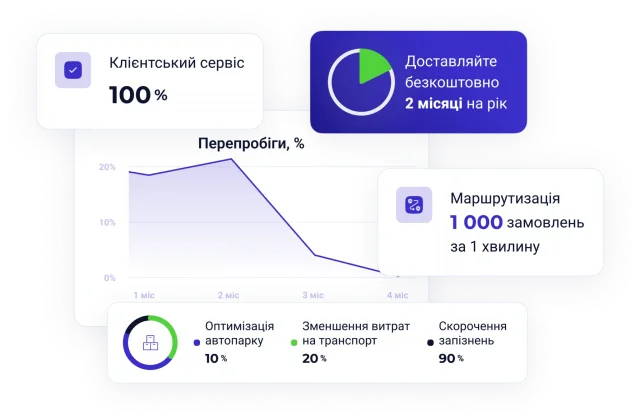
One such solution for the Ukrainian market is Rinkai TMS, logistics software from ABM Cloud. It is designed for companies that process dozens and hundreds of routes daily, and allows reducing manual dispatcher work, reducing mileage, and increasing delivery transparency. According to implementation results, the typical effect is a 15–25% reduction in transport costs within the first months. The system integrates with 1C, BAS, and SAP — orders enter routes automatically.
Practical Steps for Those Who Want to Optimize
Step 1. Measure the current state. How many trips per day, average mileage, how many points one driver serves. Without these numbers, it is impossible to assess the effect of changes.
Step 2. Look at the routes. Visualize how your drivers drive now. Often two drivers cross paths in the same area daily — and each carries several orders where one could go.
Step 3. Standardize zones. Even without software, manual zoning with fixed delivery days gives a noticeable effect. This is the first step toward systematicity.
Step 4. Automate planning. When processes are stabilized, TMS gives a multiple increase in efficiency. Automating chaos only reinforces chaos, while automating a system scales the result.
Step 5. Track KPIs. Delivery cost per order, percentage of on-time deliveries, number of repeat trips due to errors — these metrics will show where reserves remain.
Conclusion
Auto parts logistics is the operational heart of the automotive business. Those who measure, optimize, and automate win in costs and service. Those who drive "as always" gradually lose to competitors who think one step ahead.
You can start today: analyze last week's routes — and you will find enough points for the first improvement.