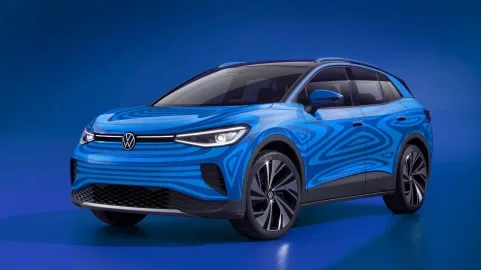
Volkswagen has unveiled the ID 4 and stated that the new SUV represents a "milestone" as the first model in its electric ID lineup to be offered worldwide.
The new car will go on sale in Europe later this year and, unlike the recently launched ID 3 hatchback, it will also be produced and sold in China and the US.
Volkswagen plans to sell 1.5 million electric vehicles per year by 2025, and it is estimated that the ID 4 will account for a third of that volume.
It is based on the same MEB electric platform used for the ID 3 and will eventually be offered with both rear-wheel drive and all-wheel drive, and two battery size options. A 302 hp ID 4 GTX model is also currently in development, which will have maximum range.
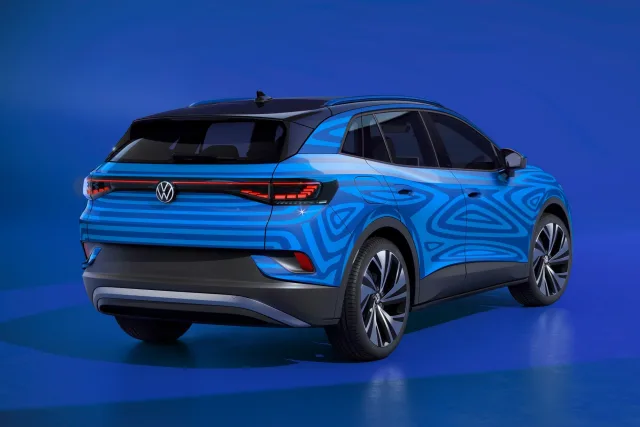
The ID 4 will initially be built at VW's plant in Zwickau, Germany. Like the ID 3, the first versions to be released will be limited First Edition models with 201 hp and a 77 kWh battery.
This gives the ID 4 First Edition a top speed of 160 km/h, a 0-100 km/h acceleration of 8.5 seconds, and a range of 520 km. In Germany, prices for the ID 4 First Edition will start at €49,950, while the higher-spec First Max version will cost €59,950.
It will compete with the Kia e-Niro, currently the most well-known affordable electric SUV in Europe, as well as the upcoming Tesla Model Y and Mustang Mach-e.
The ID 4 will also be offered in rear-wheel drive variants with 146 hp and 168 hp with a 52 kWh battery, and 173 hp with a 77 kWh battery. The dual-motor all-wheel drive GTX model will be introduced next year along with a 262 hp version, both equipped with a 77 kWh battery. The larger battery can be charged at speeds of up to 125 kW.
The design of the ID 4 is largely based on the style of the ID 3, with much work focused on optimizing the aerodynamic efficiency of the SUV body. The company claims it has achieved a drag coefficient of 0.28.
Standard equipment on the ID 4 includes LED lights, and as an option, VW automatically adjusts the IQ Light system. Initial models will be offered with 20 and 21-inch wheels.
At 4584 mm long, 1852 mm wide, and 1612 mm high, with a wheelbase of 2766 mm, the ID 4 is 102 mm longer and 13 mm wider than VW's petrol SUV Tiguan.
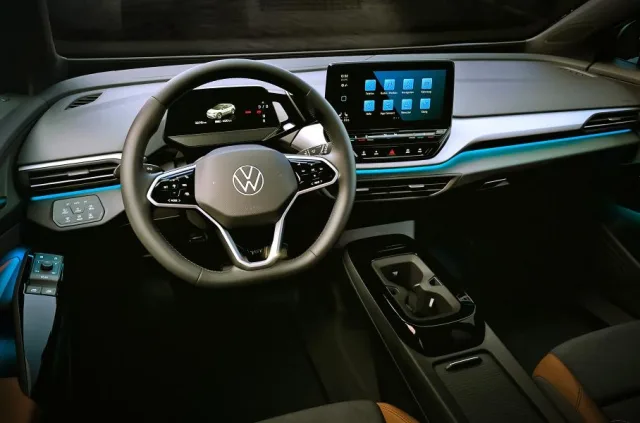
Thanks to its long wheelbase and relatively short overhangs, the ID 4 has a turning radius of 10.2 m and also increases interior space. Like the ID 3, the interior features an open minimalist design with large touchscreens that are compatible with voice control, replacing most of the physical switches. A switch attached to the steering column is used to select the three driving modes. The central touchscreen is 10.0 inches in the first variant, and 12.0 inches in higher-spec models.
The trunk volume is 543 liters, which increases to 1575 liters with the rear seats folded down. The car can tow trailers weighing up to 1000 kg.
The ID 4 offers interactive services through the VW We Connect Start system, as well as a range of IQ Drive driver assistance systems offered by the company, including lane keeping assist, braking assist, and adaptive cruise control. The electronics are powered by a new system built on two computers, with updates available over the air.
The chassis features MacPherson struts at the front and a multi-link setup at the rear, along with an optional damping regulator. Progressive steering, where the steering ratio becomes more direct as the wheel is turned further, is also available on some models.
The first models offered in Germany will be presented in an exclusive color range, along with tinted rear windows, a rearview camera, and heated seats and steering wheel. Higher-level Max models add further refinements such as LED matrix lighting, a panoramic glass roof, and a power tailgate.
Initially, the ID 4 will be built in Zwickau, with Chinese production of versions for that market starting soon at VW's Anting and Foshan plants. It will also be produced in Chattanooga, USA, for that market from 2022, when production will also begin in Emden, Germany.