In such a tense situation, it is important not to aggravate the situation and not to disable the electric pump by trying to start the system repeatedly. It usually does not break when freezing, but it should not be tested for strength unnecessarily.
Method 1. Warm up the car in a warm place
The most obvious and reliable option, although not the fastest. During the day, you can leave the car in an underground parking lot of a shopping center, and at night put it in a heated garage or a bay at a service station. If the power unit is well warmed up, then thawing of the reservoir, lines, and nozzles will go much faster. After complete thawing, you need to immediately remove water from the system and fill it with frost-resistant fluid.
Method 2. Use a car wash
You can ask at the car wash to direct a stream of water directly into the filler neck of the reservoir. With such constant exposure, the ice will dissolve quickly enough. The main thing is to ensure that water does not get on the electrical components under the hood.
Important nuance. On many models, the filler neck is in close proximity to the alternator. This place is better protected with plastic wrap or a bag.
Method 3. Remove the reservoir
Remove the tank and warm it up at home under hot tap water. However, this option is not suitable for all modern cars due to layout features.
Method 4. Use a hair dryer
Direct a stream of heated air into the neck. If there is access, it is worth warming the walls of the reservoir as well to speed up defrosting.
Method 5. Pour in salt
By pouring a pack of salt into the reservoir, you can quickly melt the ice. But such a "brine" should never be sprayed through the standard washers — this will lead to corrosion of many car elements. Salt water must be pumped out (for example, with a fuel pump) into a canister. Then you need to fill and drain antifreeze a couple more times to wash out the remaining salt.
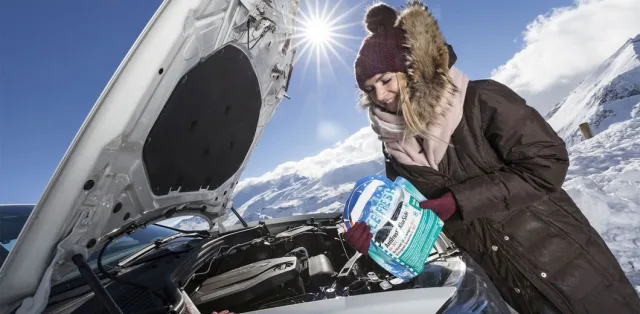
Method 6. Add antifreeze fluid
Fill the reservoir to the top mark with a composition with a low freezing point (isopropyl alcohol will also work). The more of such agent you can pour and the lower its operating temperature, the more effective the process will be.
Method 7. Warm up with a lamp
Add antifreeze fluid (preferably isopropyl alcohol) to the reservoir. Inside, immerse a lamp powered from the battery. It is convenient to use an H4 lamp, breaking off its flange — so it will fit even into a narrow hole. The wires need to be connected (and carefully insulated) so that the high and low beam filaments are connected in series. With such a device, you can even drive — this will speed up thawing and prevent the battery from draining.
Method 8. Stir with a compressor...
Pour antifreeze fluid over the ice. Lower a hose from a car compressor into the neck. Rising air bubbles will constantly mix the fluid, and the ice will melt faster.
Method 9. ...or with a fuel bulb
This process will take time, so it is better not to turn off the engine. Heat from the motor will warm the reservoir and hoses. At the same time, you can warm your hands.
What to do with nozzles and tubes?
With the engine running, cover the hood with a blanket or thick cloth. Or carefully warm the nozzles and tubes with a household hair dryer.
Precautions
Do not bring your hands near rotating pulleys and belts. Do not allow technical fluids to get on your skin. In the garage, be sure to ensure exhaust gases are vented outside.
Better to prevent
Timely fill the system with high-quality low-temperature fluid purchased from trusted places. And do not dilute antifreeze with water during a thaw. Then all these nine methods will not be needed.