The diesel scandal that erupted at Volkswagen changed the balance of power in the global automotive industry. Everything before September 2015 and everything after are two different eras, and modern diesel engines, despite their obvious advantages, are still paying for their reputation.
But now we are witnessing a kind of boomerang effect: it was Volkswagen that once gave birth to Dieselgate, and now its Audi division, which is also the most profitable brand of the concern, is trying to return diesel engines to their rightful positions.
Why exactly diesel leads the lineup of the flagship coupe-crossover Q8, we discussed with Maksym Shkil, founder of Audi Center Odesa Yuh. This is the official brand dealership, which includes Audi Terminal — the first dealer center in Ukraine in the Audi Sport format.

— Maksym Viktorovych, let's start with the TDI index in the name of the new top coupe-crossover Audi. What is your opinion on the appearance of a diesel engine under the hood of one of the brand's flagship models, which you present in Ukraine?
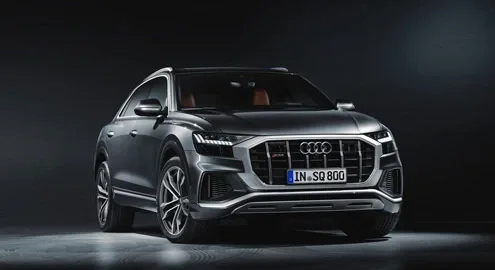
— I see logic in this. This is a high-speed luxury model created not only for asphalt but also for off-road. Therefore, the most powerful diesel among those available in Europe is quite appropriate here. We are talking about a 4-liter V8 with two turbines, producing 435 horsepower and 900 Nm of torque.
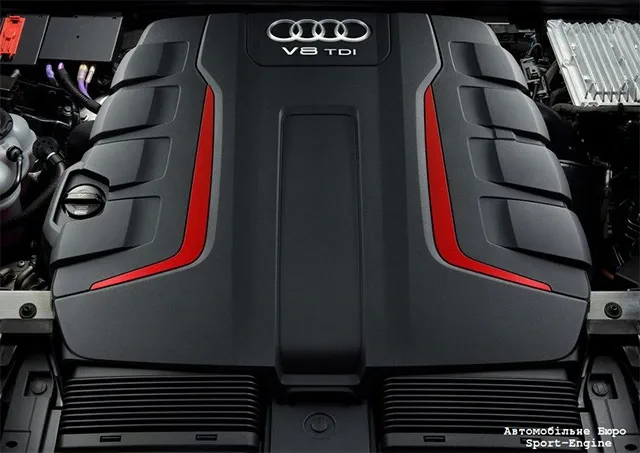
— So, you do not consider Audi's decision to install a diesel engine on the SQ8 something unusual. But this is a top coupe-crossover, and given the global reputation of diesel engines, such a step may seem almost daring...
— Everything is clear here. The SQ8 accelerates to 100 km/h in 4.8 seconds, so there is no doubt about its right to be among Audi's top models. Add to this the design, which even in the regular Q8 radiates power, and in the SQ8 TDI version it is also emphatically athletic. Let's not forget that it was diesel Audis that won the legendary "24 Hours of Le Mans" race five times — this proves that diesel engines have a place in motorsport of the highest level. Moreover, the SQ8 is a hybrid, albeit a mild one, with a starter-generator. And diesel-electric Audis won at Le Mans three more times. That is, together — eight victories. In my opinion, there is no point in abandoning years of developments just because market conditions dictate it. After all, ask the buyers themselves — are they really ready to give up modern diesel engines?
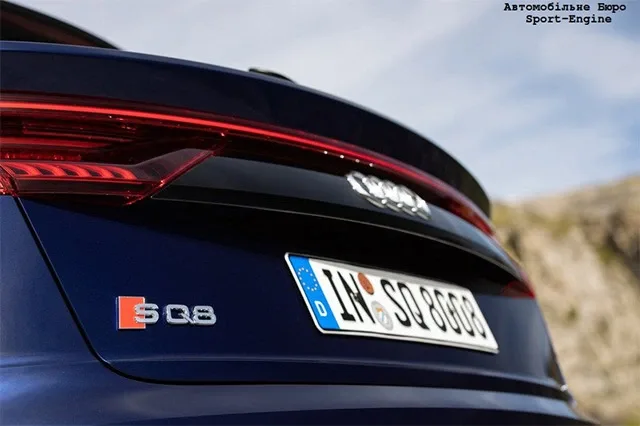
— You mentioned the "mild hybrid" scheme on which the SQ8 TDI is built. The term is just coming into use, so explain in more detail: is this some kind of trim level or option?
— Technically, the SQ8 almost repeats the SQ7: the same 4-liter bi-turbo diesel with an electric compressor, 8-speed automatic transmission, permanent all-wheel drive quattro with Torsen differential, which in normal conditions distributes torque 40% to the front axle and 60% to the rear, air suspension. However, the power unit was supplemented with a belt-driven starter-generator with 11 hp, which is responsible for the start-stop system and allows the car to move without the engine for 40 seconds at speeds from 50 to 150 km/h. It is this addition, which helped fit into EU-6 DG standards, that gives the right to call the SQ8 a "mild hybrid." All Audi SQ8 TDI will be produced in this form.
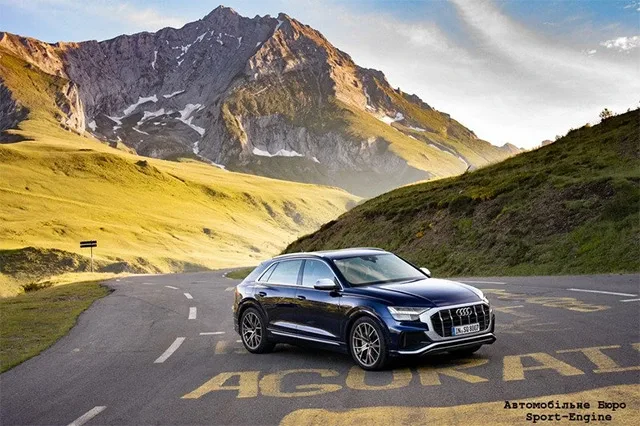
— You mentioned acceleration to 100 km/h in 4.8 seconds. This is the level of sports cars, but externally the car is almost no different from the regular Q8, whose most powerful version has a 3-liter gasoline engine with 340 hp and is significantly slower...
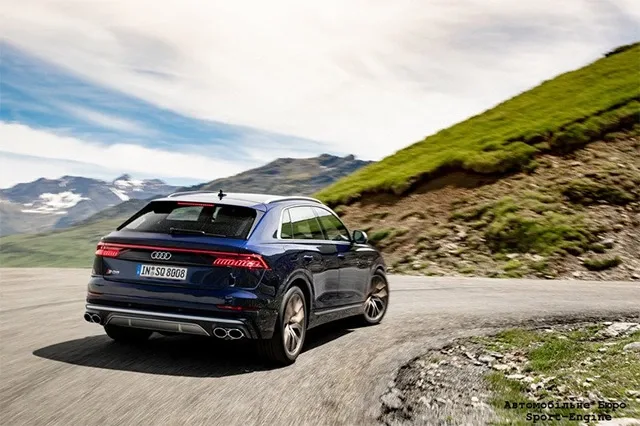
— Yes, the 340-horsepower Q8, which debuted in Ukraine in the fall of 2018, reaches 100 km/h a second longer — in 5.9 seconds. But given its appearance, I do not think that the top modification should radically differ from the standard one. It is not in Audi's style to sharply distinguish its fastest models. There is a set of exterior elements by which S-versions are recognized instantly, and in the SQ8 TDI they are all in place: mirrors made of polished metal, wheels of original design with increased diameter (standard — 21 inches, optional — 22), exhaust system with double round tailpipes. Those who know about technology will immediately notice the difference. And in everything else, customers are satisfied with the look of the Q8.
— What will be inside the SQ8?
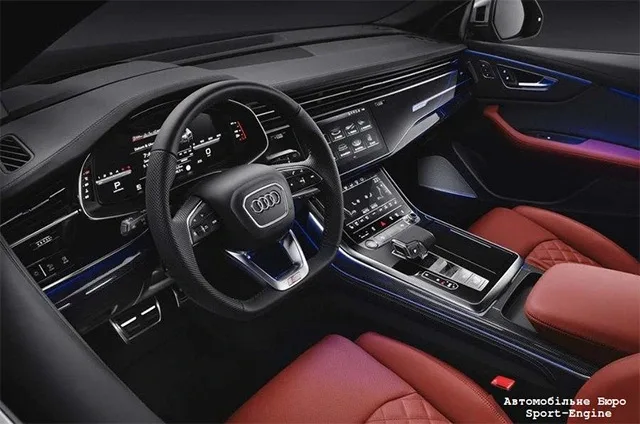
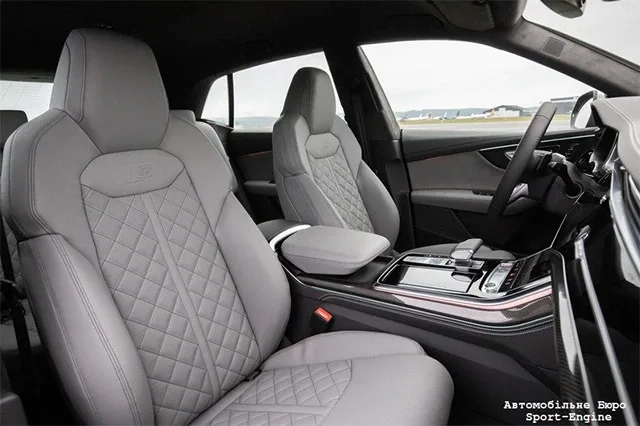
— The story is the same as with the exterior: changes are minimal but noticeable. First of all — black color, which has become the signature for Audi S-series interiors. The interior familiar from the regular Q8 with the virtual panel Audi Virtual Cockpit and two touchscreens on the central console received an S-mode instrument panel with a tachometer in the center. Front seats with integrated headrests, two steering wheel options — traditional three-spoke and with a flat bottom segment, composite materials in the trim. So, as with the interior, a few touches are enough to make it special — exactly what a Q8 in S-performance should be.
— So, we have a few stylish details outside, a few in the cabin, acceleration to 100 km/h in 4.8 seconds, a belt-driven starter-generator, the ability to order 22-inch wheels and the SQ8 badge. Is this what buyers will pay for?
— First of all, buyers will pay for the MLB Evo platform. This is the same base on which the Bentley Bentayga and Lamborghini Urus are created. What does this mean for a person who wants a real coupe-crossover? Air suspension can not even be mentioned — for such technology it has long been included in standard equipment. As for the SQ8 — electromechanical active anti-roll bars and carbon-ceramic brakes. But among the options, you can choose 22-inch wheels. They can be supplemented with sports suspension, which comes with an active differential that redistributes traction between the wheels in corners depending on load. Or order a fully steerable chassis with a rear wheel steering angle of up to 5 degrees — it is available both separately and as part of sports suspension with an active differential. This is what people will be willing to pay for. Not to mention the exterior and interior details.
— I tried to imagine a direct competitor for the SQ8 TDI. And the picture turned out interesting: Mercedes has nothing similar, diesel GLEs end with the 3-liter 330-horsepower version 400d. Porsche generally refused diesel engines. So the only rival is the BMW X6 M50d...
— Exactly. 3 liters, four turbines... But only 400 horsepower, 760 Nm of torque and a claimed 5.2 seconds to 100 km/h. The results are not bad, but even by the numbers the SQ8 wins. That is, we are talking about the most powerful and most expensive car in its segment. This is another reason why people will choose the SQ8 TDI: with moderate fuel consumption, the client gets a fast, comfortable car with excellent handling. The fastest in its class. You can drive off the asphalt without fear of damaging the car. I will not talk about design — it is a matter of taste. But I am sure that not every car even a class higher can offer such a set of qualities, although the price tag of the SQ8 can hardly be called democratic.
— By the way, is it already known when the SQ8 TDI will appear in Ukraine and how much it will cost? In Germany, sales start at the end of summer...
— It is logical that the largest markets will get the new product first. So we will have to wait: the SQ8 will come to Ukraine only in the first quarter of 2020. However, there is good news: unlike Germany, where prices start from 102,900 euros, we are luckier. The approximate cost of the basic configuration will be about 90 thousand euros.
— Well, we look forward to the appearance of the SQ8 TDI in Ukraine. Thank you for the first, so far virtual, introduction. See you!
Technical characteristics of Audi SQ8 TDI 2020MY
Dimensions:
length — 5006 mm
width — 1995/2190 mm (without mirrors/with mirrors)
height — 1624 mm (1630 mm with roof rails)
wheelbase — 2996 mm
trunk volume (5-seat cabin) — 605 l
fuel tank — 85 l
AdBlue tank — 24 l
curb weight — 2440 kg (EU)
Engine:
diesel, V-shaped, 8-cylinder, with two sequential turbochargers, additional electric turbocharger, direct fuel injection and belt-driven starter-generator; displacement 3956 cm³
maximum power — 435 hp (320 kW) in the range 3750–4750 rpm
peak torque — 900 Nm in the range 1350–3250 rpm
fuel consumption (WLTP, according to manufacturer data):
— 8.6 l/100 km (city)
— 7.3 l/100 km (highway)
Transmission:
8-speed, automatic, with manual mode; permanent all-wheel drive quattro with Torsen center differential, torque distribution 40/60% (front/rear axle)
Dynamics:
0–100 km/h in 4.8 s
maximum speed — 250 km/h (electronically limited)
prepared by Yuriy Buhayev
photo — Audi AG and Maksym Shkil