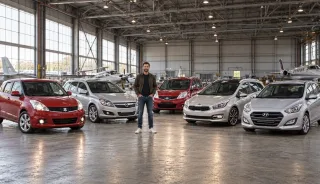

“The level of discussion is quite low – that’s a good sign. It means everyone has the same problems, and we’ve already understood that for ourselves. I agree with the previous speakers: in fact, there are no conditions for business development in the country – and that, in essence, is the main problem both for people engaged in production and for importers,” says Artem Tkachenko, head of the automotive business at “Vi-Di Group.” He is one of the speakers who gathered at a round table during the final ceremony of “Car of the Year in Ukraine 2014” to analyze current problems in the country’s automotive industry and find ways to solve them.
At the same table is the entire cream of Ukrainian auto business: representatives of major dealers, importers, industry associations, Ukrainian manufacturers, and banks. But Tkachenko expresses a position everyone agrees with: they have nothing to talk about today. The low level of discussion is an extremely cautious formulation. There is no discussion at all. In an hour and a half – only one question from journalists. “The country already has such strong confrontation that if we also start butting heads…” says Oleh Nazarenko, CEO of the Association of Auto Importers VAAID, in response to the moderator’s question about the low activity of participants.

The only problem traditionally (but this time mutually) voiced by market players: under current business conditions, it’s impossible to work. “Everything depends on the country, and we are just actors here,” supports him his foreign colleague, Loïc Sibrac, director of the “Stroen-Ukraine” representative office. According to him, everything in Ukraine is so volatile that forecasting the market more than three months ahead is unrealistic.
Players cite two reasons why 2013 became the fifth consecutive crisis year for the auto market. “The market depends on purchasing power, that is, on citizens’ incomes. This is probably the key question that determines and answers when our market will be the one we remember in 2006, 2007, 2008. Although, I want to note: the level of duties (at that time, seemingly prohibitive) should not have created such potential and opportunities for growth.
The market lies exclusively in the economic plane and people’s ability to pay for the product they consume,” says Oleh Boiaryn, CEO of the “Eurocar” plant, honestly admitting he’s not revealing anything new. “The market is falling only because the population’s income is significantly decreasing. We have no middle class, jobs are being cut because production is not supported,” he continues. Boiaryn suggests players increase jobs as a solution option.
Artem Tkachenko adds to this. According to the expert, purchasing power is determined not only by income level but also by the willingness to buy goods. “We all perfectly understand that in 2008, when the market set a record and 630 thousand cars were sold, our citizens’ income level was not three times higher,” says Tkachenko, citing data from the January GFK consumer sentiment index. It showed the lowest value in the last three years.

People not only cannot buy a car – they don’t want to buy it, even if they have money. They have no confidence in the future. Experts note an interesting trend: against the backdrop of the new car market decline, we observe significant growth in used car sales. Oleh Omelnytskyi, director of the IAG “AUTO-Consulting,” provides statistics: overall in 2013, new car sales fell by 7.4%, while the used car market grew by 49%. “It seems the fashion of the 90s is returning,” Omelnytskyi remarks in passing.
To make the “primary market” sell better, affordable credit programs are needed, players claim, complaining about high auto loan rates in banks. “Retail lending has disappeared as a class,” states Vakhtang Vasadze, vice president of the “Ukravto” corporation. “Rates will not decrease,” Galyna Zhukova, a representative of “Credit Agricole Bank,” counters him. She explains: in conditions where deposit rates reach 20%, loans simply cannot become cheaper.
“The only prospects for lowering rates are improving the overall economic situation,” says Galyna. According to her, banks will not take on additional risks. What to do in a situation where citizens’ incomes are falling, they have no desire to buy cars, and loans are becoming more expensive, the participants never decided. One thing became clear: the market is not growing – it is changing its structure. And if earlier banks actively developed programs for financing new cars, now a huge niche has emerged – used cars, whose sales are breaking records. Therefore, it is quite likely that soon we will witness a new trend in the auto loan market: of course, provided that banks dare to earn and take up the automotive “secondary market.”
Kateryna Melesh, CEO of the “Financial Company ‘Center for Financial Solutions’” (TM “CreditMarket”)