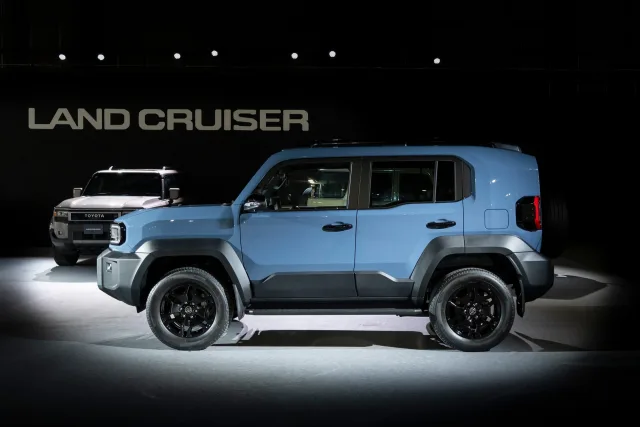
Toyota developed the Land Cruiser FJ to bring back the atmosphere of true off-road vehicles of the past. The main idea of the model is freedom and driving pleasure, when the car gives a sense of confidence under any circumstances. This is not a scaled-down version of the Land Cruiser 300 or 250, but a separate model with its own style — light handling, agility, and durability.
Exterior: strict and recognizable
The FJ's body features sharp edges, straight lines, and wide wheel arches. The silhouette references classic SUVs but is complemented by modern solutions. At the front, buyers are offered two options: round headlights — a tribute to Land Cruiser history, or rectangular optics with C-shaped LED elements — a look to the future.
In the center of the front end is a grille with a large TOYOTA logo, and the bumpers have a modular design, making them easy to replace. At the rear, a spare wheel is mounted on the tailgate, immediately evoking associations with expedition vehicles of past years.
Additional equipment includes roof rails, protective trim, roof racks for long trips, and a MOLLE system on the inside of the rear door. Such equipment makes the FJ a ready companion for travel, camping, and active leisure.
Vehicle dimensions: length — 4575 mm, width — 1855 mm, height — 1960 mm, wheelbase — 2580 mm. Thus, the Land Cruiser FJ is only slightly larger than the Corolla Cross but significantly shorter than the LC 250. The turning radius is only 5.5 m, providing excellent maneuverability both off-road and in urban conditions.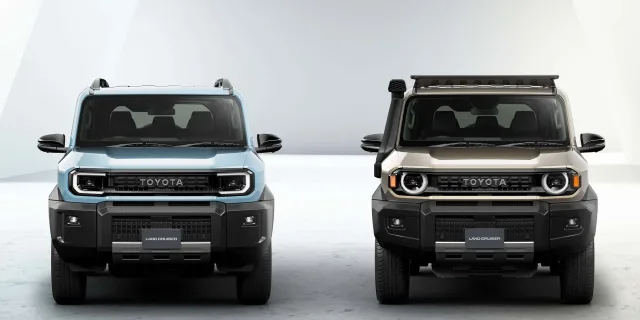
Interior
The FJ's interior follows Toyota's signature philosophy: minimalism, practicality, and clarity. The driver sees a massive steering wheel, a digital instrument cluster, and a large multimedia screen. Off-road mode switching is placed on large physical buttons that are easy to use even with gloves.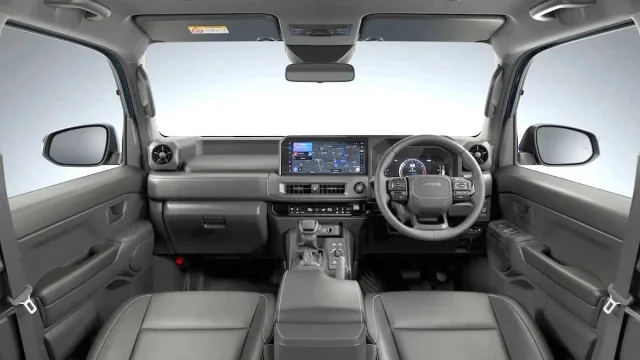
The trim uses durable plastic, rubberized surfaces, and minimal decorative elements. The equipment includes the new generation Toyota Safety Sense system with automatic braking, lane keeping, and adaptive cruise control.
The new model is based on the proven IMV platform, known from the Hilux and Fortuner. The design has a ladder frame that ensures strength and durability.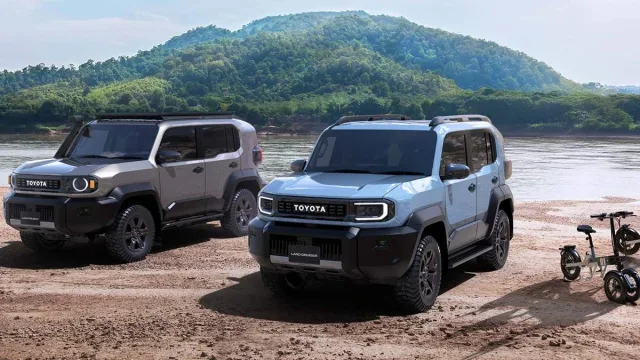
Under the hood is a 2.7-liter gasoline engine (2TR-FE) producing 163 hp and 246 Nm of torque, paired with a 6-speed Super ECT automatic transmission and part-time four-wheel drive. Toyota engineers refined the suspension, body geometry, and four-wheel-drive system to ensure true Land Cruiser-style off-road capability.
During off-road testing, the FJ was tested on mountain switchbacks, sand dunes, and rocky trails. The vehicle demonstrated excellent wheel articulation, reinforced underbody protection, and confident behavior on difficult sections. Thanks to its short wheelbase, the FJ easily navigates tight spots and sharp turns.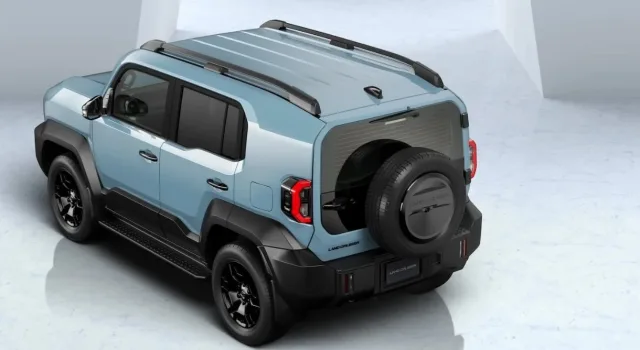
The Toyota Land Cruiser FJ is a return to the roots, where reliability, off-road capability, and the true spirit of an SUV come first. This vehicle does not claim luxury — it is built to go where roads practically end.