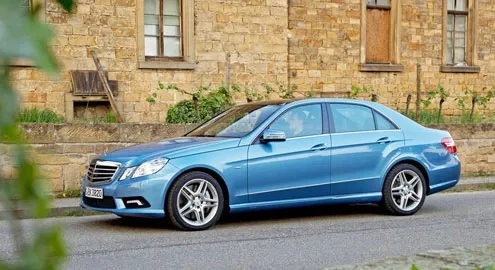
The flagship sedan has acquired more efficient powertrains and a refined gearbox, allowing it to claim the title of the most economical in its segment.
According to the manufacturer, the E 350 BlueEfficiency and E 500 BlueEfficiency versions are the most economical in their power categories. In the combined cycle, they consume 6.8-7.0 and 8.9 liters, respectively.
Fuel consumption was reduced thanks to a number of technical solutions. The E 350 features a modernized V6 with BlueDirect technology and a third-generation injection system. Paired with the new 7G-Tronic Plus automatic transmission and the standard ECO start-stop system, fuel consumption decreased by a fifth compared to the previous version. At the same time, engine output increased by 14 hp to 306 hp. With this engine, the sedan reaches 100 km/h in 6.3 seconds, and the top speed is electronically limited to 250 km/h.
Similar efficiency indicators are demonstrated by the biturbo V8 in the E 500 BlueEfficiency. Despite the reduction in displacement from 5461 to 4633 cubic centimeters, the unit with the same BlueDirect technology became more powerful by 20 hp — now it produces 408 hp. Torque also increased from 530 to 600 Nm. At the same time, the "appetite" decreased by 17%: from 10.8 to 8.9 l/100 km in the combined cycle. Dynamics remained the same: acceleration to 100 km/h takes 5.2 seconds, top speed is the same 250 km/h.
The automaker notes that the ECO start-stop function will also be standard on four-cylinder gasoline and diesel engines.
The refined seven-speed automatic transmission 7G-Tronic Plus will be available for the E 250 BlueEfficiency, E 350 BlueEfficiency, and E 500 BlueEfficiency modifications. Among its features are a new torque converter with minimal slip, an economical shift mode with an extended gear ratio range, and an additional oil pump that maintains system pressure during automatic engine stop.
Diesel versions of the E-Class have also become more economical. The E 220 CDI BlueEfficiency (170 hp) and E 250 CDI BlueEfficiency (204 hp) models with a six-speed manual consume 5.0-5.3 liters per 100 km. With an automatic gearbox, consumption is 4.9-5.3 liters.
Among gasoline versions, the leaders in efficiency were the E 200 BlueEfficiency and E 250 BlueEfficiency. Thanks to the updated transmission, consumption for the E 200 with a 184-hp engine and 7G-Tronic Plus decreased to 6.5-6.9 liters. The E 250 model with a more powerful 204-hp engine and the same gearbox now consumes 13% less — 6.6-7.0 liters per 100 km.
The bifuel version E 200 NGT BlueEfficiency (gasoline and natural gas) also received a new transmission and now consumes 5.5 kg of gas per 100 km or 8.9 liters of gasoline.