· Joint development of next-generation cars — smart fortwo and Renault Twingo models, including their electric versions, as well as expansion of the Smart and Twingo model lines
· Active use of shared powertrains and joint work on promising projects covering both passenger and commercial vehicles, namely:
- Use and joint development of diesel and petrol engines from the Renault-Nissan alliance; these engines will be used in the new smart and Renault Twingo, and will also be refined to meet the specifications of new premium compact cars from Mercedes-Benz
- Equipping Infiniti, Nissan's premium brand, with diesel and petrol units from Daimler, which opens up prospects for further partnership
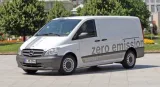
- Installation of a diesel engine and transmission from the Renault-Nissan Alliance on the Mercedes-Benz Vito van
· Cooperation in the commercial vehicle segment
· Cross-shareholding of 3.1% of each partner's capital
· Additional savings through joint procurement, common benchmarking, and exchange of experience between companies
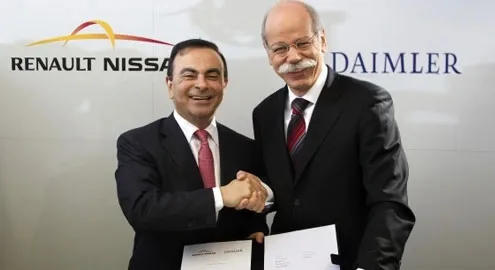
Brussels, Belgium — The Renault-Nissan Alliance and Daimler AG today announced the start of a major strategic partnership, under which both sides expect to benefit from a number of specific projects and the exchange of best practices. The companies also announced a mutual exchange of equity stakes: Renault-Nissan will receive 3.1% of Daimler shares, while Daimler will acquire 3.1% of Renault shares and a similar stake in Nissan.
As noted by Dieter Zetsche, Chairman of the Board of Management of Daimler AG and Head of Mercedes-Benz Cars, “Daimler and the Renault-Nissan Alliance have joined forces to create a new platform for successful strategic cooperation based on a number of concrete and mutually beneficial projects. Our competencies complement each other perfectly. We are now strengthening our position in the small and compact car segment and working to reduce CO2 emissions — both for the long term. We are confident that we can produce products that meet our brands' standards on shared platforms. The individuality of each brand will be preserved.”
Carlos Ghosn, President of the Renault-Nissan Alliance, stated: “The Renault-Nissan Alliance knows how to successfully build partnerships, and this experience is extremely important in current and even more so in future conditions of the global automotive industry. This agreement will expand our strategic cooperation and create long-term value for the Renault-Nissan Alliance and Daimler, as we work to expand and strengthen our model lineup, efficiently use all available resources, and develop innovative technologies that will be in demand in the next decade.”
Main areas of cooperation
Following productive negotiations, specific projects were approved that will begin implementation immediately:
New common platform for small cars
The successor to the current smart fortwo, the new four-seat smart, and the next generation of the Renault Twingo will be built on a jointly developed platform. All models will have clear design differences. A key feature of the new platform will be rear-wheel drive, which is already used on smart cars.
The launch of the jointly developed models is scheduled for 2013. The two-seat version will be produced at the smart plant in Hambach (France), and the four-seat version at Renault's plant in Novo Mesto, Slovenia. From the start of sales, the joint models will also be available in electric versions.
Powertrains
The main focus of engine cooperation will be on the shared use of efficient diesel and petrol engines between the Renault-Nissan Alliance and Daimler.
The Renault-Nissan Alliance will provide Daimler with three- and four-cylinder petrol and diesel engines, which the German company will adapt and refine to Mercedes specifications. This benefits both sides: Daimler gains access to the alliance's engines and can increase sales of future premium compact cars from Mercedes-Benz, while the Renault-Nissan Alliance optimizes the utilization of its production capacities.
In turn, Daimler will supply its engines for Infiniti. This includes four- and six-cylinder petrol and diesel units. The benefit for both sides is obvious: Infiniti gains access to Daimler engines, and Daimler can use its production lines more efficiently.
Daimler, Renault, and Nissan will also work together on future petrol and diesel engines. Final decisions on the production of new joint engines will be made later to ensure a balanced and mutually beneficial utilization of capacities for both sides.
Engine cooperation will be based on technical principles that preserve a clear distinction between brands and their products while ensuring a highly competitive cost structure. First, a high degree of unification of parts that do not affect brand identity will provide both partners with significant savings. Second, separate use of technologies important to the brand will guarantee compliance with the special requirements of each brand.
The main goal is to increase the competitiveness of all partners through a significant increase in production volumes, leading to economies of scale and cost sharing in development.
Cooperation in the van segment
The companies also agreed on close cooperation in the commercial vehicle segment. Mercedes-Benz Vans will expand its lineup by introducing a completely new entry-level model by 2012. The technical basis of this vehicle will be a Renault development, and production will be organized at the Renault plant in Maubeuge, France. Both partners will benefit from increased sales volumes, more efficient use of production capacities, and shared investment costs, leading to lower overall expenses.
In addition to cooperation in the commercial vehicle segment, common powertrain components will also be used to expand the offering and increase sales in the class of medium-sized vans. This includes small diesel engines and gearboxes that Daimler will receive from the Renault-Nissan Alliance for the Mercedes-Benz Vito. This additional motorization in the entry segment will lead to increased sales for Mercedes-Benz and optimized capacities for Renault.
Equal equity participation
The strategic nature of the partnership is emphasized by the mutual exchange of shares, which will allow all three companies to exchange experience and create synergies on a long-term basis of mutually beneficial cooperation. The agreement provides for equal participation of each company in the capital of 3.1% of shares of Renault, Nissan, and Daimler; it will be implemented through a share exchange:
- Daimler will receive 3.1% of newly issued Renault shares;
- Daimler will receive from Renault 3.1% of existing Nissan shares;
- Renault will receive 3.1% of Daimler shares; - Renault agreed to independently exchange with Nissan 1.55% of Daimler shares for 2% of Nissan shares;
* As of April 6, the market capitalization of Renault, Nissan, and Daimler was EUR 10.5 billion, EUR 29.7 billion, and EUR 37.7 billion, respectively. The participants agreed to impose a moratorium on the sale of their own shares (to third parties) for the duration of the cooperation, which may last up to 5 years.
Renault and Nissan will each become owners of 1.55% of Daimler's share capital.
The strategic partnership will be managed by Renault-Nissan B.V. for the alliance and by Daimler through a new structure — a cooperation committee representing all parties. The cooperation committee will be chaired by Carlos Ghosn and Dieter Zetsche. Top managers of all three companies will also participate in its work.
Development of cooperation opportunities
Both groups intend, within the framework of the long-term partnership, to jointly work on future areas of cooperation between Renault, Nissan, and Daimler. Each company will be able to take advantage of opportunities that arise as the strategic agreement is implemented and the first major joint projects are completed. This includes exploring opportunities for sharing modules and components on Infiniti and Mercedes-Benz vehicles, as well as cooperation in regions such as the USA, China, and Japan between Nissan, Infiniti, and Daimler. In addition, Renault, Nissan, and Daimler will consider prospects for joint development of technologies for electric vehicles and battery packs.
For more information about Nissan cars, please visit the website www.autosystem.com.ua