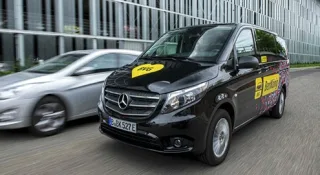
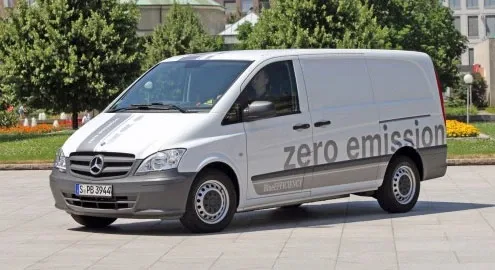
After them, other vehicles appeared on the stage: the 307 E, 308 E, and also the Sprinter, which to this day works faithfully for its owners on the Heligoland islands, located in the North Sea near Germany. The next chapter in the history of electric vans is the Mercedes-Benz Vito E-CELL. It is based on the long-wheelbase version of the commercial model, and under the hood is an electric motor producing a peak of 70 kW (95 hp) and continuous power of 60 kW (82 hp), with a maximum torque of 280 Nm. The torque is transmitted to the front axle via a single-speed gearbox, which was created specifically for the Vito E-CELL.
The lithium-ion batteries provide a range of 130 kilometers, and according to the developers, this is more than enough, since on average European commercial vans of this class cover 50–80 kilometers per day. The maximum speed of the vehicle is 80 km/h, and for urban use this is also sufficient. The batteries can be recharged, as usual, from standard household outlets at 230 volts.
Series production of the Mercedes-Benz Vito E-CELL is scheduled for this year: by the end of 2010, customers will receive a hundred such vans, and in 2011, it is planned to assemble two thousand units. Moreover, the Germans are ready to offer vehicles with both right-hand and left-hand drive.