Once upon a time, air conditioning was perceived as a sign of luxury, but today it is even found in inexpensive cars. However, there are still many vehicles, especially used ones, that are not equipped with air conditioning and never have been.
In this article, Autoportal will explain how automotive climate systems are designed and work, how to properly use them, and what to pay attention to when checking the air conditioner before buying a used car.
Comfortable microclimate and how the air conditioner works

Comfortable conditions mean the temperature and humidity of the air that are optimal for the human body. These parameters change depending on the weather outside and even on how long you have been on the road. The direction of the airflow is also important.
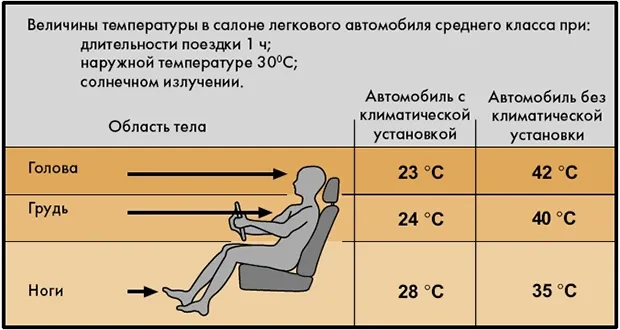
As the table shows, the difference in the driver's well-being in a car with and without air conditioning is quite significant. In addition to comfort, there is also a safety aspect: in unfavorable conditions, the driver's concentration drops and reaction time slows down.
The level of comfort in the cabin depends on the outside temperature and the intensity of air exchange. The Volkswagen/Audi repair manual provides the following guidelines:
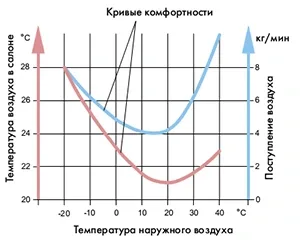
- in severe frost, say, –20ºC
- the cabin should be warm — 28 ºC, and air exchange intense — 8 kg/min
- in extreme heat, for example, at 40 ºC
- the temperature in the cabin should be moderate — 23 ºC, air exchange — 10 kg/min
- in comfortable weather, around 10 ºC
- in the cabin, 21.5ºC and a small air exchange — 4 kg/min — are sufficient.
Comfortable conditions — these are the temperature and humidity of the air that are optimal for humans
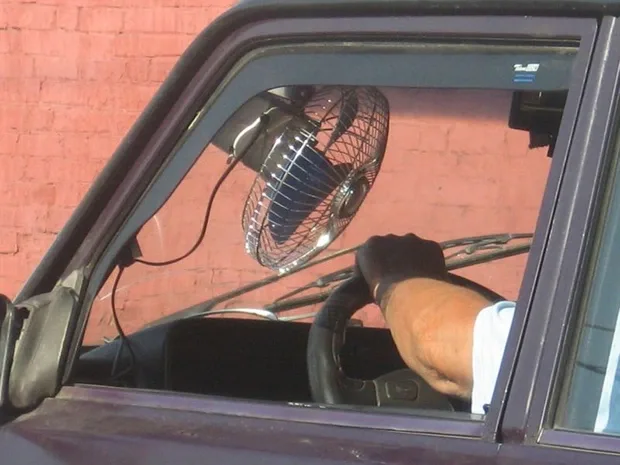
It is clear that ordinary ventilation with heating, which is familiar to owners of VAZ cars and can only circulate air and supply heat, is practically useless in summer. Only an air conditioner can cool the air entering the cabin and remove excess moisture.
How the air conditioner is designed
The principle of operation of an air conditioner is simple and generally repeats the logic of a regular household refrigerator. It is a sealed system through which freon circulates. It is based on a physical law: when a substance evaporates, heat is absorbed, and when it condenses, heat is released. In an automotive system, this role is played by freon, also called refrigerant. Its task is to take heat from the cabin, maintaining the desired temperature. In gaseous form, freon absorbs heat; in liquid form, it releases it. Thus, heat is transferred from the car to the outside.
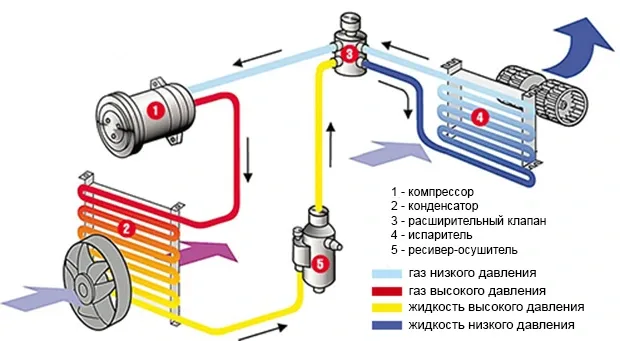
Compressors come in different types and with different drives. Most often, piston and rotary units are found, which are driven by the engine's crankshaft — they are simple and efficient. Compressors with their own drive are convenient because they can operate even when the engine is off. For cars with a start-stop system, Sanden produces compressors that can switch between engine drive and their own.
Each car model has its own air conditioning scheme
Air conditioners also differ in their operating principle. There are two main options. In the first, the refrigerant flow is regulated through a receiver-dryer and a thermostatic expansion valve (TXV), in the second — using an accumulator and an orifice tube. The first scheme is typical for cars from Japan, France, Italy, and Korea. The second — for most American cars, as well as for Audi, Volkswagen, and some other brands.
Condenser — a heat exchanger made of aluminum or copper, in which the refrigerant transitions to a liquid state.
Evaporator — it is this that provides coolness in the cabin. It is also a heat exchanger, usually aluminum or copper, where freon turns from liquid to gas.
Blower fans. The condenser fan removes excess heat from it. The evaporator fan, in turn, supplies cooled air into the car.
Control and protection of the automotive air conditioner
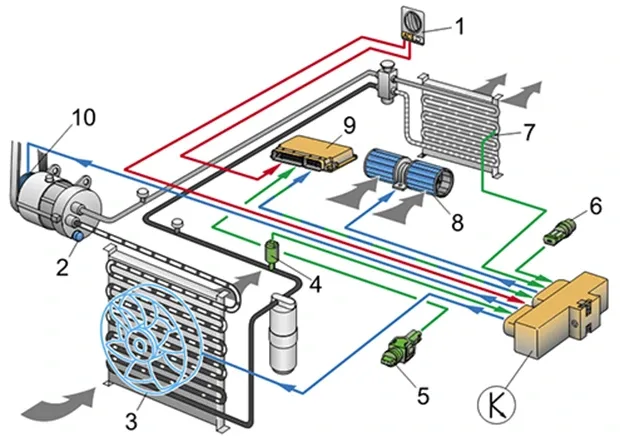
The control and protection system of the manually controlled climate unit of Volkswagen/Audi includes:
- Climate unit switch
- Safety valve on the compressor
- Condenser fan
- Pressure switch
- Coolant temperature sensor
- Thermal switch for the condenser fan
- Evaporator temperature sensor
- Evaporator fan
- Engine control unit
- Electromagnetic clutch
- Climate unit control unit (or condenser fan control unit — depending on the trim level)
The air conditioning control system includes sensors and actuators
The air conditioning control system is a set of sensors and actuators. Among them:
Control unit. It receives signals from sensors and controls actuators, ensuring that the pressure in the circuit and cooling capacity remain stable.
Electromagnetic clutch. When the air conditioner is activated, it engages the compressor.
Pressure switch. If the pressure in the system dangerously drops or sharply rises, it disconnects the compressor. In case of excess pressure, it turns on the condenser fan at a higher speed.
If the pressure continues to rise to a critical level, the safety valve releases refrigerant until the pressure normalizes.
Thermal switch for the condenser fan. It starts the fan when the refrigerant gets too hot.
Evaporator temperature sensor. It prevents the evaporator from freezing by disconnecting the compressor.
Coolant temperature sensor. It disconnects the compressor if the freon overheats.
The cooled air is usually colder than needed, so part of it passes through the heater radiator via a flap and is warmed up. With manual control, the driver himself chooses the temperature, fan speed, and flap position.
In most modern cars, climate control is automated. There are several types of climate systems with different capabilities. The desired temperature is maintained automatically based on data from sensors that record solar radiation, outside temperature, and other parameters.
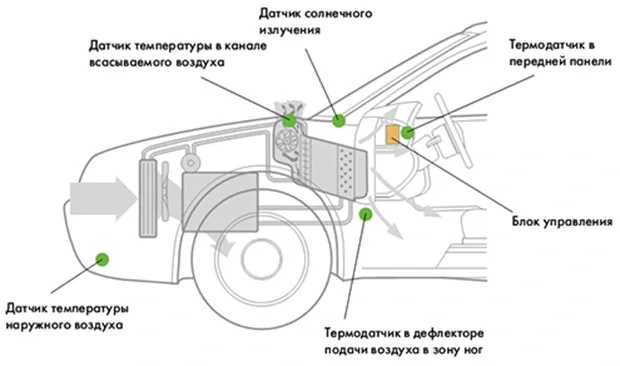
The outside air temperature sensor measures the temperature outside.
The sensor in the air duct channel controls the air temperature after the evaporator.
The solar radiation sensor is responsible for the fan speed in the cabin.
The microclimate can be divided into several zones — as a rule, 1, 2, or even 4 (in luxury cars), and for each zone, its own parameters can be set.
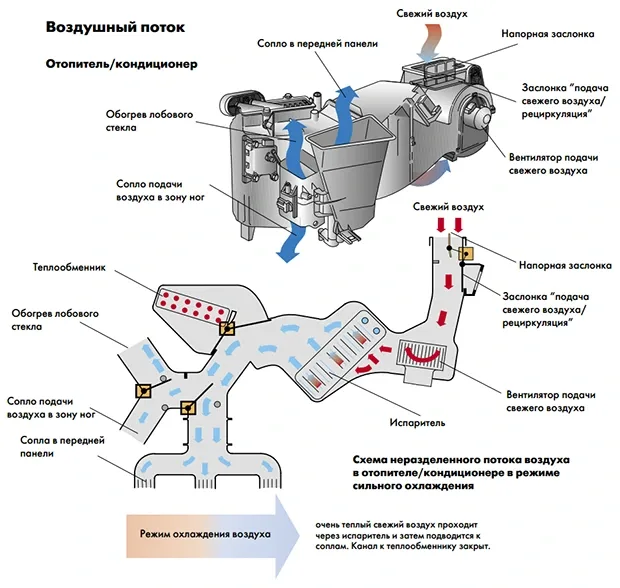
Information from the sensors is processed by the control unit, which controls the actuators. The desired temperature in the zones is maintained by drives that turn the flaps.
The microclimate in the cabin can be divided into several zones
In automatic mode, the climate system usually operates in the range from 18ºС to 28ºС. In the “Auto” mode, the air conditioner starts with the ignition, displaying sensor data and the set temperature on the panel. You can set the temperature outside this range — then the unit will operate at maximum cold or heat. When the outside temperature is below 5ºС, the system turns off by itself.
Approximate prices for new original car air conditioners:
- Daewoo Lanos 1.3, 1.5, 1,6 – 13.000-15.000 UAH.
- Daewoo Nexia N100, N150 – 9.000 UAH.
- Volkswagen Passat B5 1.6 – 17.000 UAH.
Air conditioner installation
Installation, if you do not have sufficient experience, is best entrusted to a trusted service station.
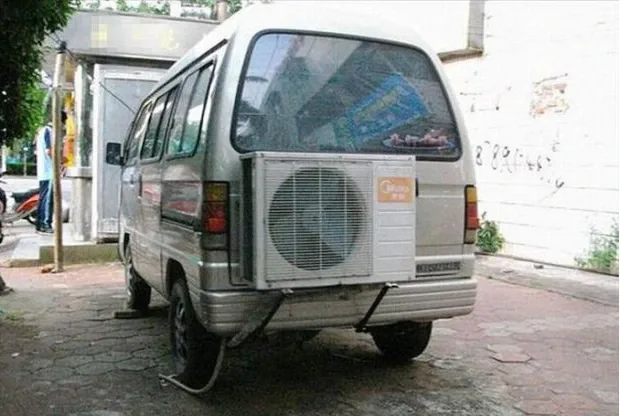
In short, the installation process looks like this:
Compressor is placed in the engine compartment near the crankshaft pulley. This may require removing the air filter, alternator, and other elements. The compressor pulley is positioned so that the belt is tensioned correctly and does not skew.
Condenser is installed in front of the standard radiator, and an additional fan can be installed along with it.
Evaporator is usually placed under the dashboard.
Pipelines. To route them, you will likely need to drill holes into the engine compartment. The lines must be securely fastened and connected. Regular clamps will not work — special fasteners are needed.
Next, the electrical system is connected, the engine control unit is reprogrammed, the system is evacuated, and it is charged with freon.
The cost of installation varies greatly. For example, installing an air conditioner on a Daewoo Nexia at an official dealer will cost 3.500 UAH, while at an unofficial service station — 1.600-2.500 UAH.
Air conditioner care
To prevent the air conditioner from losing efficiency, the condenser radiator needs to be cleaned regularly. This should be done once a quarter — after winter, after the poplar fluff season, etc. It is also important to change the cabin filter in a timely manner.

Monitor the condition of the freon lines and their connections. Oil stains or traces of condensate may indicate a freon leak or a clogged line. If you have a system with a TXV, there is a sight glass on the receiver — through it, you can assess the condition of the refrigerant. If there are too many bubbles (like in soda) or the liquid is cloudy, the system is depressurized.
Mold may appear on the evaporator, and moisture may stagnate in the drainage system. To avoid turning the car into a breeding ground for bacteria, 10-15 minutes before stopping, it is worth turning off the air conditioner and ventilating the cabin by turning on the heater fan. You also need to monitor the condition of the drain.
Check the tension of the compressor belt.
Even if you do not use the air conditioner, it is worth turning it on for 15-20 minutes once a month so that the oil does not stagnate and the seals do not dry out.
Air conditioner maintenance
Freon charging is only needed in case of a leak. The charging itself involves diagnosing the system. On a new air conditioner, maintenance is carried out once every 2-3 years.
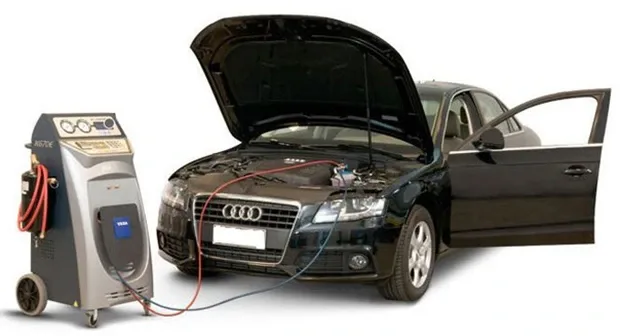
To find a good service, you will have to do a little investigation
Finding a good service is a whole task, because, judging by the reviews of drivers and mechanics, even the status of an official service station does not guarantee quality. Check whether they do evacuation and with what — a vacuum pump or purging with freon (the latter is useless).
The air conditioner should be charged only with the freon recommended by the manufacturer.
Do not chase cheap charging — the risks are too high. There is counterfeit freon on the market with impurities of chlorides and other refrigerants that cause corrosion and can be hazardous to health.
The oil added during charging must be compatible with the freon brand!
Prices for maintenance in Kyiv:
- Air conditioning system diagnostics – 50-255 UAH.
- Full freon charging – from 400 UAH.
- Full diagnostics with recharging – from 300 UAH.
- Disinfection – 100-300 UAH.
- Compressor diagnostics – from 50 UAH.
Usage recommendations
The safe temperature difference between the cabin and the outside is 5-10ºС.
It makes sense to turn on the air conditioner if the trip will take more than 15 minutes.
The main sign of a malfunction is deterioration of cooling. Moreover, while driving, the system may work normally, but in a traffic jam, its power is no longer enough.
A change in the sound of the compressor operation most likely indicates problems in the system.
Checking the air conditioner when buying a used car
The best option is to have a specialist with equipment perform diagnostics. If this is not possible, you can use a few tips. They will not give a 100% guarantee, but they will increase the chances of buying a car with a working air conditioner.
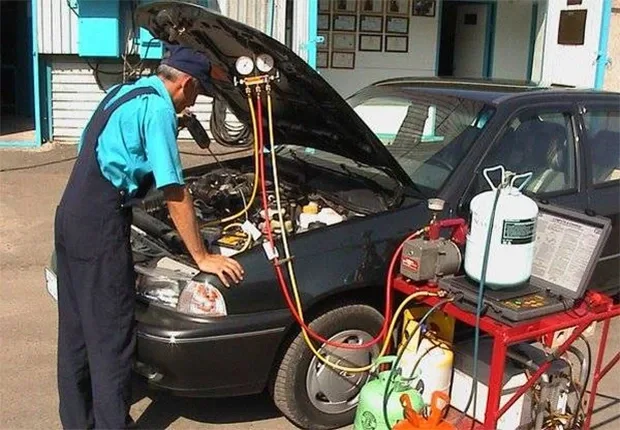
The air conditioning system must work. If it does not work (for example, the seller says that “the freon was drained for the winter”), consider that it does not work at all — this is a reason to reduce the price by several thousand hryvnias. The best confirmation of serviceability is the actual temperature in the cabin.
Knowing what the system components look like and where they are located, it is worth making sure that they are all in place and look normal.
If there is a sight glass on the receiver, assess the condition of the freon (this was already mentioned).
If the air conditioner does not work (like “the freon was drained for the winter”), consider that it does not work at all
If there is no time for a full diagnosis and you do not want to wait for the cabin to cool down, you can check the temperature at “control” points. After turning on the air conditioner, tightly wrap your hand around the metal part of the thickest evaporator tube that goes to the compressor. When the compressor is running, the metal should be very cold. The tube going from the compressor to the condenser should be warm or hot during operation, depending on the outside temperature. The thinnest tube leading from the evaporator into the cabin should also be warm or hot. If you cannot hold your hand on it, there may be problems with the evaporator fan, contamination of the evaporator, or overcharging of the system.
Check the air temperature in the deflector with a regular thermometer (not a mercury one!), directing the flow at maximum speed at minimum temperature. With a working system, the temperature should drop to 5-10ºС.
Inspect the freon lines and their connections. In case of a leak, as already mentioned, traces of oil and condensate will be visible.
In winter, checking the air conditioner is more difficult. You can drive the car into a heated garage for a few hours. If this is not possible, try warming the cabin to a “hot” state — on simple systems without an outside temperature sensor, the air conditioner should start. In cars with climate control, you can try turning on recirculation — on many cars, in this mode, the control unit ignores the outside temperature readings.
Instead of an epilogue
Many drivers refuse to install an air conditioner due to increased fuel consumption and deterioration of dynamics when it is turned on. Yes, this is true, but health is more important (besides, driving with open windows also increases consumption). The main thing is to use the air conditioner wisely and check the system from time to time.