During such periods, the "moonshiners" traditionally become more active, as price increases promise them additional demand and, consequently, earnings. Hence the significant price spread at gas station price boards – in some small chains and single filling stations, the cost per liter can be 4-5 hryvnias lower than at large nationwide operators. And here, the situation cannot be explained solely by the seller's "margin" and non-payment of taxes. This became a reason to find out what is actually being poured into our tanks at such a high price. The check was carried out at the Institute of Consumer Expertise. Experts tested samples of A-92 euro gasoline, which is popular due to its lower price. Samples were taken from large chains (OKKO, WOG, Ukrnafta), medium ones (Parallel, Motto, Glusko, KLO, BRSM-Nafta, Sun Oil, Chipo, Marshall, Avantage 7, Grand petrol) and several single gas stations. The results were disappointing: a quarter of the samples turned out to be substandard, and half of them were outright "moonshine".
About octane
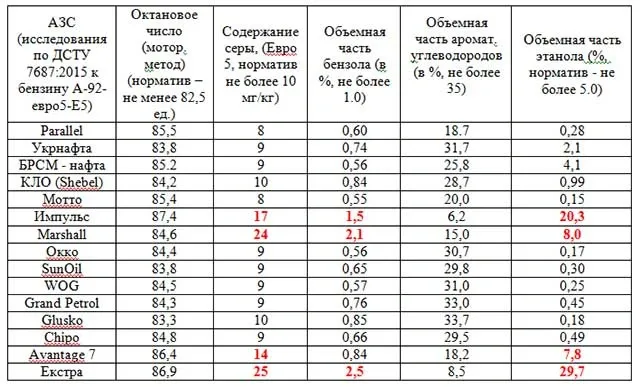
First, they checked the indicator that characterizes the fuel's resistance to detonation – premature combustion of gasoline in the combustion chamber. Detonation is harmful to the engine not only due to increased fuel consumption and reduced power, but also due to premature engine wear from excessive loads. The octane number was measured by the motor method, in which the installation (a single-cylinder engine with a variable compression ratio) simulates the load on a real engine. According to this method, the standard is set at 82.5 units (which is practically analogous to the usual number 92 by the research method that we see at gas stations). This time, oddly enough, no violations were found in this most important indicator. Moreover, absolutely all samples demonstrated a "reserve". But some results alarmed experts. For example, at Avantage 7, Extra, and Impulse gas stations, the octane number "went off scale" beyond 86-87 units. Such values will not cause harm, except that dynamics will decrease due to a longer combustion time of the fuel mixture. But the reason for such an "overage" became clear after checking the ethanol content – in these samples, it was 2-6 times higher than the standard. For the rest of the participants, everything is more even, in the range of 83-84 units. And some gas stations (Motto (85.4), Parallel (85.5), and BRSM-Nafta (85.2)) even sell "ninety-fifth" gasoline, which should please those who like to save.
Chemical composition
Benzene corrodes the fuel system and leads to its premature wear. The results for benzene and aromatic hydrocarbons content differed. In particular, harmful benzene was found in the smallest amounts in samples from OKKO, WOG, Motto, and Parallel. But Extra, Impulse, and Marshall "distinguished themselves" – the benzene in the fuel of these chains turned out to be one and a half to two and a half times more than the boundary standards of DSTU allow! As for the volumetric part of aromatic hydrocarbons, everyone stayed within the tolerance limits.
Sulfur
If there is too much of it in the fuel, it leads to the formation of carbon deposits, contamination of fuel injectors, and "kills" catalysts. Moreover, the exhaust becomes "dirtier" and very dangerous oxides enter the air we breathe. The Euro 5 standard provides for a sulfur content in gasoline of no more than 10 mg/kg. In previous studies by the Institute, there were practically no violations of this most important indicator, which indicated, first of all, the factory origin of the fuel. This time, four samples (Extra, Impulse, Marshall, and Avantage 7) fell within the limits of Euro 4, which is banned in Ukraine. For the rest of the chains, everything is in full order; the lowest sulfur content (8 mg/kg) was recorded in samples from Motto and Parallel.
Ethanol
Currently, DSTU allows the presence of ethanol in gasoline of no more than 5 percent. Gasolines purchased at Extra, Impulse, Marshall, and Avantage 7 gas stations turned out to be more "alcoholic" – in some of them, the ethanol content reached a third of the composition. So you won't be able to save on such fuel – as is known, fuel consumption on "alcohol" exceeds the usual by 5-7 percent.
Conclusions
The fears of market analysts regarding the deterioration of fuel quality after price increases, unfortunately, turned out to be true. According to Yuriy Chernobrivets, Director of the Institute of Consumer Expertise, "now more and more sellers are looking for ways to reach producers of the so-called 'straight-run', low-quality fuel produced in artisanal conditions. And such an offer exists on the market, since many car owners prefer to save here and now. Large chains are still holding on, not saving, buying quality resources of Ukrainian and Belarusian production, because reputation in a competitive market is very expensive." The experts were also pleased that in fairly large discount chains (Motto, Sun Oil, Chipo), according to the research results, they also do not want to deal with a low-quality product.
It is also important to remember that large systemic players operate in the legal field, and the taxes they pay go to the budget, including for road repairs. But the "moonshiners" not only sell substandard fuel, but also thereby slow down the development of road infrastructure.
Vadim Krivenko