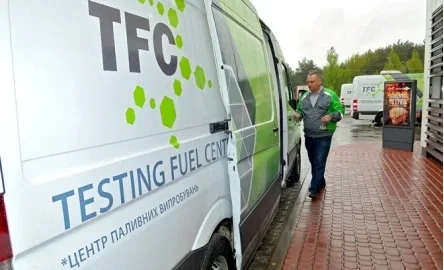
How to distinguish a reputable filling station from a dubious one, and why it is beneficial for drivers and responsible gas station networks to unite in the fight against low-quality fuel, explains Alla Sydorovych, who heads the TFC Fuel Research Center. Her experience in the field of petroleum product quality control spans about four decades, and she is considered one of the leading experts in the country.
- Why has Ukraine still not formed an effective system for controlling fuel quality?
- Quality control requires significant expenses. Our center annually invests up to 10 million hryvnias just in the purchase and maintenance of equipment. This allows us to check fuel monthly at 400 stations of the "OKKO" network — our main client, as well as serve other customers. However, there are over 6,000 gas stations across the country. To cover them all, a budget at least 15 times larger than ours would be needed, that is, about 150 million hryvnias. And this does not include salaries and current expenses.
Today, only a few large networks, inspection companies, and individual refineries have a full set of equipment for analyzing gasoline and diesel fuel. But all of these are private structures. The state should have its own laboratory base, which requires investment. Perhaps it would be reasonable to allocate part of the excise taxes from traders for this purpose. Currently, taxes account for more than 40% of the fuel price. If at least 1% of these revenues were returned to the quality control system, the result would not be long in coming.
For now, the situation is only worsening. Previously, regional consumer protection inspections regularly brought us samples for testing. Last year, no one came — funding was not allocated. At the same time, according to our observations, the share of counterfeit fuel on the market is growing every year. Some analysts already speak of 30-40%. This is a serious threat both for the economy and for ordinary motorists.
- Is there a way to counter this?
- We need to act together. The authorities, consumers, and honest gas station networks must find a common position. The point is that some should not protect the interests of unscrupulous sellers, others should not use the services of dubious brands, and still others should ensure constant control at their stations.
- Do you really believe this is possible?
- European countries have achieved this, although Italy, Poland, or Turkey also had serious quality problems. A market without counterfeits benefits everyone. For the state, it means additional budget revenues. For drivers, it is real savings. By overpaying today, say, 100 hryvnias for quality fuel, tomorrow you can avoid spending 1,000 hryvnias or more on repairing the fuel system. And it is not only about money. When low-quality fuel burns, many harmful substances are released, which are inhaled by both the driver and passersby. As for gas station networks that think about the long term, honest work bears fruit — not immediately, but over time. Brand reputation is built on quality, and customer trust increases business capitalization. Take, for example, the "OKKO" network, which openly declares its principled stance in everything — from fuel quality to dispensing accuracy and tax payment. Only in 2015, this company transferred more than 6 billion hryvnias to the budget.
- But how can an ordinary driver understand how honest a filling station is and whether it monitors quality?
- First of all, I would advise finding out how many accredited laboratories — stationary or mobile — serve the network. This information is usually available on company websites. If it is not there, that is already a reason to be wary. Our center works closely with the mentioned "OKKO". Sixteen laboratories are involved in control. They provide a three-level check throughout the entire chain: when fuel arrives at the depot, during shipment, and directly at the gas station. Importantly, the company does not know in advance which specific station we will visit tomorrow. If all operators acted on this principle, the quality problem would not be so acute.
- Can a customer review the test results? And what should they do if they do not trust them?
- We check each "OKKO" station once or twice a month and issue quality passports, which are kept openly accessible for consumers. But if a driver still has doubts, they can contact a specialized laboratory — state or private. The main thing is that it has certification.
- How much fuel is needed for analysis?
- One sample is enough — that is one liter. However, we always ask for twice as much: we keep one sample as an arbitration sample in case of disputes. When handing over the fuel, the laboratory head listens to the car owner's complaints and advises which specific tests to conduct. After all, it is not always necessary to analyze fuel for all DSTU parameters. Sometimes it is enough to check one or two characteristics. In general, we can provide a conclusion on dozens of different indicators.
- Often drivers complain not about quality, but about underfilling. What do you advise?
- I hope the myth about the operator's "magic button" that allows controlling fuel dispensing is already outdated. With current automation, electronic accounting, and video surveillance, it is impossible to interfere with the operation of the dispenser. Moreover, all fuel dispensers are sealed. But if you want to be sure, you have the right to ask the staff to fill you using a reference measuring container. Such containers should be at every gas station. They are verified and sealed by the State Standards authorities. They have no "buttons", so there is nothing to doubt.
Source: Komsomolskaya Pravda in Ukraine