With the arrival of winter, everything around changes: decorated Christmas trees appear in homes, and the air fills with anticipation of the holiday. Many people eagerly await the first snow, because with it comes New Year's Eve, when you can leave behind the failures of the outgoing year and hope for the best in the new one.
However, for Ukrainian motorists, winter brings no joy — in offices and courtyards, the talk is only about studs, tread patterns, speed and load indices. Some park their cars for a couple of months, others choose all-season tires, and others simply hope that there will be no snow. Either way, the question of changing tires becomes relevant.
Mykola Petrovych from garage number seven changes only two tires to winter ones — why buy four?
Although Mykola Petrovych's driving experience is comparable to the age of the average reader of our magazine, the modern city places much higher demands on the driver and their car than three decades ago.
Let's examine this situation in detail:
• Imagine you have a front-wheel-drive car, and you've put winter tires only on the front axle. Then the front's grip on the road will be noticeably better, and when turning, the rear may skid — because the rear wheels risk losing contact with the surface.
• There's another option: put winter tires on the rear axle. The idea is not bad, but only if you plan to drive exclusively back and forth without leaving the garage. In this case, a front-wheel-drive car will most likely simply not be able to move, and a rear-wheel-drive car will have difficulty entering turns — the steering of the front wheels will resemble a sled.
Bottom line: you need to change all four wheels. The spare can be left as summer or all-season, but use it only as a "donut" to the nearest tire service.
Uncle Pasha from Odesa drives on "all-season" tires all year round — maybe I can do the same? I'll save a bunch of money!
It must be said that in the southern regions of the country, high-quality all-season tires can indeed replace winter ones. But this practice is justified only in the south — in other regions of Ukraine, "Nordic" type tires are needed for safe winter driving.
It's also worth remembering SUV and crossover owners, who often choose all-season tires, reasoning that all-wheel drive provides better handling, so universal tires will work all year round. Four driven wheels will help accelerate quickly, but for braking on a winter road, it's the grip that matters, which only properly selected tires can provide. So the choice is obvious: in winter, use winter tires.
My director Ihor Albertovych installs "Nordic" type winter tires, but I'm looking at "European" tires — what's the difference?
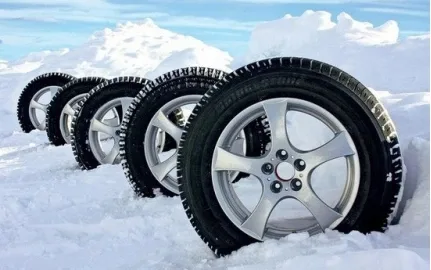
"European" tires differ from "Nordic" ones by a stiffer tread and a rounded shape, which reduces noise and is designed primarily for winter driving on asphalt.
This type of tire is suitable for a "mild winter," that is, for rare trips on snow and ice. In warm European countries (Italy, Spain, France, Greece), this is quite enough, but in most of Ukraine, such tires may not cope with the tasks and lead to problems on the road.
Zhorа (a taxi driver) from the third entrance drives on friction tires, and my godfather recommends studded ones — what to choose?
A lot here depends on the temperature outside. In moderate cold — from 0 to -15°C — studded tires, as a rule, behave better on asphalt. The contact patch of "studs" and "Velcro" is approximately the same, but thanks to the stiffer tread, studs hold better on both asphalt and ice than the friction competitor (under the weight of the car, the studs sink inward).
However, as soon as the frost becomes more severe and drops below twenty degrees, studded tires begin to "harden," the studs hide deeper, and the car almost loses traction.
Friction tires, on the contrary, at frosts below twenty degrees, demonstrate better grip on asphalt, in snowy courtyards, and in snow-water slush.
My classmate Danylo from Kyiv says: the more studs, the better. Is that true?
No, this statement is fundamentally wrong. If you follow this logic, tires with 96 studs should work poorly on ice but hold asphalt well, 130 studs should be the golden mean, and 190 should turn into sleds on asphalt and ice cleats on ice.
Numerous tests of tires with different numbers of studs do not confirm this theory: a stud is just one of many characteristics. When choosing, you should evaluate not only their number but also all other tire parameters. For example, the Avtoshuz online tire and wheel store offers almost 3000 items, among which are hundreds of tire types for any wallet and rim, with different speed and load indices. There's something to think about.
Our programmer Denys believes that tire tests are all "paid-for" and advertising
Of course, not all tire tests are objective, and it cannot be denied that sometimes different "experts" give completely different ratings to the same model.
Specialists who understand the topic explain this by differences in testing methodologies. At the same time, authoritative organizations (Test World, Vi Bilagre, Tuulilasi) have quite similar test results for the same tires.
When studying the market, it's worth paying attention to at least three different tests — the average rating will be more objective.
One-on-one with the road
Winter is, without a doubt, the most dangerous time for a driver. The main condition for safety on the road is compliance with traffic rules, the serviceability of the car, and experience. Our main advice when choosing winter tires: take the best you can afford. Good luck and no nails!
Sponsor of winter tires 2016 in Ukraine — Avtoshuz online store.