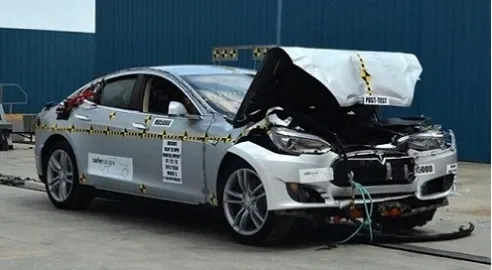
The American agency NHTSA, responsible for road safety, awarded the Tesla Model S electric car the highest score — five stars — in all crash test categories.
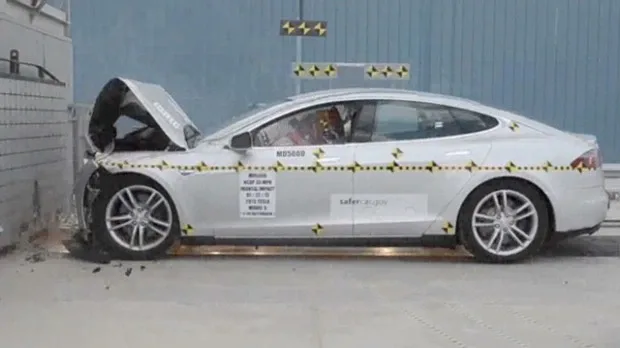
The high rigidity of the passenger capsule was achieved thanks to fresh design solutions and a large amount of free space inside. The electric motor here is placed at the rear axle and takes up very little space — its diameter is only 30 centimeters.
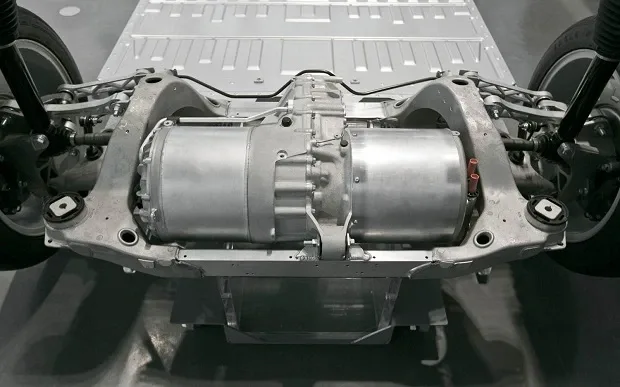
This layout eliminates the negative impact of a conventional internal combustion engine on the body's structural integrity during a crash. At the front, the Model S has another trunk instead of an engine. And since the car has no fuel tank, engineers were able to make the crumple zones that absorb impact energy noticeably longer.
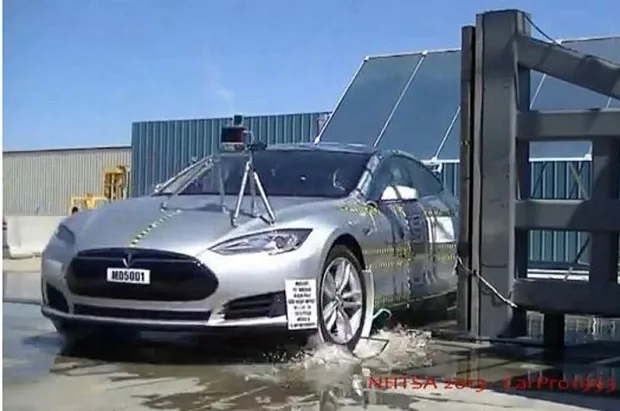
Particularly impressive was the result in the challenging side impact test. To absorb collision energy, Tesla Motors reinforced the body with numerous aluminum elements on the side rails — the same principle used in the creation of the Apollo lunar module.
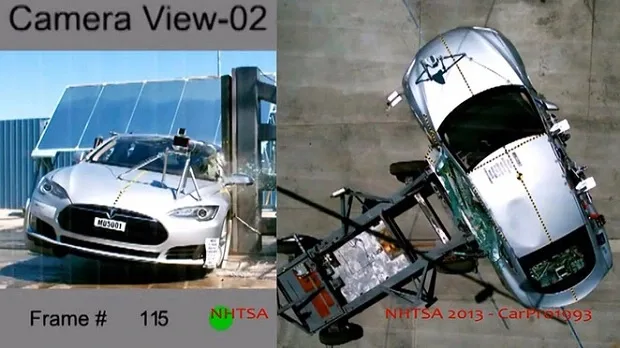
In addition, the Model S demonstrated excellent stability in the rollover test. The massive batteries distributed across the entire floor significantly lowered the car's center of gravity, making it extremely difficult to roll over using standard methods.
The electric car's batteries also performed reliably in the fire test. NHTSA specialists were unable to ignite the lithium-ion batteries of the Model S in any realistic scenario.
The most curious moment of the tests was the roof strength check. When the load exceeded 4G, the testing press simply broke.
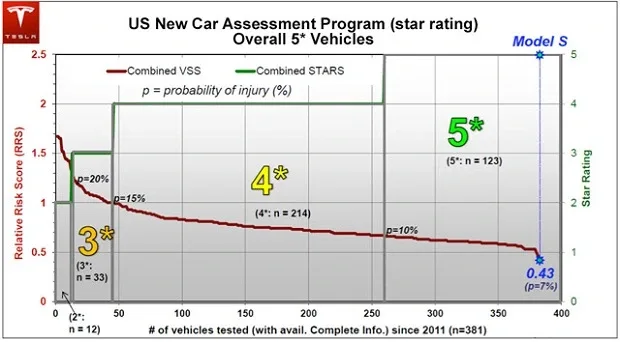
As a result, the Tesla Model S sedan scored 5.4 points in safety — a figure higher than that of many SUVs and minivans.