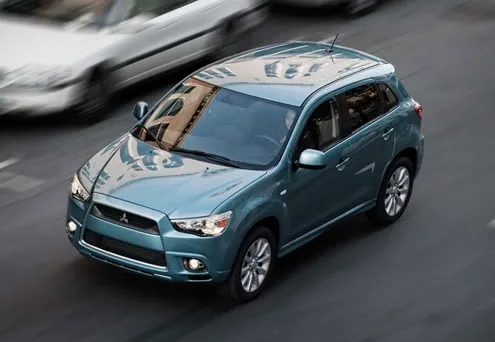
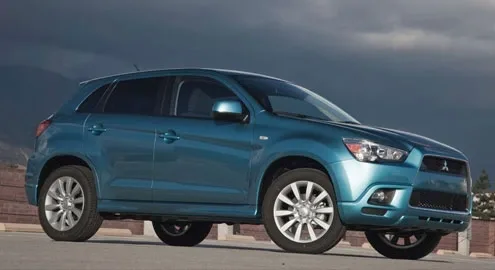
The compact dimensions of the 2011 Outlander Sport are capable of attracting a noticeably wider audience of buyers to it.
Under the hood of the updated Outlander, a refined version of the 2.0-liter four-cylinder engine is installed, equipped with the proprietary MIVEC technology. Engineers also added electric power steering and reduced friction of internal parts, which improved fuel efficiency and reduced CO2 emissions.
For the Mitsubishi Outlander Sport, two transmission options are available: a CVT Sportronic continuously variable transmission or a five-speed manual gearbox.
The main visual feature of the updated crossover is the front end, which stylistically echoes the famous Lancer Evolution. This solution gives the car a sporty character, improves aerodynamics, and sets it apart from competitors.
In the American market, the Outlander Sport is offered in the ES version with front-wheel drive 2WD and in more equipped SE modifications, where an electronically controlled all-wheel drive 4WD is available. All-wheel drive variants are equipped exclusively with the CVT Sportronic and include 18-inch alloy wheels, adaptive S-HID headlights with automatic activation, a rain sensor for wipers, and automatic climate control. To enhance comfort, the MacPherson suspension was recalibrated, providing an optimal balance of stability and ride smoothness. The equipment list also includes Hill Start Assist, Active Stability Control (ASC), Traction Control Logic (TCL), anti-lock braking system ABS, as well as electronic brake-force distribution EBD with Brake Assist function.
Thanks to these technical solutions and the use of a body built using Reinforced Impact Safety Evolution (RISE) technology, which effectively dissipates impact energy and protects the driver and passengers, Mitsubishi expects the Outlander Sport to receive at least five safety stars in crash tests by the U.S. Insurance Institute for Highway Safety (IIHS) — both in frontal and side impacts.