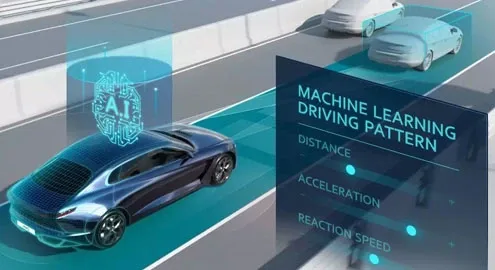
The name SCC-ML hides two key technologies: Smart Cruise Control — an active cruise control already familiar to many — and Machine Learning. Unlike standard driving assistants, this development not only maintains a set speed and monitors the distance to the car ahead but also learns the driver's behavior patterns.
To achieve this, the front camera together with the radar continuously records data on driving style and sends it to the central computer. The computing system with artificial intelligence processes the received information and forms behavioral algorithms: the distance to the vehicle ahead, the speed of reaction to changes in the road situation, and the current speed are taken into account. Based on these and other input data, SCC-ML can build up to 10,000 scenarios that allow adjusting the cruise control to any road situation. At the same time, safety-hazardous options are not recorded in memory.
For example, the SCC-ML system determines that the car is in dense traffic and reduces the distance to the car ahead; on the highway, when speed increases, the distance increases. In conjunction with the highway driving assistant, which facilitates lane changes, the new technology provides autonomy level 2.5 according to the SAE classification, essentially being an improved version of regular cruise control.