
This is due to several factors, the main ones being the massive switch to LPG, as well as the "invasion" of "euro plates" (foreign-registered cars), which mostly have diesel engines. Gasoline is "hitting the pocket" of many motorists, and drivers, logically, would like to get quality corresponding to the price. The Institute of Consumer Expertise decided to test the most popular 95-octane gasoline. In previous studies, experts recorded violations in almost 20 percent of samples; the current study showed that the situation, unfortunately, is still far from improving.
The experts focused on large all-Ukrainian chains, but also "in the crosshairs" were mid-sized chains positioning themselves on the market as discounters. In a recent diesel fuel study conducted by the Institute, the latter showed a decent result, offering quality fuel at a price lower than the main players. How will things be with gasoline? In this study, samples were taken from 12 chains - WOG, BRSM-Nafta, KLO, Parallel, Chipo, GLUSCO, ANP, Motto, Sun Oil, Shell, Grand petrol, and Narodna.
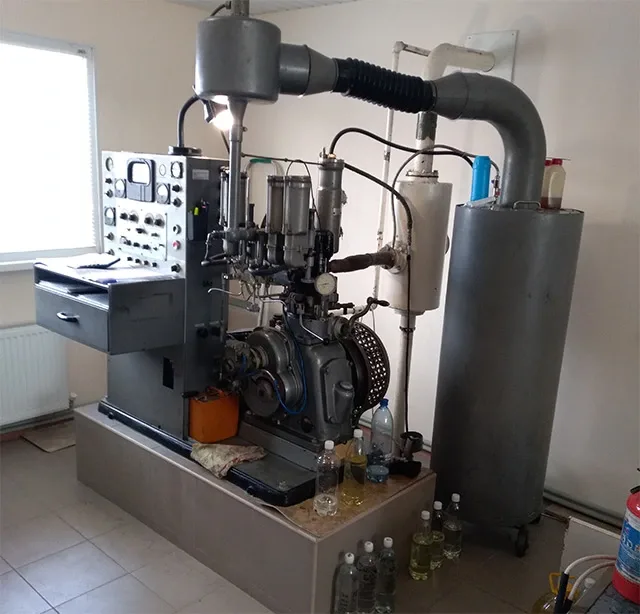
The samples were sent to a certified laboratory, where they were tested for compliance with the relevant DSTU 7687:2015 standard (A-95-Euro5 gasoline). The samples were checked for key parameters – octane number, sulfur content, and volume fractions of aromatic hydrocarbons and benzene. The results were not encouraging – two samples turned out to be off-spec.
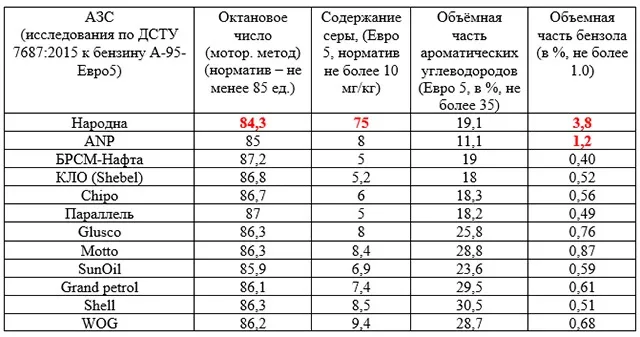
First, the most important parameter for engine operation was checked – the octane number, which characterizes the fuel's resistance to detonation – premature combustion of gasoline in the combustion chamber. Detonation is harmful to the engine not only due to increased fuel consumption and reduced power, but also due to premature engine wear from extra loads. The octane number was measured by the motor method. According to it, the standard is set at no less than 85.0 units. All samples except one met the standard; moreover, almost all had a "reserve" of one unit! The gasoline turned out to be "ninety-seventh" at BRSM-Nafta and Parallel chains (87.2 and 87 units). Colleagues from KLO (86.8) and Chipo (86.7 units) were practically not far behind. But the gasoline from the Narodna chain "lacked" octane – only 84.3 units, which does not meet the standard.
Next, experts checked another crucial indicator – sulfur content. If there is too much of this harmful substance in the fuel, it leads to the formation of carbon deposits, contamination of fuel injectors, and the "death" of the catalytic converter. In addition, the exhaust becomes "dirtier," and very dangerous oxides enter the air we breathe. DSTU for A-95-Euro5 requires no more than 10 mg/kg. Here, too, the situation turned out to be "rosy," with one exception. The Narodna chain recorded a kind of recent "record" – the gasoline turned out to be Euro 3, with a sulfur content of 75 mg/kg! For comparison, the leaders had minimal sulfur content – BRSM-Nafta and Parallel (5 mg/kg each), KLO (5.2 mg/kg), Chipo and Sun Oil (6 and 6.9 mg/kg, respectively). By the way, the result of the KLO chain is doubly pleasing because such results are shown by fuel of Ukrainian production – Shebel is produced at the domestic Shebelinka refinery.

Another important parameter is benzene content. This substance can wash away the oil film, leading to increased engine cylinder wear. DSTU regulates the volume fraction of benzene content at no more than 1%. In this parameter, there were two violators – in the ANP chain sample, benzene was 20% more than the established standard (1.2 percent), and in Narodna – as much as 3.8 percent! Experts have not seen such a thing for a long time... The least harmful substance was found in samples taken at Shell (0.51%) and BRSM-Nafta – 0.40 percent.
As for the content of aromatic hydrocarbons, DSTU regulates the content of aromatic hydrocarbons in gasoline of the 5th ecological class at no more than 35% by volume. Exceeding this threatens an increased process of carbon deposit formation. In this parameter, all tested samples met the standard; no violations were found.
Summarizing this study, it can be stated that motorists still have a risk of "feeding the horse" something wrong. After all, the temptation for some traders to make money on off-spec fuel is great, and this must be taken into account. At the same time, it should be noted that conscientious discount chains are still "stepping on the heels" of large chains and approach the issue of quality responsibly.
Vadim Krivenko