Roof Rails: What Are They For?
When there is constantly not enough space in the trunk, it is worth considering installing roof rails. With their help, it becomes possible to transport not only additional items but also oversized or non-standard cargo. Roof rails come in two types:
• longitudinal;
• cross.
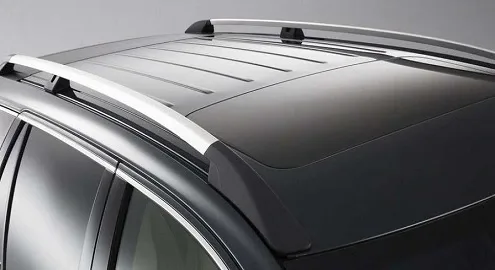
Longitudinal roof rails are most often found on foreign cars — minivans, station wagons, and SUVs. They can be integrated or installed with a gap. If such roof rails are not provided in the factory configuration, there are usually special mounting points on the roof, closed with plastic plugs.
Cross roof rails, as a rule, are made for a specific car model. They can be attached:
• to standard places;
• to gutters;
• in the door opening.
In shape, they resemble oval arcs, which reduces aerodynamic drag to a minimum.
There are also cross roof rails with a rectangular cross-section. They are made of steel coated with an anti-corrosion compound.
With the help of roof rails, you can place on the roof:
• a roof box;
• cargo baskets and platforms;
• mounts for bicycles, skis, snowboards, or boats.
How to Choose Roof Rails
Before buying roof rails, it is important to find out what maximum weight the car roof can withstand. This data is specified in the service book.
If the body has standard places for mounting, it is better to use them. They are located on the power elements, so you can transport the permissible load without fear of damaging the roof surface.
For cars with a smooth roof, universal crossbars are suitable — they are fixed using clamps and brackets on door openings or gutters.
If the car is already equipped with roof rails, to secure the luggage you need to additionally buy crossbars. They can be installed at different distances from each other, which allows transporting both a boat and a small roof box.
As a result, before installing roof rails and additional equipment, it is important not to exceed the permissible load on the body, as well as to regularly check the strength of the fixation and the condition of the entire structure.