Now all fuel must comply only with Euro 5, which should have a positive effect on both vehicle longevity and the environment. Of course, many chain gas stations previously sold Euro 5, but now Euro 4 requirements are already illegal. The Institute of Consumer Expertise, the only organization that constantly monitors fuel quality in Ukraine, decided to check whether gas stations are violating the law, since there was a lot of Euro 4 fuel at filling stations. As it turned out, many fuel sellers simply ignore the new requirements and continue to sell gasoline that does not meet the regulations.
The most popular 95-octane gasoline was tested. Since previous checks clearly showed that large branded chains, even without the ban, sell only Euro 5 standard fuel, experts focused mainly on small regional chains. But all-Ukrainian chains were not left without attention either. Thus, among the large chains, WOG, BRSM-Nafta, OKKO, and GLUSCO were on the list. Among medium and small chains, experts checked KLO, SunOil, Luxwen, Marshall, Chipo (Vinnytsia), Brand Oil (Kharkiv), NPZ (Kharkiv), B-set (Kharkiv), Bell Oil (Zaporizhzhia), ZOG (Zaporizhzhia), DNK Group (Dnipro), Stells (Chernivtsi), Avtotrans (Poltava), and Impulse LTD (Kyiv).
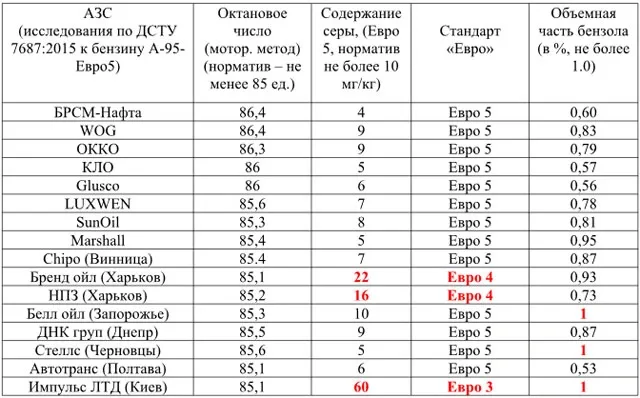
Samples were sent to a certified laboratory, where they were tested for compliance with the relevant DSTU 7687:2015 standard (A-95-Euro5 gasoline). The samples were checked according to “European” parameters – octane number, sulfur content, and volume fraction of benzene. The results, to put it mildly, were not encouraging – three samples turned out to be completely off-spec, and three more were on the verge of falling out of the standards.
But let's take it in order. First, the most important parameter for engine operation was checked – the octane number, which characterizes the fuel's resistance to detonation – premature combustion of gasoline in the combustion chamber. Detonation is harmful to the engine not only due to increased fuel consumption and reduced power, but also due to premature engine wear from excessive loads. The octane number was measured by the motor method. According to it, the standard is set at no less than 85.0 units. All samples met the standard, and some even demonstrated a “safety margin.” The largest was at BRSM-Nafta and WOG (86.4 units). Colleagues from OKKO, KLO, and GLUSCO were practically not far behind – 86 units.
Next, experts checked another crucial indicator – sulfur content. If there is too much of this harmful substance in fuel, it leads to the formation of carbon deposits, contamination of fuel injectors, and the “death” of the catalytic converter. In addition, the exhaust becomes “dirtier,” and very dangerous oxides enter the air we breathe. DSTU for A-95-Euro5 requires no more than 10 mg/kg. And here the “surprises” began. Three participants had violations – the Kharkiv chains NPZ and Brand Oil sell Euro 4 gasoline (16 and 22 mg/kg, respectively). This is not fatal, but nevertheless. And the “ninety-five” at the Kyiv chain Impulse LTD turned out to be Euro 3 (60 mg/kg). For comparison, large “branded” chains had almost no sulfur – BRSM-Nafta (4 mg/kg), KLO and GLUSCO (5 and 6 mg/kg, respectively). However, there are also good results among local chains: LUXWEN, SunOil, Marshall, ZOG (7, 8, 5, 6).
Another important parameter is benzene content. This substance can wash away the oil film, leading to increased wear of engine cylinders. DSTU regulates the volume fraction of benzene content at no more than 1%. All met the standard, three turned out to be “on the verge” – Bell Oil, Stells, Impulse (1%). The lowest was in the sample taken at GLUSCO gas station – 0.56 percent.
Summarizing this study, it can be argued that with the entry into force of the new gasoline quality standard (Euro 5), not all filling stations responsibly fulfill state requirements, which is why Ukrainian motorists are at great risk when refueling at local gas station chains, as well as at single gas stations. After all, such players in the fuel retail market are simply unable to ensure proper logistics of gasoline and constant quality control, and this is not even part of their plans. Buy cheaper and sell more expensive, without taking into account a mass of factors affecting fuel quality and without regard to public opinion – this, unfortunately, is what the business strategy of fuel retail outsiders looks like today. Large national chains, such as WOG, OKKO, BRSM-Nafta, and others, for which fuel quality standards are not empty words or a bureaucratic formality, but a business reputation at the level of caring for the customer's car and the environment. It is the branded all-Ukrainian gas station chains, as the results of the A95 gasoline study show, that responsibly and systematically control the chemical composition of their products.
Vadym Kryvenko