Yes, we have all heard that in Western countries this is a whole industry, that there are programs for recycling parts at the factories of the automakers themselves (for example, Volkswagen buys worn-out units through its dealers). But how does it all work in Ukraine? Are the prices really that low? Which brands are worth restoring parts for? How reliable is it? And are all parts subject to restoration?
To answer these popular questions, we conducted a market research.
Indeed, the price difference is objectively tied to the car brand. The explanation here is quite simple: the manufacturer's marketing policy. For example, liberal Koreans or dumping Chinese sell their parts with minimal markups, so it's easier to buy an original from a dealer here. But when you find out the price of a brake caliper for a thoroughbred Audi Q7 or, say, a suspension arm for a prestigious Lexus GX470, you will want to look into your options. And these are actually stamped or cast simple all-metal products. But a European (American) worker doesn't get his 12 euros (dollars) per hour for nothing. Therefore, complex mechanisms such as brake cylinders, starters and alternators, turbos and power steering pumps of English, German, American and Japanese production are sold by official representatives at not the most affordable prices. Italian and French products occupy an intermediate position here. As for complete assemblies, such as internal combustion engines or automatic transmissions, for that money it's quite possible to buy a small car that runs.
Where do they save on restoration?
Since there are a great many parts for all makes and models of cars and the format of this article does not allow collecting all data for all models, we selectively collected prices for different cars in a summary table. We tried to cover models of all price ranges from the affordable Chevrolet Aveo to the top-end Porsche Cayenne, as well as show the most demanded parts on the market from all car systems. So, let's compare prices in 5 categories: original part, cheap and expensive replacement, used from a scrapyard, and a restored product.
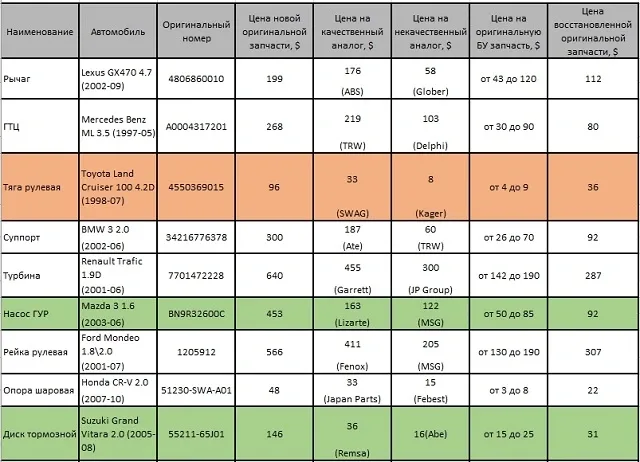
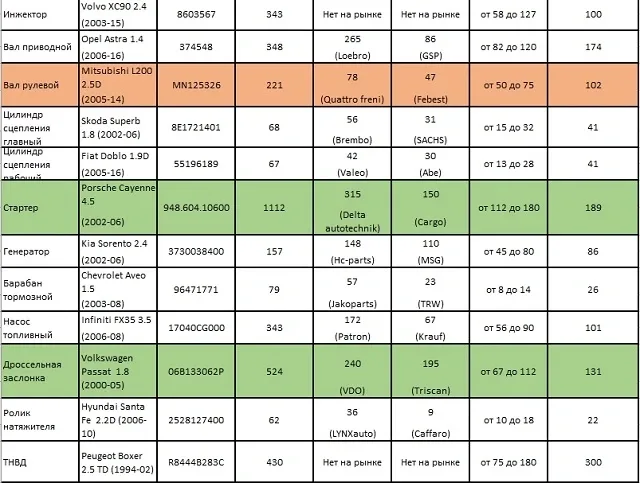
• Red color shows where restoration is not advisable: a restored part is more expensive than a reliable analog.
• Green color marks where the relative price difference gives an advantage of 75% or more for restored parts.
It is noteworthy that the price of restored parts and mechanisms is almost always lower than the price of quality analogs and rarely exceeds the threshold of 50% of the cost of a new original. At the same time, experienced workshop specialists can offer the market a restored part (with the performance characteristics of a new one and a warranty) at a price comparable to a used part.
The conclusion suggests itself: you can buy a worn-out unit at a scrapyard for pennies, invest effort and money into it, and get a guaranteed working part cheaper than a branded replacement, and sometimes even cheaper than an unreliable ersatz (see, for example, a turbo or throttle body). This strategy is increasingly used by auto repair shops and service stations.
It should be noted that for a number of engine parts (crankshaft and camshaft, gearbox or differentials as assemblies), analogs are not produced at all. Here restoration becomes the only alternative to used parts from a scrapyard.
On the other hand, there are a number of inexpensive parts whose restoration is not advisable: for struts and arms, even a quality replacement will cost less than repair (shown in red in the table).
To figure out which parts are most profitable to restore, of course, you need to compare parts for one model. We will illustrate with an example of prices for parts for BMW X5, E53 3.0D (1999-2006)
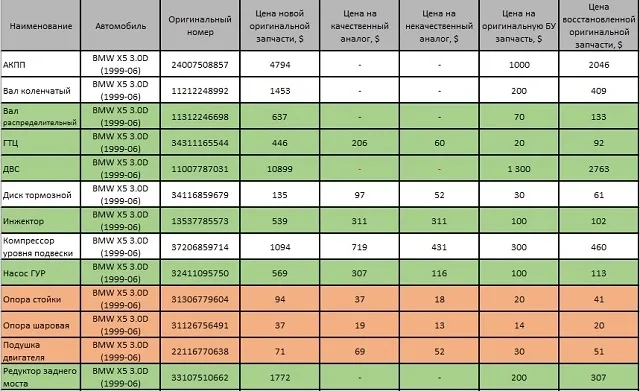
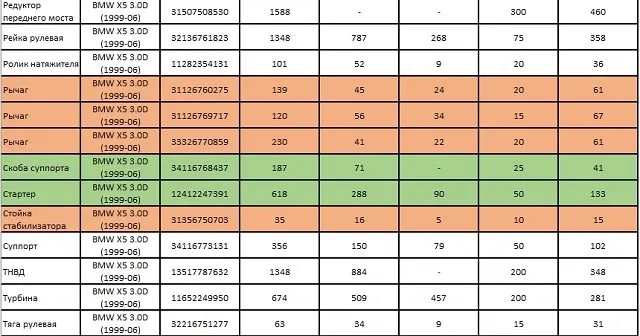
As we can see, savings on restored parts range from 28% (engine mount) to 82% (differential, master brake cylinder). And the entire BMW X5 (excluding body elements) can be equipped with used parts for 4,113 dollars, with restored ones for 10,335, and with new ones for 35,502. How is this achieved?
After talking with employees of companies specializing in restoration, we found out this simple secret:
• First, our auto mechanics work for much lower wages than their colleagues in the EU and the USA, while being in no way inferior to them in qualifications.
• Second, savings are achieved through the so-called “gentle” approach - as a rule, body parts that are not subject to wear remain, while friction pairs, bearings and seals, and gear transmissions are replaced with new parts. If wear is insignificant, the “original” part is left, thereby reducing the cost of the service. At the same time, original repair kits are used, and the mechanism being restored is carefully diagnosed and inspected for defects.
• Third, auto services engaged in restoration receive wholesale discounts when ordering repair kits, thus reducing the cost of restoration.
• Fourth, local repair organizations develop specialization and, as a result, mass production (for example, only steering racks).
How reliable are restored parts?
This is the second most popular question after the question about price. Indeed, warranty obligations are an important factor when choosing a repair method. Obviously, restored parts are more reliable than used ones from a scrapyard – that's what the overpayment is for. Warranty periods for restoration are comparable to warranties on analogs. As a rule, this is from 3 (brake calipers and discs, starters and alternators, steering rack) or 6 (arms, transmission parts, fuel injection pump, turbos) months and up to 12 months for complex units, such as an engine or its components. Often a warranty is offered by agreement.
As everywhere, everything here depends on the contractor, the qualifications of its employees, the quality of components and equipment. We advise you to contact only specialists with a proven reputation.
Data from specialized retail online stores, price lists of major auto parts importers, and electronic classifieds boards were used. Prices for restored parts are taken from the website partmart.com.ua