Let's ask this question to Maxim, a representative of the company "Vremya Gaza".
When people ask me what shape a gas cylinder for LPG should be, I always answer: cubic! From the point of view of convenience, it would be ideal. It is no coincidence that in Japan they grow square watermelons – they are convenient to stack on top of each other, which is very important for transportation.
Making a container in the shape of a cube is not a difficult task. But it cannot be used, since metal tanks that operate under high pressure must have a spherical shape.
Spheres optimally withstand excess pressure – that's physics. A torus and a cylinder are varieties of a sphere, so they are equally reliable, even with a wall thickness of only 3 mm. Here again it is worth remembering ergonomics. Let's look at this with a specific example.
Features of installing LPG on a Ford
Let's take the Focus III sedan, since compared to its predecessor, its trunk has become smaller – 372 liters versus 467 liters. Therefore, owners have to rack their brains: how to convert the car to gas if the space for a propane cylinder is limited?
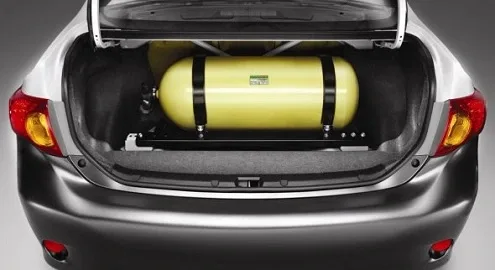
A cylindrical cylinder will take up at least 50 liters. And this is useful space, because you can't put it in the corner of the trunk due to its size: the length of the tank is 798 mm, and the diameter is 299 mm.
An alternative is a 30-liter cylinder, but its dimensions – 503 mm in length with the same diameter – are too large for a compact trunk.
The only option left is to install a torus. True, you will have to sacrifice fuel supply – the capacity of the torus under the spare wheel is 42 liters. But if you place it in the spare wheel niche, the useful volume of the trunk will remain untouched.
Features of operating a torus
Among the disadvantages of the "under-spare" cylinder, I will note the following:
• the spare wheel needs to be put somewhere, because you can't do without it;
• the difference of 8 liters is about 100 km of Focus highway driving, which is noticeable;
• the torus costs more.
Practice shows that a spare wheel is needed about once every 25 thousand kilometers. Therefore, I had no doubts about installing a torus, especially since the extra charge turned out to be small. You can find out more about prices here − http://gaz-time.ua/services/ustanovka-gbo/
However, driving completely without a spare wheel is uncomfortable: Murphy's law, according to which a wheel gets punctured at the most inopportune moment, works flawlessly. So the spare wheel in a cover lies in the trunk. When I need the full volume of the luggage compartment, I move it into the cabin, behind the driver's seat.
For those for whom the "extra" hundred kilometers of highway driving matter, the option of installing a larger torus outside is suitable. Then the spare wheel will remain in its place, but the ground clearance will decrease. For urban crossovers, this is not a problem. But for compact sedans, this option is not always suitable. Although much depends on operating conditions. Come to us for a fitting – a solution will definitely be found. See you!