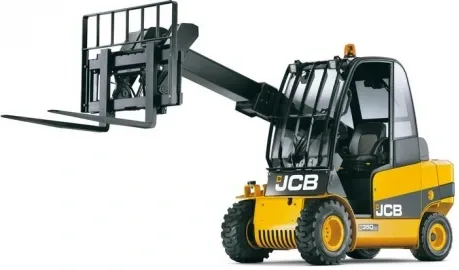
Manual maintenance of such a warehouse by loaders is an extremely complex and labor-intensive process, but the use of a forklift significantly simplifies it, allowing pallets to be lifted and lowered to considerable heights without much effort. Below, in the format of answers to frequently asked questions, we consider the types of forklifts, their key differences, and operational features.
Which forklifts to choose: electric or liquid fuel?
The choice depends on operating conditions. If the equipment is needed primarily for work inside a warehouse with rare trips outside, an electric forklift will be the optimal solution. For more intensive work, when the machine spends most of its time outdoors and only occasionally enters the warehouse, it is wiser to look at models running on liquid fuel or liquefied gas.
What is the fuel consumption of a forklift?
Manufacturers conduct tests and indicate hourly fuel consumption under certain loads, and there are also special formulas for calculating it, but all these indicators are very conditional. For example, if the warehouse has elevation changes and the operator has to frequently lift pallets to the upper tiers of racks, consumption will be one thing. At another enterprise, where the floor is perfectly flat and the racks are low, it will be completely different. As a result, the difference in fuel consumption among identical models can reach a liter per hour or more.
How long does a forklift battery last?
A traction battery, before a significant loss of capacity, on average withstands from 1500 to 2000 charge cycles within the warranty period. If the warehouse operates daily, the battery will last at least four years, provided that the rules of its operation are followed.
To what height and what load mass can be lifted?
These parameters directly depend on the specific model and its load capacity. The lower these indicators, the more affordable the price of the equipment. Today, on sale you can find forklifts with a load capacity from 1500 to 7000 kg, and the lifting height varies from 2 to 6 meters and more.
Which forklifts are most in demand on the market and how much do they cost?
The sales leaders among loading equipment are brands such as CAT, Toyota, NISSAN, Linde, Mitsubishi, HELI, Crown, and others. In total, more than 30 brands from different countries are represented on the market. The price range is very wide and depends on the characteristics and manufacturer. A new forklift will cost approximately 20,000 dollars, while a used model with decent mileage can be found for 8,000 dollars.
How do forklift tires differ?
There is a difference. There are two main types of tires: pneumatic and solid. Pneumatic tires are similar to automotive ones and can be tube-type or tubeless. Solid tires are filled with a special rubber compound instead of air. Their main advantage is resistance to punctures, but they handle road irregularities worse.
How difficult is it to learn to drive a forklift?
If you watch training videos, it becomes clear that there are certain nuances here. If we speak seriously, a forklift has practically nothing in common with driving a car.
Control here is carried out by turning the rear wheel, so the logic of movement of the equipment is completely different. The most difficult thing is to learn to correctly assess the distance and height of lifting loads, while the movement itself is mastered quite quickly.
What training is required to work on a forklift?
Today, the operator must have a certificate for the right to operate this equipment. There are enough specialized educational institutions offering theoretical and practical training; the training period is about 6 months. To operate an electric forklift, you will additionally need to obtain group II for electrical safety, as well as undergo instruction on replacing and charging traction batteries.
What is the maximum speed of a forklift?
Racing on forklifts, especially electric ones, is hardly possible, and there is no need for it. A modern diesel model can accelerate to 25 km/h. The speed of an electric counterpart is somewhat lower and directly depends on the battery charge level.