No matter how perfect the other components are, without a quality spring, the suspension cannot function properly. It is the spring that is responsible for the key quality of the suspension — its elasticity.
In essence, all other suspension elements — arms, rods, stabilizers, ball joints, and bushings — perform only one task: to give the spring the ability to cope with road irregularities, ensuring constant tire contact with the road surface. Shock absorbers, in turn, are designed to dampen oscillations so that after overcoming an obstacle, the car does not rock for a long time. The fluid inside the shock absorber has no elastic memory; it absorbs energy and converts it into heat. Therefore, even the highest quality shock absorbers cannot ensure normal suspension operation if its main element — the springs — do not perform their functions properly.
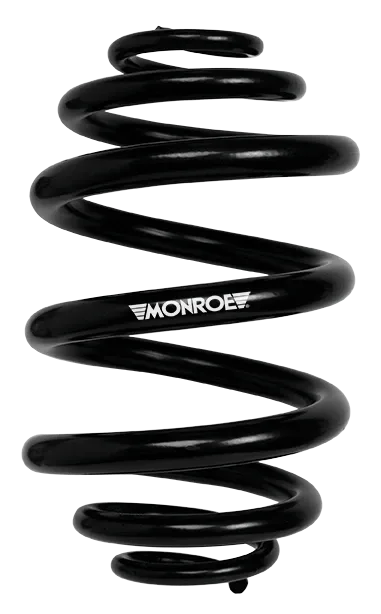
At first glance, a suspension spring may seem like a simple coil of steel rod, but it is not. It not only supports the vehicle's mass and maintains the necessary ground clearance in static and dynamic conditions. The car's behavior when hitting an obstacle also depends on it. Of course, when hitting a pothole, the shock absorber also affects the spring's operation, forming a single elastic system with its own characteristics.
The energy generated during vertical body movements is stored in the spring during its compression. The spring tends to release this energy by expanding. This leads to body movements, making the car unstable, unsafe, and uncomfortable. To avoid this, the system includes a shock absorber. However, the characteristics of this entire system with working shock absorbers again depend on the spring.
Firstly, springs differ in their design. In addition to standard coil springs, there are "banana" type springs, products with variable cross-section rods, and miniblocks. Except, perhaps, for springs with variable cross-section, all others are quite easy to counterfeit or produce as ersatz components that only outwardly resemble a real part. However, making a quality spring is actually not easy.
In addition to basic aspects such as the quality of steel and the blank, MONROE springs use modern winding technology — both hot and cold methods. In "banana" type springs, radial impacts are used. In other words, before twisting the blank into a spring, it is specially deformed. Such springs during operation provide confident vehicle handling, especially at high speeds.
Springs with variable cross-section and miniblocks have a progressive nonlinear characteristic. The force required to compress them increases proportionally to the degree of compression, which guarantees durability, silence, and compactness. Thus, a quality spring that not only has the correct geometric parameters before installation but will also work according to the automaker's design (or the developer's, if they offer an improved version) can only be manufactured on specialized equipment, not in an ordinary workshop.
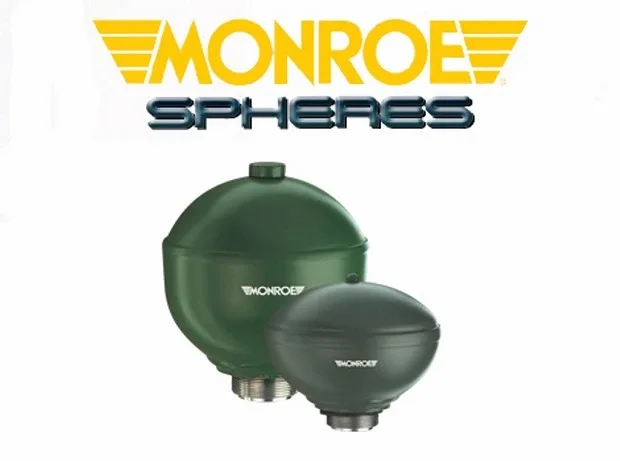
There are, however, springs that cannot be imitated by simply twisting a steel rod. We are talking about rubber, or rather, pneumatic elements. Such springs are used not only in trucks but also in passenger cars, for example, in Citroën models BX, CX, GS, ID, SM, Xantia, XM, C5, and C6. MONROE® SPHERES springs, specially created for cars with hydropneumatic suspension, have the same design and characteristics as the original parts installed on the assembly line.
Of course, for any springs, manufacturing quality is crucial. Low-quality springs may not only fail to meet the calculated elasticity parameters but may also differ within the same batch. Simply put, if you install two such springs on one axle, then when driving over a speed bump strictly perpendicular, the car will rock from side to side, and when taking identical turns at the same speed, it will lean differently. Moreover, the service life of such springs leaves much to be desired.
All MONROE and MONROE® SPHERES springs available on the market and purchased from points of sale that can confirm the origin of the product are 100% compliant with the strictest requirements of automakers. After all, the company that produces them is the largest international supplier of suspension systems for passenger cars and trucks. For example, a MONROE spring can be selected for 80% of all European cars. Every fourth shock absorber in the world is also a Monroe® shock absorber. Monroe® offers innovative solutions for both automakers and the aftermarket, making it a leader in suspension systems.
Material prepared by the international marketing agency "AGV-Aftermarket".