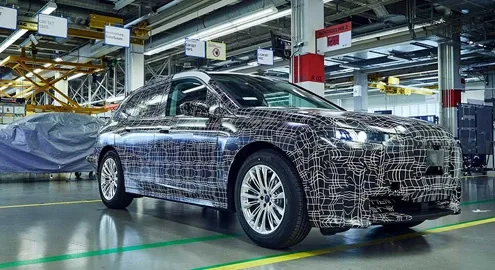
At the Research and Innovation Center (FIZ), located in the northern part of Munich, work is underway to create about a hundred prototypes of the future electric car.
Udo Henle, who heads the experimental production, noted that preparing an electric vehicle for series production is an interesting but not easy task. According to him, before the start of official production, the company will manufacture up to a hundred prototypes of the BMW iNext model. During this stage, various innovations will be tested to improve and speed up production operations. BMW's key goal is to produce the electric car on the same assembly line as traditional vehicles.
To test the prototypes, the method of computed tomography is used. Scanning is performed by robotic devices that take many images from different angles. These images are then combined into a three-dimensional model, allowing a detailed examination of the smallest elements and an assessment of the quality of assembly and paint coating. In the published footage, the prototypes are still hidden under camouflage film.
According to unofficial data, the range of the crossover will depend on the modification and will be from 450 to 700 kilometers without recharging. The most powerful version of the electric car is expected to get up to 800 horsepower. The car will also be equipped with an autonomous control system, but details of this driverless technology are not yet disclosed.
Externally, the new product will resemble the concept of the same name, presented last year on board a Lufthansa Boeing 777F aircraft. The dimensions of the production model will be larger than those of the iX3, sales of which will begin in 2020.
The premiere of the car is scheduled for 2021. By 2025, BMW intends to release 25 production electrified models, with 12 of them being fully electric.