Of course, the reason here is one – motorists want to save money. Wealthier people install LPG, and those for whom gas in a car is not affordable prefer an “alternative.” The difference can reach four hryvnias per liter – a serious argument! And since there is demand, there will be an overabundance of supply.
The first in Ukraine to start selling such gasoline with the addition of absolute bioethanol was the BRSM-Nafta gas station chain. The experiment turned out to be successful, and this made the market think. Not long ago, the “alternative” also appeared at the WOG chain.
Global biofuel production by 2017 should increase by 25% and amount to about 140 billion liters. In the European Union, the main part of biofuel production comes from biodiesel made from rapeseed, and its consumption is steadily growing. We are also not standing still; in particular, the largest gas station chain in the east of the country, Parallel, also decided to introduce the “alternative.” The new fuel E95-40, as the company claims, has passed certification by MASMA-SEPRO and is produced in factory conditions in strict accordance with technical specifications. Such fuel can be mixed in any proportions with traditional gasoline. For now, the new product is only available in Zaporizhzhia, but the company promises to start selling it in some other cities as well.
And how is the quality of such fuel? Some traders produce it themselves, so there are certain concerns. This became the reason to “get down to business” at the capital’s Institute of Consumer Expertise.
For now, the choice of such gasoline is not very large – experts found alcohol fuel in five gas station chains – BRSM-Nafta, Parallel, WOG, KLO, and Avias. But the results turned out to be better than last year.
How much alcohol?
Many motorists are distrustful of biofuels, and completely in vain. So far, no one has officially proven that fuel consumption on high-quality “eco” gasoline will be higher. On the contrary, bench tests indicate the opposite. Also, many drivers are afraid of alcohol in fuel, saying, alcohol is “water.” This common stereotype is also not entirely true. What is added to gasoline is not food-grade alcohol, which our bodies happily “consume,” but crude alcohol with a large amount of fusel oils, dehydrated and denatured with gasoline.
Laboratory tests began with the main thing – determining the volume fraction of bioethanol, the value of which determines the main properties of alcohol fuel. It should be noted that alcohol fuel is divided into two categories – gasoline with a bioethanol content of at least 30% is classified as alternative fuel; if bioethanol is less than 30%, it is not alternative but is classified as alcohol fuel by grades E5, E7, E10 (according to the Technical Regulations), and these gasoline grades should not be confused with alternative fuels – they are produced according to different regulatory documents!
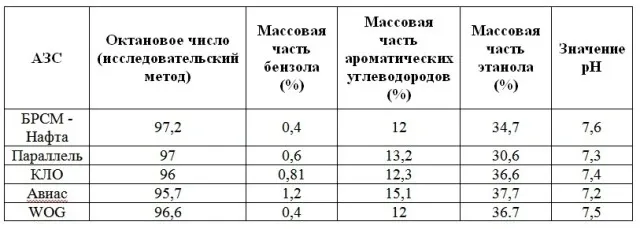
According to the results of laboratory tests, all samples turned out to be alternative, i.e., ethanol content was more than 30 percent. The least “alcohol” was found in the E95-40 samples from the Parallel chain (30.6 percent) and BRSM-Nafta (34.7%), and the maximum – in Avias (37.7 percent).
Octane check
Usually, alternative fuels have a considerable margin in this parameter. This time it was the same.
This indicator characterizes the fuel’s resistance to detonation – premature combustion of gasoline in the combustion chamber. Detonation is harmful to the engine not only due to increased fuel consumption and reduced power, but also due to premature engine wear from excessive loads. The octane number was measured by the research method. And again – a favorable picture. The highest safety margin was found in A-95E Premium+ fuel from the BRSM-Nafta chain – 97.2 units, and the new fuel E95-40 from the Parallel chain – 97 units.
Benzene and aromatics
As is known, benzene and aromatic hydrocarbons are substances that can harm the fuel system and lead to its premature wear. In addition, without evaporating completely, benzene washes away the oil film in the engine, which leads to increased wear of the engine cylinders. And of course, they harm the environment.
However, without aromatic hydrocarbons, it is impossible to produce high-quality gasoline, since aromatics are products of secondary oil refining that provide a high-octane component. The negative side is the negative impact on the environment, so the content of these components is limited in regulatory documents. In alternative gasolines, due to the 30% bioethanol content, the content of aromatic hydrocarbons can be reduced, since alcohol has a high octane number.
Alcohol gasolines are produced according to technical specifications, so the manufacturer determines the boundary amounts of these substances, for example, the same benzene. For example, Avias allows up to 2.5%, and KLO 4%. Therefore, they were evaluated by actual content, with an eye on the DSTU for improved “ninety-five,” which does not allow benzene content above 1%. The practical absence of this harmful substance (from 0.4 to 0.6 units) was found in samples from Parallel, BRSM-Nafta, and WOG. An excellent result! And the most benzene and aromatics were found in Avias fuel (1.2 and 15.1%, respectively), but this fits within the technical specification standards with a margin.
Corrosion will not pass
One of the most important operational indicators of alcohol fuel is corrosion activity. The fact is that alcohol is a strong solvent and corrodes rubber and plastic parts of the fuel system. To avoid this, a special additive must be introduced into the biofuel composition, increasing the value of the acidic pH parameter. In general, this indicator should be from 6 to 9 units. All participants coped with this test, and the highest value (7.6 units) was found in the A-95E Premium+ fuel sample from the BRSM-Nafta chain. The other participants also had values above seven. Such indicators indicate that in terms of anti-corrosion properties, alcohol gasoline is practically no different from regular gasoline and is harmless to the rubber-technical parts of the engine.
Results
The results showed that you can refuel with “alcohol” gasoline without risk to your own car. Moreover, its quality is also growing year by year. Such fuel is beginning to appear in large regional chains, which indicates that competition in this segment will intensify. We can rejoice for motorists in Zaporizhzhia, Kryvyi Rih, and other cities in the east – now they also have the opportunity to drive cheaper. In any case, competition is the key to fair prices and quality, which cannot but please motorists.
Dmitry Sysoev