Consumption of liquefied hydrocarbon gas in Ukraine in 2019 increased to 2.03 million tons (+11.1%) compared to 2018. Moreover, last year the volume of the autogas market for the first time exceeded the volume of the gasoline market, which in 2019 amounted to 1.95 million tons. The decrease in gasoline consumption in Ukraine is caused by the growth in registrations of used foreign cars, most of which are equipped with diesel engines, as well as the conversion of both new and used cars to run on gas.
Against the background of these trends, the quality of gasoline offered to motorists comes to the fore. The Institute of Consumer Expertise conducted another check of the most popular 95-octane gasoline. Experts paid attention not only to large chain gas stations, but also to more modest distributors of automotive fuel. In this study, samples from 11 networks were selected – Parallel, WOG, KLO, Chipo, Glusco, ANP, UPG, SunOil, Grand petrol, Avantage and Marshall.
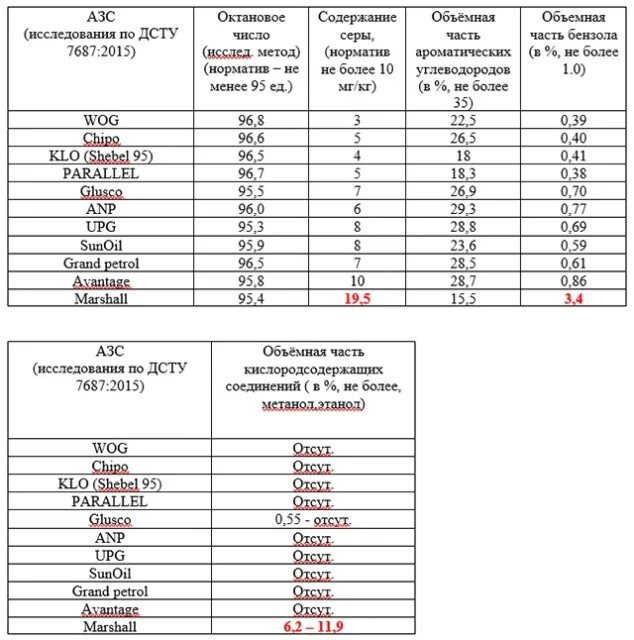
Samples were sent to a certified laboratory, where they were tested for compliance with the standards of the relevant DSTU 7687:2015 (A-95-Euro5 gasoline). The samples were checked for key parameters – octane number, sulfur content, volume fractions of aromatic hydrocarbons, benzene, ethanol and methanol. Of the 12 samples, only one turned out to be non-compliant with DSTU requirements.
First of all, the most important parameter for engine operation was checked – the octane number, which characterizes the fuel's resistance to detonation – premature combustion of gasoline in the combustion chamber. Detonation is harmful to the engine not only due to increased fuel consumption and reduced power, but also due to premature engine wear from excessive loads. The octane number was measured by the research method, according to which the standard is set at no less than 95.0 units.
All samples met the standard; excellent results were demonstrated by WOG (96.8) and Parallel – (96.7). Chipo (96.6) and KLO (Shebel 95) (96.5) also showed a “margin”. The rating is closed by samples from UPG (95.3) and Marshall (95.4).
The next important indicator is sulfur content. A high content of this substance in fuel leads to the formation of carbon deposits, contamination of fuel injectors and rapid failure of the catalyst. Naturally, when burning fuel with a large amount of sulfur, more harmful gases are emitted into the atmosphere, which we breathe. According to DSTU standards for A-95-Euro5, the sulfur content should not exceed 10 mg/kg.
Among the studied gasoline samples, the anti-rating was led by fuel from Marshall, which exceeded the norm almost twice – 19.5. Another sample turned out to be “borderline” – 10 mg/kg of sulfur was found in fuel from Avantage. For comparison, the leaders had minimal sulfur content – WOG (3 mg/kg) and KLO (Shebel 95) (4 mg/kg). It is important to note that compared to previous studies, the indicators for fuel from Chipo and Parallel (5 mg/kg) have improved. The result of the KLO network is especially pleasing, since Shebel 95 fuel is produced at the domestic Shebelinka refinery.
Next, the fuel was evaluated for benzene content. This substance can wash away the oil film, which leads to increased wear of engine cylinders. According to DSTU, the volume fraction of benzene content should not exceed 1%. According to this indicator, fuel from Marshall turned out to be a violator, exceeding the norm by 3.4 times! The least sulfur was found in samples taken at Parallel (0.38%) and WOG (0.39%) gas stations.
When checking the volume fraction of aromatic hydrocarbons, no exceedances were found. For reference – with an increase in the content of “aromatics”, the toxicity of exhaust increases, and more carbon deposits form in the combustion chamber. All participants have this indicator within the tolerance, and with a good margin. The minimum values are for KLO (Shebel 95) and Parallel. Anomalously low in this category was fuel from Marshall (15%), and at the end of the list were UPG (28.8%) and ANP (29.3%).
Well, the last test was to detect oxygen-containing compounds in gasoline – ethanol and methanol. Unfortunately, not all samples were able to pass this test. According to DSTU standards, the volumetric content of ethyl and methyl alcohol should not exceed 3% for methanol and from 5 to 10% for (bio)ethanol. 11 out of 12 fuel samples passed the test, but the A-95 sample from Marshall gas stations demonstrated a high content of alcohols, significantly exceeding the permissible standards.
Summarizing the research results, it is worth noting that most Ukrainian chain gas stations not only offer fuel that meets European standards, but also improve its quality over time. But, unfortunately, the risk of refueling with fuel with an abundance of sulfur and alcohol still remains…