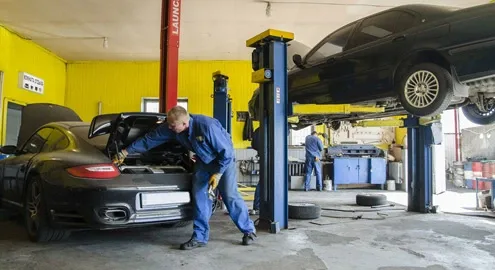
In pursuit of reducing vehicle weight, the wall thickness of almost all components is calculated with maximum precision so that they can withstand loads during operation. However, all testing assumes driving on roads with high-quality surfaces. Therefore, even after a small mileage in Ukraine, foreign cars develop problems with the chassis. This is due to poor road conditions, where it is difficult to avoid loads on the chassis exceeding the maximum possible. As a result, Japanese, Korean, and European cars have to be brought in for chassis diagnostics more often.
As a rule, chassis problems are identified and fixed during vehicle maintenance. However, you can also identify problems yourself by looking at the appearance of chassis components or by a sound that was not there before. This is a signal to go to the nearest auto service center for diagnostics. Extraneous noise and vibration can occur for various reasons, some critical, others not requiring urgent repair. But you should not take risks, as chassis malfunctions are one of the causes of accidents in most cases. Therefore, if there is still a long time before scheduled maintenance, and the car has started behaving on the road differently than usual, it is recommended to go for diagnostics.
How to independently identify chassis problems
The chassis of a car is a complex mechanism that requires regular adjustment, maintaining clearances, and replacing some deformed components. You can identify the presence of chassis problems by several signs. Most often, the car pulls to the side while driving. This behavior can be caused by deformation of the body or a separate part in the suspension structure. But more often the car pulls to the side due to misalignment of camber or uneven tire pressure. In the latter case, it is enough to equalize the pressure, and if that does not help, then perform diagnostics and adjustment of camber. If the problem is not solved by such methods, you should perform a full chassis diagnostic to identify a failed part in the suspension structure. The problem may be as follows:
• the upper support of one of the shock absorbers is damaged;
• the wheel does not fully release due to problems with the brake mechanism;
• the front suspension arms are deformed;
• the strut springs have different stiffness;
• problems with the hub bearing;
• the parallelism of the car's axles is disturbed.
If one of these problems is found, then chassis repair is required in an auto service center. Let's consider other signs of chassis failure that are not so common but no less important.
Car rocking during braking and on turns
This sign indicates a malfunction of the shock absorbers or springs of the car. In some cases, the cause of such behavior may be wear of the stabilizer bushing responsible for lateral stability.
Vibration in the chassis
There may be several reasons for vibration while driving, and the simplest is a difference in tire pressure or loosening of wheel nuts. However, more often the cause is wear of hub bearings or steering drive joints. More serious problems are associated with deformation of the wheel rim or wheel imbalance. All these problems are easily identified by diagnostics in an auto service center.
The suspension bottoms out
This sign means that the tire or wheel rim is deformed. But if after a visual inspection it turns out that this is not the case, then the problem should be sought in the deviation of the optimal clearance in the hub bearing. You should also inspect the shock absorbers and suspension arms for breakage or deformation.
Shock absorber knocking
When it is obvious that it is the shock absorbers that are knocking, the source of this sound arises for the following reasons:
• worn mounting bushings or shock absorber supports;
• uneven tire wear;
• the shock absorber is leaking;
• wheel balancing or camber adjustment is required;
• the brake system mechanisms are not working correctly;
• deformation of suspension arms;
• the body geometry is disturbed.
In all these cases, shock absorber knocking is inevitable, which will be confirmed by diagnostics in an auto service center.
What is checked during chassis diagnostics
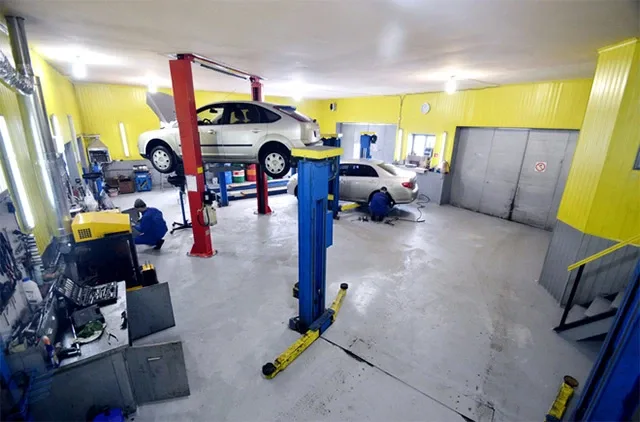
To perform diagnostics, the auto service center must be equipped with special equipment, including a camber stand. During diagnostics, the following is checked:
• the condition of the support cups and shock absorber springs (if they are damaged, the assembly is completely replaced with a new one);
• compliance of play in tie rod ends and ball joints;
• integrity of the steering mechanism;
• CV joints;
• wheel rims for geometry compliance;
• suspension arms for deformation;
• condition of silent blocks;
• the car's brake system;
• wear of brake drums and discs, as well as their replacement in case of critical wear.
After completing the diagnostics, the specialist who performed it provides a sheet with a report on the check performed. Based on it, he will give valuable recommendations and offer to replace some components. After selecting the necessary spare parts, the client is informed of the final cost of chassis repair.
You can perform diagnostics and repair of the car's chassis in Kyiv using the services of the auto service centers of the company "Oiler". It has several service stations operating in different parts of the capital, and each of them is equipped with professional equipment for diagnostics and repair of the chassis of passenger vehicles. You can learn more about the services on the company's website https://oiler.ua/, where the terms of cooperation and fixed prices for repair work and vehicle maintenance are described.