Illegal diesel "barrels" are also working en masse, and they are in no hurry to legalize. In any case, car owners have a choice, but what quality of diesel fuel is actually sold at "white" and "black" gas stations, they decided to find out at the capital's Institute of Consumer Expertise. Experts took samples from the largest gas station chains in our country, as well as from illegal sellers, and sent them to a certified laboratory. The check showed that "diesel drivers" will be able to drive even in the most severe frost, but only if they refuel at "legal" stations.
What was studied
Experts visited representatives of almost all major chains – Shell, KLO, MOTTO, OKKO, WOG, Chipo, Glusco, AMIC, ANP, BRSM-Nafta, SunOil, and a "partisan" station selling without documents. They studied both regular diesel fuel and selectively "branded" varieties that, according to sellers, have improved parameters. The list of parameters was traditional - cetane index, fractional composition, flash point in a closed crucible, sulfur content, and the main "winter" indicator – cold filter plugging point.
Will it start in the cold?
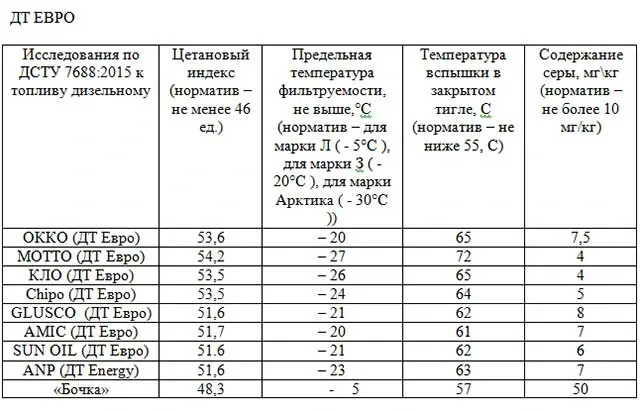
Frost resistance is the first parameter tested in the laboratory. In counterfeit "diesel fuel", paraffins quickly "precipitate" at low temperatures, accordingly filters clog – and the fuel system is unable to deliver fuel to the engine. Tests to determine the cold filter plugging point showed that all samples, except the "illegal" one, are "honest" "winter" fuel. The standard states that the filterability of the "winter" grade "Z" for diesel fuel should be at least minus 20°C. None of the "white" test subjects fell below this mark, and the greatest margin of safety was demonstrated by diesel samples purchased at KLO (– 26°C), MOTTO (– 27°C), and Chipo (– 24°C) gas stations. For the "illegals" at the "barrel", the filterability corresponded to "summer" diesel fuel indicators - minus 5°C. The only consolation for customers of such gas stations can be the fact that in real frost (and weather forecasters predict up to minus 25 in the near future), they physically will not be able to dispense fuel – it will simply freeze in the fuel lines, dispenser, and hose.
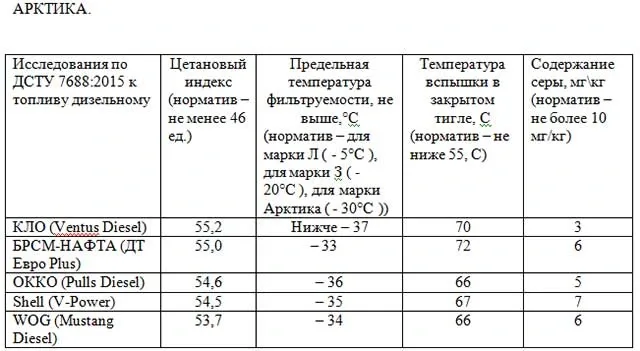
As for diesel fuel of the "Arctic" grade, here the "brand" is at its best – all samples turned out to be of the highest quality. The most extreme "polar explorers" in terms of cold filter plugging point were branded fuel from KLO (Ventus Diesel) – below minus 37°C, and OKKO (Pulls Diesel) - minus 36°C. If you need to travel in frost (especially over long distances), experts recommend refueling only with such fuel.
Cetane index
Next, specialists calculated the cetane index of the test subjects. This parameter is the cetane number of the fuel before additives are applied. In cold weather, a high cetane number provides greater efficiency of the diesel engine and its quick start. The general principle is the more, the better. All test participants met the standard; the largest margin among "regular" fuel was demonstrated by samples from MOTTO, KLO, and Chipo – 54.2, and 53.5 units, respectively. Among branded fuel - KLO (Ventus Diesel) and BRSM-NAFTA (DT Euro Plus) – 55.2 and 55 units.
Flash
The second significant indicator is the flash point in a closed crucible. It characterizes the ignition temperature of the fuel. Indirectly, this indicator can show whether foreign components have entered the "diesel fuel". No violations were found among the participants.
Sulfur – Euro-5!
The process of extracting sulfur from oil is the most difficult and expensive, and sulfur combustion products harm the environment and the engine. Sulfur is deadly for catalytic converters and particulate filters, but at a sulfur concentration in fuel of less than 10 mg/kg, this is not a problem. This time, the results for this parameter were excellent. With the exception of one sample, all samples met the Euro-5 level. Almost complete absence of sulfur was recorded for KLO (Ventus Diesel) – 3 mg/kg, MOTTO – 4 mg/kg. But at the illegal "barrel", sulfur was found much more – 50 mg/kg, which corresponds to the outdated Euro 4 standard and is "off-spec".
Conclusions
It seems that a significant barrier has been placed against diesel "adulteration" in the country, at least as far as large network operators are concerned. Overall, large gas station chains (OKKO, WOG, KLO) look very decent against the backdrop of expected blizzards and frosts. Another important trend is also emerging in the market - economy-segment retailers (MOTTO, Chipo, SunOil) are seriously stepping on the heels of the market giants. At least, the quality of fuel now matches or even surpasses that of large chains. At the same time, they significantly win in price (1-2 hryvnias per liter), but so far lose in service, coverage, and loyalty programs. The fight for the customer promises to be interesting, and for motorists such competition brings only pluses.
Roman Petrenko