The last month of last year and the beginning of January this year turned out to be abnormally warm, but weather forecasters predict severe cold starting in February, reaching minus 30 degrees Celsius. Are sellers of "heavy" fuel ready for such a scenario? The capital's Institute of Consumer Expertise decided to answer this question by taking samples from the largest gas station chains in our country and sending them to a certified laboratory. The experts had certain concerns, since in a similar study last year, a third of the samples turned out to be substandard. The current check showed that "diesel drivers" will be able to drive even in the most severe frost!
What was studied
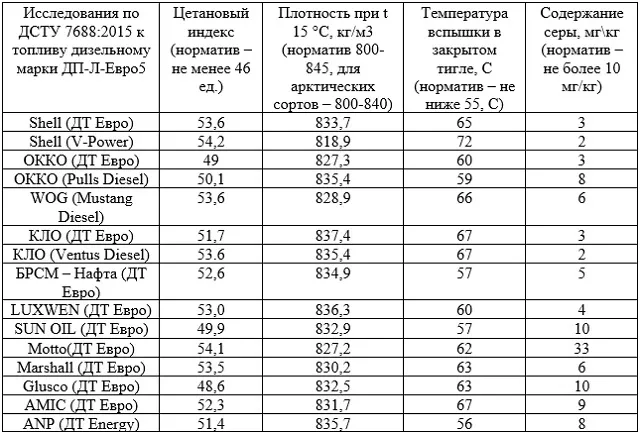
Experts visited representatives of almost all major chains, and selectively smaller networks. Shell, OKKO, WOG, Glusco, AMIC, KLO, ANP, BRSM-Nafta, SunOil, LUXWEN, Motto, and Marshall were "in the crosshairs." Both regular diesel fuel and "branded" varieties, which, according to sellers, have improved parameters, were studied. The list of parameters was also quite extensive - cetane index, fractional composition, flash point in a closed crucible, sulfur content, density. And, of course, the main "winter" indicators - cold filter plugging point and mass fraction of water. The results surprised even seasoned experts - no one had "moonshine," and only one sample turned out to be Euro-4, the rest corresponded to the high Euro-5 class.
"Polar" records
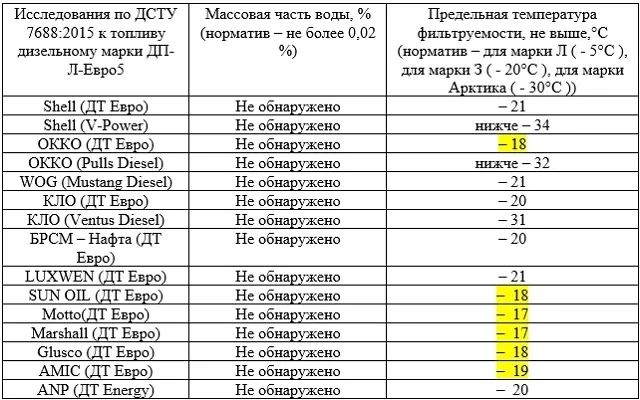
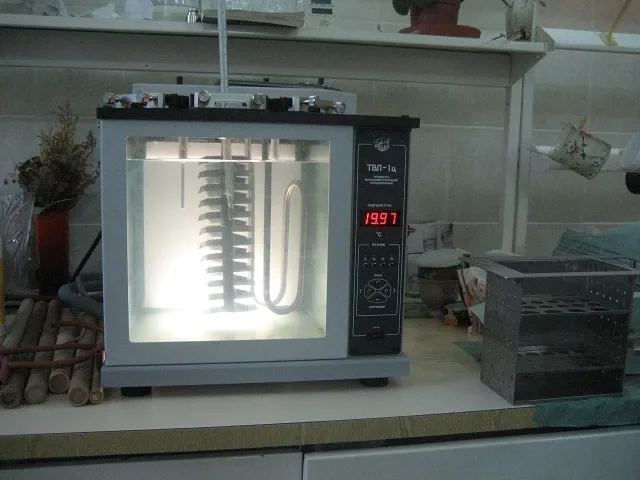
First of all, the laboratory checked the most important "winter" parameter - frost resistance. Substandard diesel fuel quickly turns into jelly at low temperatures, clogs filters - and the car becomes "real estate." Tests to determine the cold filter plugging point showed that only 9 samples are "honest" "winter" fuel. For the remaining participants, whose fuel fully complied with the standards, the indicators fell in the range from minus 17 degrees Celsius and below. Formally, this does not correspond to the "winter" grade "Z" (-20°C), but while the temperature has not dropped much, you can refuel with such fuel. Well, the "polar explorer" record holder for filterability temperature was Shell's branded fuel (V-Power Nitro+) - below minus 34°C! This is even lower than the chain itself declares - the advertising indicates a freezing point of up to minus 32 degrees Celsius. Next on the podium were OKKO (Pulls Diesel) - below minus 32, and KLO (Ventus diesel) - 31°C. In the case of OKKO, the result does not reach the advertised minus 40, but overall it is very good.
There is never too much cetane
Next, specialists calculated the cetane index of the test subjects. The cetane index is the cetane number of the fuel before the use of cetane-enhancing additives. In cold weather, a high cetane number provides greater efficiency of the diesel engine and its quick start. The general principle is the more, the better. All test participants met the standard, with the largest margin demonstrated by Shell samples (regular diesel and V-Power Nitro+) - 53.6 and 54.2 units, respectively, WOG (Mustang Diesel), KLO (Ventus diesel) - 53.6 units, LUXWEN (DT Euro) - 53 units.
Flash point
The second significant indicator is the flash point in a closed crucible. It characterizes the ignition temperature of the fuel. Indirectly, this indicator can show whether foreign components have gotten into the diesel fuel. No violations were found among the participants.
Water
As a rule, water gets into diesel fuel due to improper storage or imperfect logistics. Water will very quickly cause the engine to stall, since ice crystals will clog pipelines and filters. Fortunately, this time no traces of water were found in any sample.
Sulfur content
The main "environmental" indicator of diesel fuel is sulfur content, although sulfur combustion products harm not only the environment but also the engine. Sulfur is deadly for catalytic converters and particulate filters, but at a sulfur concentration in fuel of less than 10 mg/kg, this is not a problem. This time, the results for this parameter were excellent. With the exception of one sample, all samples corresponded to the Euro-5 level! Almost complete absence of sulfur was recorded for Shell (regular diesel and V-Power Nitro+) - 3 and 2, KLO (Ventus diesel) - 2 mg/kg, OKKO (DT EURO) - 3 mg/kg. Excellent result!
Conclusions
Overall, gas station chain operators have prepared well for snowstorms and frosts, at least there is no obvious "substandard." Yes, some chains try to earn more by selling not quite "winter" fuel, and "diesel drivers" should be careful, since our climate is something else - plus temperatures can suddenly change to snow and severe frosts. Therefore, some large chains, for example, Shell and WOG, prepared for the cold in advance, and not when the temperature reaches critical values. It remains only to advise motorists not to "fall for" the low price at single gas stations and, of course, to monitor the weather. In severe cold, you must refuel only with arctic "diesel," since only it will 100% ensure comfortable driving.