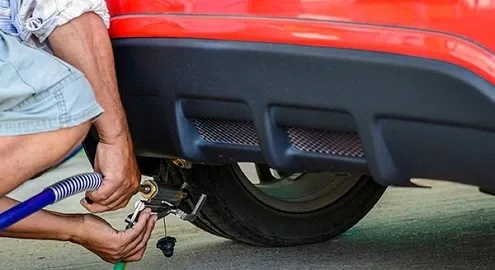
At first, literally within a week, the price of “blue” fuel almost doubled, then price tags decreased by about 30 percent. At the same time, many chains felt a shortage of the resource – and it was the factor of supply interruptions that led to the price rally. In addition, many experts note that when a resource shortage occurs, the number of “left” products of dubious quality increases sharply on the market. In last year's study, experts found an ambiguous picture – there were many violations, especially among illegal sellers. How the situation is now was investigated by specialists of the Institute of Consumer Expertise.
Participants
Recently, on social networks, many motorists complained about the quality of gas, blaming mainly large gas station chains. Therefore, experts focused on a number of nationwide gas station chains (Shell, OKKO, WOG, BRSM and others), large chains of the capital and the region (KLO, Luxwen) and several “barrels”, i.e., illegal filling stations. Experts took samples into a special sampler, after which the samples were delivered to the laboratory. Unlike last year's test, this time both network filling stations and “illegals” without problems dispensed fuel for analysis. True, at the “barrels” they dispensed only on the condition of not issuing a fiscal receipt, and after the laboratory the reason became clear.
How much is “underfilled”?
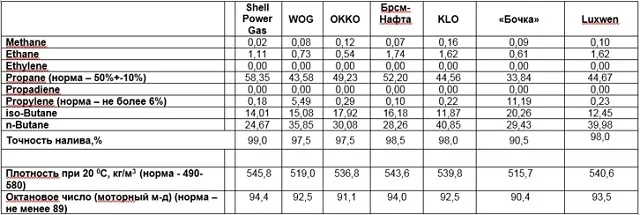
The accuracy of gas dispensing is the most criticized parameter by drivers. Many motorists measure mileage and complain that they are filled with more gas than the capacity of the cylinder. According to standards, underfilling can be no more than 1%, but achieving such a result at a column is quite difficult. Nevertheless, in fact, the results were excellent – all network filling stations have a dispensing accuracy above 97%. The most accurate dispensing was when dispensing Power Gas at Shell filling stations – 99.0% and BRSM-Nafta – 98.5 percent. But “illegals” sin with underfilling – according to insider information, underfilling of 10% is still “godly”. Some especially greedy “comrades” manage to deceive drivers by 20% of the amount indicated on the meter. Also, underfilling can happen without malicious intent – “illegals” simply save on timely maintenance of columns. Ultimately, the consumer wins slightly in price, but travels fewer kilometers.
In the laboratory
In the laboratory, samples were tested for compliance with the requirements of GOST 27578 “Liquefied hydrocarbon gases for automotive transport” according to the indicator “Component composition”. As is known, automotive gas consists of a mixture of propane and butane, as well as other hydrocarbons (isobutane, propylene, ethane, ethylene, etc.). For different seasons, the quantitative content of the mixture may be different – in summer it is approximately 40:60 (propane to butane), in winter, on the contrary, 60:40. After all, the more propane in the gas, the higher the saturated vapor pressure and the better the starting qualities and operation of fuel equipment in the winter period of operation.
One of the main points is also the brand of liquefied gas. There are two main ones – PBA (automotive propane-butane) and SPTB (technical propane-butane mixture). What is the difference? The first brand is purified gas adapted for use in cars, the second is “dirtier”, intended for household needs (for example, heating). And here unpleasant surprises were found.
The European standard EN 589-2008 in the terms section defines automotive liquefied gas as one that contains a small amount of unsaturated hydrocarbons (propylene, butenes and pentanes (pentenes). In Ukraine, GOST 27578-87 is still in effect, which establishes the permissible norm of unsaturated hydrocarbons – no more than 6%. In the sample taken at an illegal LPG filling station, there were much more than the norm – over 11%! Based on these data, this fuel cannot be classified as automotive. In addition, the gas from the “barrel” also had little propane – 33% at a norm of at least 50±10%. For a car, this will not cause significant harm, but the consumption of such gas will be much higher.
According to the requirements for SPTB, a liquid residue of up to 1.6% is allowed, and for PBA the presence of residue is not allowed. In addition, the permissible maximum sulfur content in PBA is lower than in SPTB (and according to EN 589 requirements – no more than 50 mg/kg).
The presence of liquid residue in SPTB when used in cars leads to the accumulation of residue in tanks, clogging of filters, and malfunctions of fuel equipment. The presence of unsaturated hydrocarbons leads to an increase in harmful substances in combustion products. Increased sulfur content leads to a reduction in the service life of catalytic converters and environmental pollution with sulfur oxides. The presence of mercaptan sulfur leads to increased corrosion of fuel equipment parts.
Overall, all large chains passed the test, showing good results. The best ratio was shown by the Power Gas sample at Shell filling stations – 58 propane and 39 butane. This ratio allows for the most complete combustion of the mixture, and therefore will provide dynamics while maintaining fuel economy. In second place is automotive gas from the BRSM-Nafta chain, with a ratio of 52:44. By the way, the Shell Power Gas sample turned out to be the “cleanest”, with only 0.10% propylene in it. Also, the OKKO sample showed good results, having a well-balanced composition of components and a low propylene content.
And one more important parameter – gas density. The higher it is, the greater, all other things being equal, the mileage on one fill. In this parameter, the highest indicators were demonstrated by samples from the Luxwen and Shell chains.
In the dry residue
Overall, the situation with the quality of automotive gas turned out to be not so critical, which cannot be said about price fluctuations. Apparently, the chains sell high-quality fuel of Ukrainian, Belarusian or Russian production. It remains to wish that supplies are rhythmic and the market does not experience a shortage. Then prices will go down, because competition in this segment is very high.