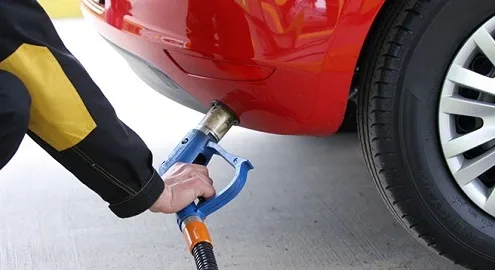
At the same time, a significant number of gas filling stations operate outside the legal framework, which does not prevent “barrels” from appearing in large numbers and in the most unexpected places. The reason for this mass phenomenon lies in money – illegal filling stations do not pay retail excise tax (about 1.20 UAH/liter), so they can sell gas cheaper than “white” gas station networks. Of course, such a discount attracts drivers like Putin attracts Trump, but no one can be sure what they ultimately get. If even the quality of gasoline in our country is subject to very conditional control, then the quality of gas is generally terra incognita. What are they actually “pumping” into our cylinders? Specialists from the Institute of Consumer Expertise, in cooperation with the inspection company Inspectorate Ukraine, undertook to answer this question.
Sampling
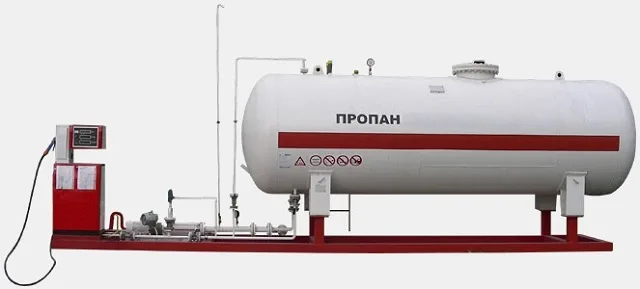
The research process is quite labor-intensive and financially costly, so it was decided to check a number of nationwide gas station networks (OKKO, WOG, BRSM-Nafta), large networks of the capital and the region (KLO, Luxwen), and several “barrels,” i.e., illegal filling stations that stand on every corner. Experts arrived at gas stations and took samples into a special sampler that looks like an ordinary household cylinder. While there were no problems with network stations, all the “barrels” refused to dispense gas when experts stated the purpose of sampling. Eventually, at one of the stations, sampling was carried out, but the sellers did not provide a receipt. This situation alarmed the experts, and, as it turned out, not in vain.
Filling accuracy
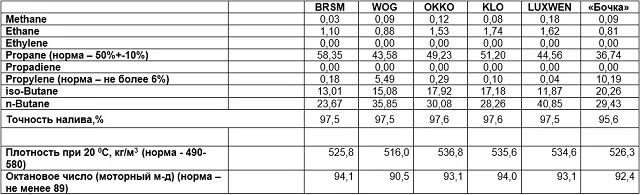
First, the laboratory checked the accuracy of gas dispensing. Many motorists have repeatedly complained that they are filled with more gas than the cylinder capacity, or that they get much less mileage on the same amount of gas purchased at different LPG stations. At the same time, few people pay attention to the temperature regime, blaming the stations for everything. The research data shamed the slanderers – all network stations have filling accuracy above 97 percent. The most accurate are OKKO and KLO. But for “illegals,” the error is much greater. It turns out that the driver gets no savings from a “barrel.” The owner of such an LPG station compensates for the reduced selling price through underfilling. And also fills with unknown substance. More on that below.
Breaking down into components
In the laboratory, samples were tested for compliance with GOST 27578 “Liquefied hydrocarbon gases for motor vehicles” in terms of “Component composition.” As is known, automotive gas consists of a mixture of propane and butane, as well as other hydrocarbons (isobutane, propylene, ethane, ethylene, etc.). For different seasons, the quantitative content of the mixture may differ – in summer it is approximately 40:60 (propane to butane), in winter, on the contrary, 60:40. In the off-season, the optimal proportion is about 50:50. After all, the more propane in the gas, the higher the saturated vapor pressure and the better the starting qualities and operation of fuel equipment in winter operation.
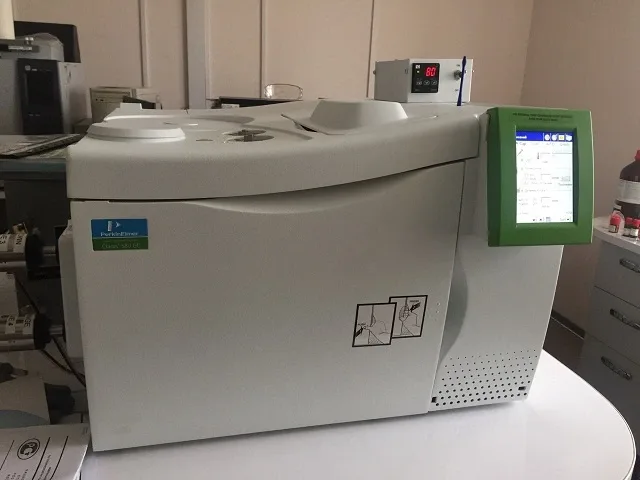
One of the main points is also the grade of liquefied gas. There are two main ones – PBA (automotive propane-butane) and SPTB (technical propane-butane mixture). What is the difference? The first grade is purified gas adapted for use in automobiles; the second is “dirtier,” intended for household needs (e.g., heating). And here unpleasant surprises were found.
The European standard EN 589-2008 in the terms section defines automotive liquefied gas as one that contains a negligible amount of unsaturated hydrocarbons (propylene, butenes, and pentanes (pentenes). In Ukraine, GOST 27578-87 is in force, which sets the permissible norm for unsaturated hydrocarbons – no more than 6%. In the sample taken at an illegal LPG station, there were much more than the norm – over 10 percent! Based on these data, such fuel cannot be classified as automotive. In addition, the gas from the “barrel” also had too little propane – 36 percent with a norm of no less than 50±10%. Based on the above, it can be stated that the tanks of these stations contain SPTB gas, since the content of unsaturated hydrocarbons in it (DSTU 4047-2001) is not regulated. For a car, this is not fatal, but at least the consumption of such gas will be much higher than that of ordinary PBA. There are other nuances. For example, according to the requirements for SPTB, a liquid residue of up to 1.6% is allowed, while for PBA the presence of residue is not allowed. In addition, the permissible maximum sulfur content in PBA is lower than in SPTB (and according to EN 589 requirements – no more than 50 mg/kg). The same applies to mercaptan sulfur.
The presence of liquid residue in SPTB when used in automobiles leads to the accumulation of residue in tanks, clogging of filters, and malfunctions of fuel equipment. The presence of unsaturated hydrocarbons leads to an increase in harmful substances in combustion products. Increased sulfur content leads to a reduction in the service life of catalytic converters and environmental pollution with sulfur oxides. The presence of mercaptan sulfur leads to increased corrosion of fuel equipment parts.
For the other participants in the study, all samples showed positive results, and all of them prove that the sampled fuel is automotive gas of the PBA grade. The sample purchased at the OKKO gas station network showed a near-ideal component ratio for the off-season (samples were taken in October) – 49 propane and 48 butane. This ratio ensures the most uniform combustion of the mixture, and thus economical driving. In second place is the automotive gas of the KLO gas station network, with a ratio of 51:45. By the way, the KLO and Luxwen network samples turned out to be the “cleanest,” with propylene content of 0.10 and 0.04 percent, respectively.
And one more important parameter – gas density. The higher it is, the greater the mileage on a single fill, all other things being equal. In this parameter, the highest indicators were demonstrated by samples from the OKKO and KLO networks.
Conclusions
The study showed that despite the low price, filling up at “barrels” is unprofitable – there will be higher consumption and a risk of damage to car parts. And it must be remembered that in case of trouble at such stations, it will be impossible to prove anything. Moreover, safety there is very conditional.
For large “white” networks, the situation is much better. They are interested not in one-time momentary profit, but in retaining regular customers, so they are not inclined to risk product quality. And at least there you can look at the documentation for liquefied gas to double-check what you are pouring into the cylinder.