Twitter cybersecurity specialist Charlie Miller and Chris Valasek, head of security at IOActive from Seattle, managed to gain control over the electronics of a production Toyota Prius. Shortly before that, they received an $80,000 grant from the Pentagon to study vulnerabilities in automotive electronic systems.
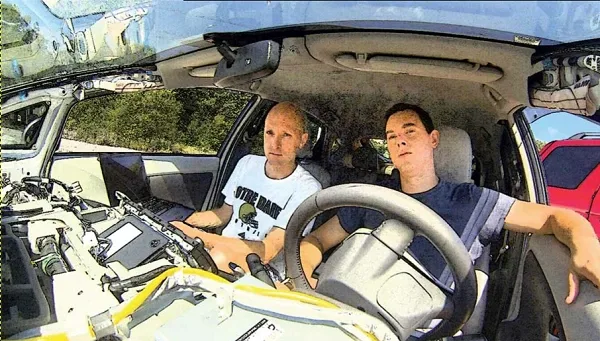
American journalist Andy Greenberg suggested that professional hackers conduct a demonstration experiment. The specialists decided to clearly show how unprotected the electronics of modern cars can be and how little a driver can do in such a situation. The hackers' laptop, which had seen better days, was connected via the Prius diagnostic port located under the handbrake.
The most harmless prank by the specialists was the Prius instrument panel — it displayed whatever the researchers wanted. Of particular interest was the ability to fully intercept control of GPS navigator commands.
The first surprise for the driver was the spontaneous activation of the seatbelt pretensioners and the horn. And when Andy Greenberg lost control over the braking system and steering, he truly felt uneasy behind the wheel.
It's good that all this happened within the framework of an experiment. But now there is no doubt that such an attack can also be carried out remotely — it is enough to add a transmitter and receiver.
Meanwhile, back in 2010, a group of researchers from the University of Washington and the University of California, San Diego, using a production sedan as an example, showed that wireless access to key vehicle systems is quite possible. For this, it was enough to infect the car with a virus via a smartphone, flash drive, audio disc, or unsecured access points.