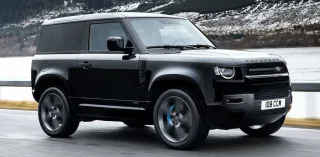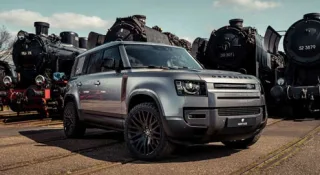
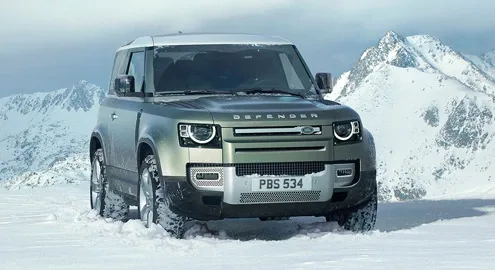
Yes, the frame is gone — the Defender is built on the new aluminum architecture D7x. But the British explained that it is precisely thanks to this solution that the SUV has the strongest body structure of all Land Rover models in history. The torsional rigidity figure has been brought to 29 kNm/degree, which is three times stiffer than frame-based models.
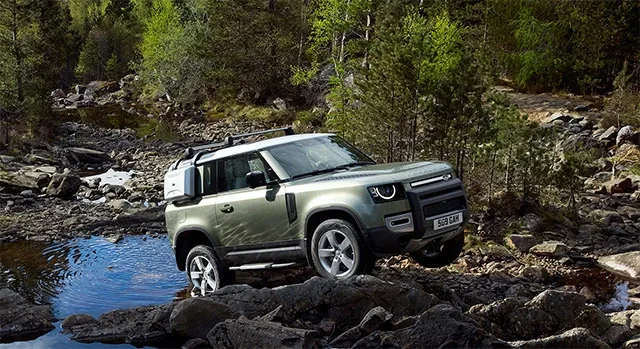
Now the Defender has fully independent suspension, a two-speed transfer case, and permanent all-wheel drive. Ground clearance is a crazy 291 mm. Moreover, Land Rover promised that the new Defender has the best geometric off-road capability in its class: approach, ramp, and departure angles are 38, 28, and 40 degrees, respectively.

For an extra charge, the Defender can be ordered with air suspension: ground clearance can be increased by about another 145 mm, and for passenger boarding and alighting, the vehicle can be lowered.
Like other Land Rover models, the new Defender gets the Terrain Response 2 system — it allows changing transmission, engine, and gearbox settings depending on the surface. There is also an "Auto" mode where the SUV decides what to do itself. By the way, Terrain Response 2 here is supplemented with a new "Wade" mode — the Defender can cross small rivers up to 0.9 m deep and does it almost autonomously.
At launch, the new SUV will be offered in as many as six trims, which has never happened in the model's history: Standard, S, SE, HSE, Defender X, and First Edition. First, the long-wheelbase version with the "110" index will be delivered to dealerships, and a few months later — the three-door "90" version.
The new Defender is the first model of the brand with a new protective coating for the body — Satin Protective Film. This material is based on polyurethane. It is applied to the body, and in case of scratches and other minor damage, the coating has the property of self-healing.
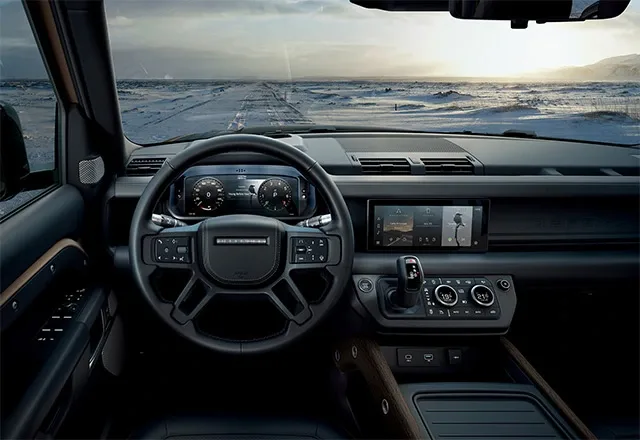
Digital instrument cluster, new Pivi Pro multimedia with a fast Snapdragon processor, 3D navigation, head-up display, cameras in the rearview mirror, and several safety systems — all this is now also available on the Defender. It brakes automatically before obstacles, helps with parking, and can see around corners when reversing out of a parking spot.
The most interesting option, however, is not related to electronics. For the Defender, you can order a third front seat — instead of a wide armrest between the driver and passenger, a folding seat will be installed. That is, the cabin will be not five-, but six-seater. Moreover, the additional seat can be ordered even for the short-wheelbase version of the Defender.
The new model can be ordered in one of four versions. There are two diesel modifications: 200 and 240 hp (2.0 with twin turbo). The least powerful one reaches 100 km/h in 10.3 seconds. The petrol Defender produces 300 hp and accelerates to 100 km/h in 8.1 seconds. Finally, the power of the top hybrid Defender is 400 hp. The most expensive SUV reaches 100 km/h in 6.1 seconds with an average fuel consumption of less than 10 liters.
All engines work in pair with an eight-speed automatic gearbox ZF and a two-speed transfer case. There is no manual transmission in any of the trims anymore.