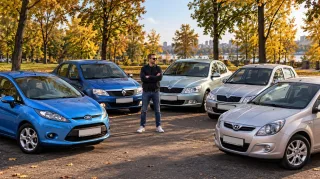
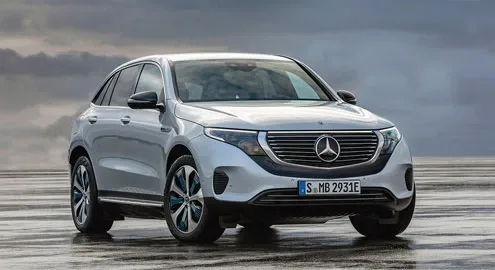
The main competitors of the car will be the Audi E-tron (its debut is scheduled for mid-September), the Jaguar I-Pace, and the Tesla Model X.
Production of the car will be established at a plant in Bremen (Germany). The company promises that the crossover will enter the assembly line as early as next year. Later, production will be launched in China.
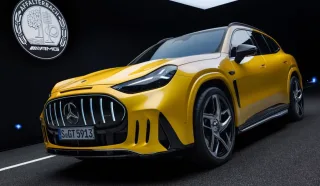
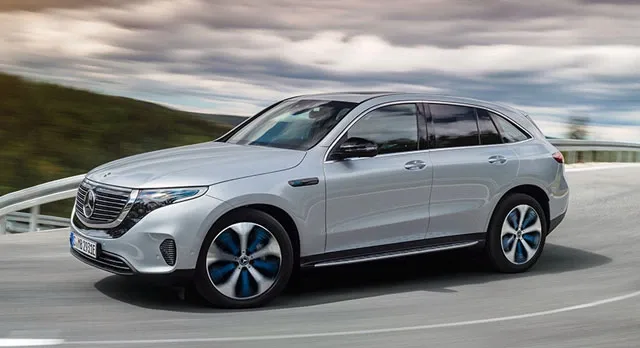
The length of the car is 4761 mm, and the width is 1884 mm. The wheelbase size is 2873 mm. The drag coefficient is less than 0.30. Overall, the production car turned out to be similar to the EQ concept, which was presented at the Paris Motor Show in 2016, and also acquired features of the GLC. The production version of the crossover differs from the concept by traditional side mirrors, which replaced external cameras.
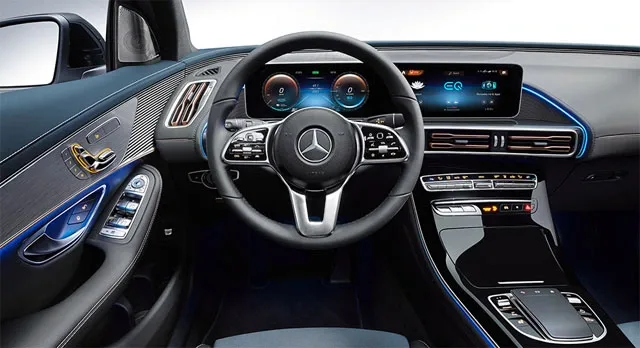
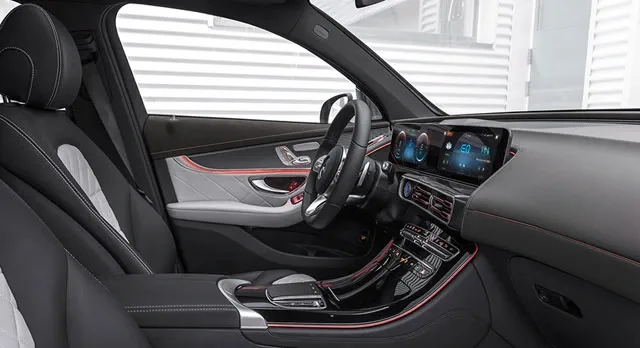
Inside, the new model features a digital instrument panel and a steering wheel with touch-sensitive buttons.
The crossover is built on the newly developed Electric Vehicle Architecture (EVA) platform. The car's construction uses high-strength steel and aluminum. The weight of the new model is 2425 kg.
The EQC is equipped with two electric motors installed on the front and rear axles. The total power of the electric crossover is 408 hp. With this setup, the new model accelerates from 0 to 100 km/h in 5.1 seconds. The top speed is 180 km/h. Without recharging, the car can travel up to 450 km. Additionally, according to the stated characteristics, the EQC is capable of towing up to 1800 kg of cargo.
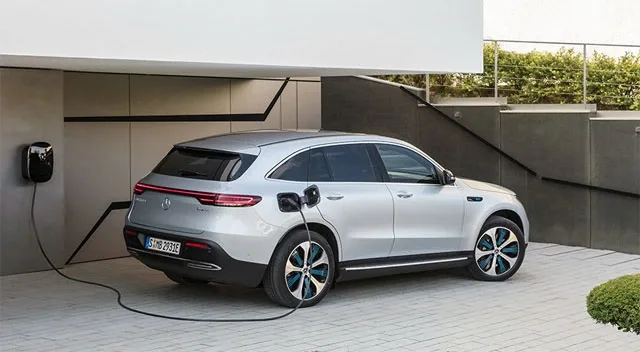
The car's batteries can be recharged to 80% in about 40 minutes. The car is equipped with an energy recuperation system during braking. Customers will have access to numerous assistance systems, as well as the new Mercedes-Benz User Experience (MBUX) multimedia system, which replaced the top-end Comand and already debuted on the A-Class. The artificial intelligence is capable of self-learning and over time will be able to understand even complex commands.