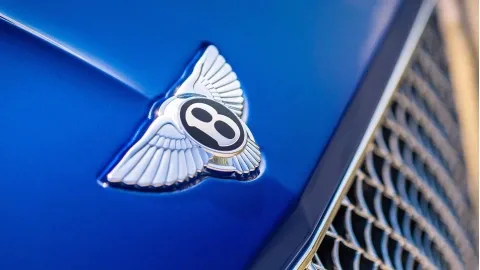
Bentley will launch its first electric model in 2025 and switch to a fully electric lineup by 2030 as part of a new bold business strategy aimed at becoming the "world leader in sustainable luxury mobility."
The British firm, owned by the Volkswagen Group, has committed to phasing out internal combustion engine vehicles over the next decade as a key part of its new Beyond100 plan.
Under this plan, Bentley will step up electrification efforts and reduce the environmental impact of its Crewe factory by 75% compared to 2010 levels within five years.
Bentley boss Adrian Hallmark said: "Since 1919, Bentley has defined luxury cars. Being at the forefront of progress is part of our company. The first Bentley employees were pioneers and leaders. Now, as we look at Beyond100, we will continue to lead by reinventing the company and becoming the world benchmark in luxury car manufacturing."
Speaking about the commitment to switch to a fully electric lineup by 2030, Hallmark added: "This is a profound change for the industry, and we want to lead it. It doesn't scare us, but rather inspires us. The most important thing is not just to produce electric cars: we must produce Bentleys. We must take 100 years of Bentley DNA and put it into a modern context."
By 2030, Bentley's lineup will be fully electric
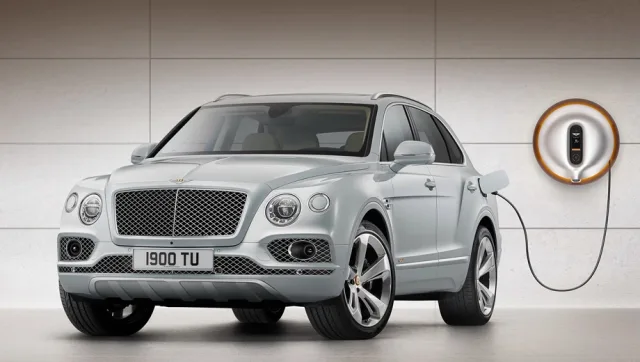
Bentley will launch two new plug-in hybrids in 2021, joining the existing Bentayga Hybrid, as part of a previous commitment to offer a PHEV version of every model by 2023. The Flying Spur PHEV will use the powertrain installed in the Panamera 4 E-Hybrid from sister company Porsche.
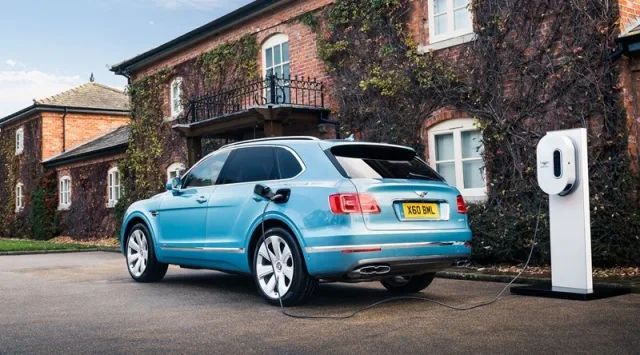
Bentley has committed to offering only plug-in hybrid or fully electric models by 2026, and then gradually phase out its hybrid offerings by 2030 to become a fully electric firm.
The company's first electric car in 2025 will be a high-riding sedan that, like the Jaguar I-Pace, will sit somewhere between an SUV and a traditional car. Technical details have not yet been announced, but during the Beyond100 presentation, Bentley's technical chief Matthias Rabe said it would be built on a "completely new platform." It will likely be a version of the electric-only architecture developed by sister companies Porsche and Audi.
The firm showcased its electric future with last year's EXP 100 GT concept car, which had four electric motors ranging from 800 to 1340 hp, depending on specification, with a 0-100 km/h time of 2.5 seconds.
Bentley claimed a weight of 1900 kg and a range of about 640 kilometers, although both figures were based on clearly optimistic developments in battery technology.
While the company has not yet confirmed how many electric cars it has planned beyond the initial model, Rabe confirmed that the firm is "working on a whole family of electric vehicles."
Restructuring for sustainability
In addition to moving from internal combustion engines to electric motors, the Beyond100 plan also includes a "transformation program" aimed at making Bentley a fully carbon-neutral organization. The firm has already made its Crewe base a carbon-neutral car manufacturing plant, and now it aims for further measures to reduce the environmental impact of its production environment, key parts suppliers, and retailers.
By the end of this year, Bentley will require all suppliers to conduct sustainability audits, and by 2025 it will make its factory plastic-neutral and "climate-friendly" as part of a package of measures to further reduce environmental impact.
The focus on improving the firm's sustainability has been accompanied by a major restructuring of the business. Bentley previously announced that it intended to cut 1000 jobs through a voluntary redundancy program, although that number has been revised to 800 employees, including 200 contractors. According to Bentley, the success of the voluntary scheme means that fewer than 10 employees remain at risk of compulsory redundancy. These measures mean that the firm is on track to achieve positive financial results this year, despite the impact of the coronavirus pandemic.
Educational program
Bentley has also launched a program to develop new skills and "greater diversity of talent," which it says will be necessary to produce future models in the era of electrification. This includes investments in two new research and development buildings, a vehicle testing center, and a launch quality center at the Crewe site, as well as forging closer ties with schools and colleges in the area.
The company has also committed to attracting more diverse candidates for future vacancies and aims for 30% of its management staff to be "truly diverse," up from less than 20% currently. Bentley has also restructured its bespoke division Mulliner, built on three portfolios: Classic, Collections, and Coachbuilt.