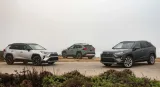
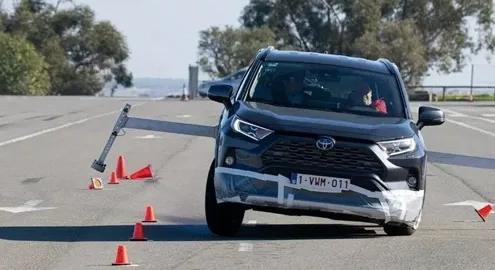
However, this time the Swedes took for testing a car that had an updated version of the electronic stability control (VSC) software, created by the company after the first test failed.
Last year, in autumn, the publication in Teknikens Värld caused a great public outcry: Swedish experts directly advised buyers not to purchase the new hybrid Toyota RAV4. The reason was that the car failed the so-called "moose test." During these tests, it turned out that when performing a sharp maneuver, the stability system activates too late on the car. When the speed exceeded 68 kilometers per hour, the RAV4 lost control: it either leaned onto the outer wheels or was pushed sideways.
Toyota responded to the criticism by stating that the crossover meets all internal standards and successfully passed, including the "moose test." Nevertheless, the automaker met customers halfway and offered a compromise solution — a special optional package that included new settings for the electronic stability control system. In this configuration, the RAV4 system operates in normal mode or activates slightly earlier than usual. The latter option was developed specifically for critical situations, for example, for the same maneuvers that the "moose test" simulates.
It was previously stated that this option would appear on the model around mid-2020, but the car with the recalibrated stability system was received by Swedish journalists already in January. They conducted repeated tests and concluded that the refinement benefited the RAV4: now the crossover holds confidently and does not lose stability even at a speed of 72 kilometers per hour.