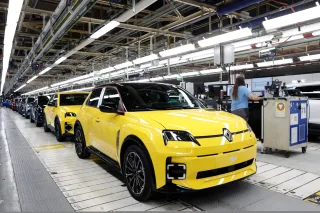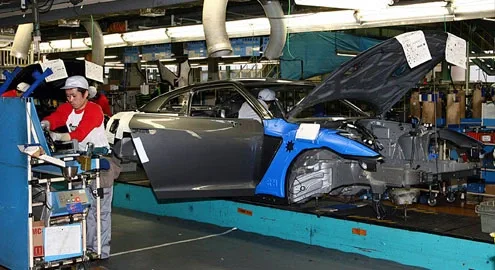
About a third of all cars produced last year came off the assembly lines of Chinese factories — 21,360,193 units. Although passenger car production in China decreased by nine percent, the local automotive industry still confidently holds the title of the largest in the world.
In second place is the Japanese auto industry, which produced 8,328,756 passenger cars. Compared to 2018, production volumes in Japan decreased by only 0.4 percent.
German companies produced 4,661,328 passenger cars, which secured them third place in the global ranking. The German industry lagged behind last year's figure by nine percent.
India, having reduced output by ten percent, managed to hold onto fourth place with a result of 3,623,335 cars, almost closely approaching the achievement of the Korean auto industry.
South Korea, in turn, lost only 1.3 percent of volumes and remained fifth, producing 3,612,587 passenger cars.
It is noteworthy that in the top ten ranking of passenger car producing countries, up to the ninth line, there were no changes in the balance of power compared to 2018.
Thus, the United States retained sixth place — 2,512,780 cars (-9.8%), the Brazilian auto industry remained seventh, increasing output by 2.5% to 2,448,490 units, Spain occupies eighth place — 2,248,019 cars (-1%), and ninth place belongs to France, which produced 1,675,198 cars, which is 5.5% less than a year earlier.
The top ten largest manufacturers of passenger cars at the end of 2019 is closed by the Russian industry: domestic factories assembled 1,523,594 cars, which is 2.6 percent less than the 2018 figure.
Ukraine, whose production capacities are utilized at less than two percent, took the penultimate, 44th position in this global list, producing 6,254 passenger cars and ahead of only Azerbaijan (2,360 cars).