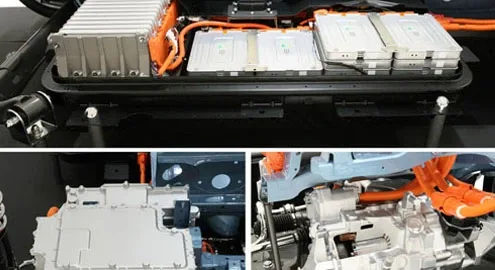
The key problem is a noticeable drop in maximum capacity after just the first year of use.
In early June, several Nissan Leaf owners from the US, without prior coordination, sent complaints to the manufacturer about a decrease in battery capacity. On the dashboard of the Nissan Leaf, on the right side, there is a charge level indicator and a remaining range counter. The indicator scale consists of 12 segments. Car owners reported that the battery now only charges to 11 segments, which also reduced the maximum distance the car can travel without recharging. Simply put, after a year of use, the batteries lost 8.3% of their capacity. The mileage of two such cars is known: one had not reached 22,000 km, the other was about 27,000 km.
The manufacturer did not delay in responding to the first complaints, immediately explaining that the reduction in capacity is considered a "natural part of operation," and therefore there is nothing unusual about it. At the same time, Nissan adds that this process is not uniform, and the most significant deterioration in performance occurs only in the first one to two years of use. According to the company's calculations, after 5 years the battery will retain 80% of its original capacity, and after 10 years - 70%.
There is, of course, nothing yet to confirm these promises: sales of the first Leaf started only about a year ago.
Meanwhile, the number of complaints is increasing, and while initially they came only from one region, now owners from different parts of the US are reporting the same problem. The first five complaints came from residents of Arizona, where the climate is characterized by intense heat. Nissan saw the cause of the malfunction in severe operating conditions, but now, probably, the explanation will have to be changed.
In parallel, the company announced plans to install an improved battery pack on the 2013 Nissan Leaf, which, apparently, will be free of this drawback. In addition, for early production cars whose owners complained about batteries, a solution seems to be being prepared for free replacement with new-type batteries. How much better the new batteries will be than the current ones will likely become clear only in a year.