Inexperienced motorists mainly rely on the size of the wheels. In fact, it is important to pay attention to the markings. How to correctly read the information on the sidewall of a tire? All the details are in today's article.
What you need to know
Owning a car is an opportunity to cover hundreds of kilometers in a short time and not depend on public transport schedules. The best thing you can do to improve safety and comfort while driving is to buy tires from a manufacturer in accordance with the permissible sizes.
The issue of replacing tires sooner or later arises for every car owner. All-season, summer, and winter tires have markings on the side surface. By knowing how to decipher them correctly, a car owner can learn important information about tire size and performance characteristics.
Deciphering tire markings: a brief guide
Tires contribute to effective handling. Installing an unsuitable model can lead to loss of control over the vehicle and, as a result, an accident.
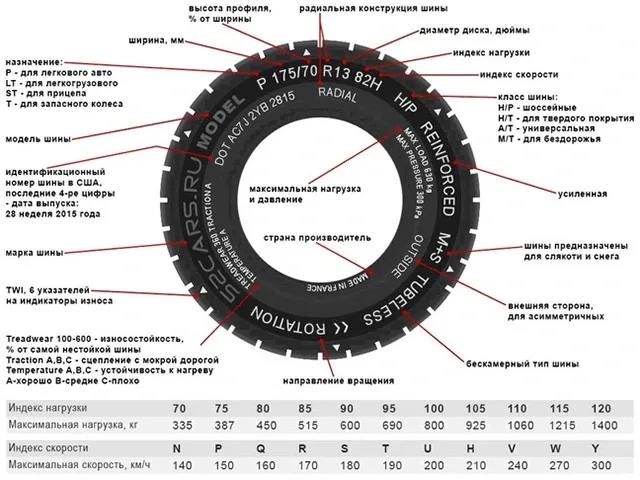
The alphanumeric code on the side of the tire consists of 6 groups of characters. As an example, let's decipher the marking of a European tire 205/55 R16 94V, where:
• 205 — tire width at normal pressure (mm);
• 55 — profile height (%). Wheels with a profile of 50% and above are suitable for driving in the city and on country roads, in other words, for standard operating conditions. Wheels with a profile of less than 50% (sports) contribute to better handling at impressive speeds, but due to the high rigidity of the rubber, bumps on the road are felt;
• R — denotes a radial tire. Such options are characterized by improved balancing and wear resistance due to the radial arrangement of the cord threads. Almost all new tires produced today are radial. If the letter R is absent, then you have a diagonal-type tire;
• 16 — rim diameter (in inches);
• 94 — load index. The number 94 means that the tire can withstand up to 670 kg at normal pressure;
• V — speed index. In this case, you can comfortably drive at speeds up to 240 km/h on these tires.
If there is the inscription XL (Extra Load) and RF (Reinforced), then the tire has increased load capacity. Reinforced tires are designed specifically for transporting goods while maintaining speed characteristics.
In addition to the parameters listed above, additional information is indicated on the sidewall of the tire.
Nuances that should not be missed
Seasonality and coverage are key criteria for choosing tires. The rules are dictated by climatic conditions: in summer, the greatest danger on the road arises from rain, in winter — from snow and ice. Summer and winter tires differ radically in the chemical composition of the rubber and the tread pattern, so they cannot be used year-round. To ensure safe and effective braking, you need to choose tires taking into account the climate of the area.
The following markings may be found on tires:
• AS — for any time of year;
• M+S — all-season or winter tires;
• AGT — all-season tires;
• R+W — for the cold season;
• Frost — for winter;
• AW — for any weather;
• Aquatred — rain tires;
• A/T — for any terrain;
• M/T — for off-road.
Often, manufacturers use corresponding images to indicate seasonality. A snowflake denotes winter tires, and an umbrella mark denotes summer tires effective during rain.
Modern car tires are characterized by technologies that allow avoiding pressure loss due to punctures or cuts. They minimize the risk of emergency situations. The following markings are possible: SSR, MFS, FR, DSST, RunFlat.
Choose tires from "top-tier" manufacturers. For brands with a worldwide reputation, reputation is important, so you can be confident in the quality of the products. In addition, consider the date of manufacture of car tires. It is not recommended to buy tires that have been stored for more than three years.