Specifications
The fourth generation of the South Korean bestseller will be sold with a 1.6-liter 4-cylinder petrol and diesel engine. Some of them are equipped with 48-volt hybrid technology, as well as a 1.6-liter T-GDi hybrid with 227 hp. The turbocharged hybrid version will appear next year, but its specifications have not yet been disclosed.
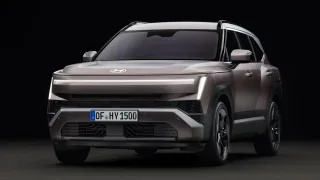
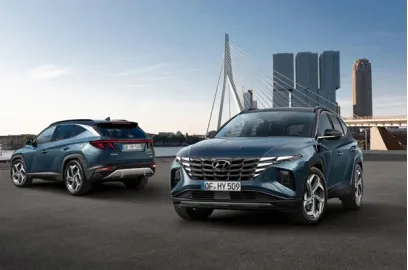
The new Tucson has a bold new front grille with what Hyundai calls "Parametric Hidden Lights". Essentially, the LED headlights and "jewel-like" daytime running lights are integrated into the sides of the grille. In daylight and with the lights off, the headlights are hard to notice. The radiator grille features three-dimensional parametric graphics that are used as backlighting elsewhere on the car.
At 4500 mm long and 1865 mm wide, the Tucson is 20 mm longer and 15 mm wider than its predecessor. The wheelbase of 2680 mm is also increased by 10 mm. Buyers can choose 17", 18" and 19" wheels, as well as two-tone combinations.
Exterior
Eduardo Ramirez, exterior designer at Hyundai Europe, described the new Tucson as "quite bold". He added: "We experiment, we always try to find a very distinctive character in design. Although that doesn't mean we will apply the same formula to every car".
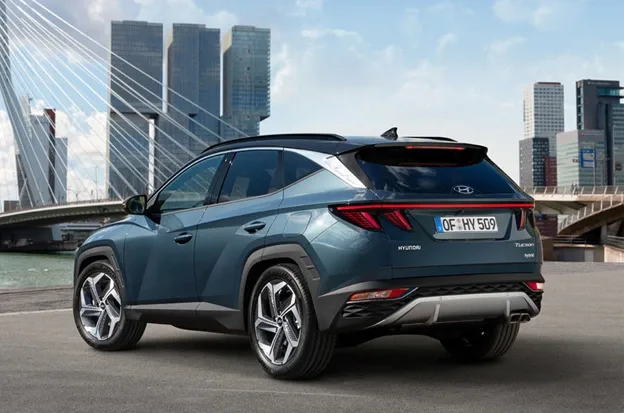
Ramirez continued: "It's always a big challenge to replace a car that has been so successful. We are so proud of the Tucson, but we didn't want to fall into the trap of trying to preserve what we have achieved and not go further. We felt free to innovate, and that's how ideas like hidden headlights came to life".
Interior
The interior also marks a radical departure from previous Hyundai models, with a minimalist, "layered" design. Hyundai introduced a new "multi-air mode" technology that combines direct and indirect vents to reduce occupied space and provide a softer airflow.
Most of the physical controls have been removed, and control of the infotainment and heating system is available through a 10.25-inch vertically mounted touchscreen. There is also a digital instrument cluster, customizable ambient lighting, and a wireless smartphone charger.
The infotainment system uses the latest version of Hyundai's Bluelink system, including a range of connected car features such as Last Mile Navigation, which allows owners to switch route navigation to their smartphone if they park near their destination.
Hyundai says it has increased rear legroom. All models have the same interior dimensions, with batteries in hybrid variants mounted under the rear seats.
Other features and technologies
The manufacturer has also added a number of new safety and driver assistance features, including a central airbag and remote parking on hybrid and PHEV models.
Engines are offered as mild-hybrid petrol with 148 hp or 178 hp, and diesel with 134 hp. The car has a 6-speed manual or 7-speed automatic. The non-electrified 148-hp petrol and 113-hp diesel will be offered with a 6-speed manual or 7-speed gearbox. All-wheel drive is an option on most transmissions.
Hyundai has also worked on improving the ride and handling of the Tucson. Vehicle dynamics engineer Julio Varela said the focus was on making it "more comfortable and enjoyable to drive". This is the first Hyundai outside the N model range to be offered with an electronically controlled suspension that includes normal, eco, and sport driving modes. There are three additional off-road modes on all-wheel-drive variants.
Price
European versions of the new Tucson will be built in the Czech Republic. Like the PHEV model, the N-Line version should appear next year. Pricing has not yet been confirmed, but a slight increase over the original model is expected. Surely, the price will start from $30,000 for the base trim.