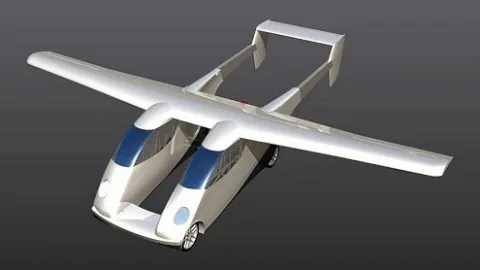
They promise that the first flights will take place this summer. The new product has an original twin-fuselage design. This information was reported by our colleagues from Aviation Week.
This architecture should provide the machine with good controllability when moving on the ground. And the folding wings can be stored in the space between the two fuselages. This will minimize the occurrence of lift when driving on highways. The likelihood of strong crosswind impact is also reduced.
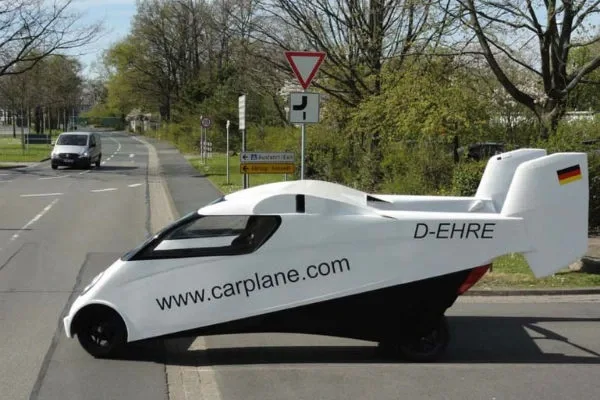
The car uses full-fledged 15-inch road wheels, exactly the same as those of Smart.
The prototype's power unit has a gasoline turbocharged two-cylinder engine with a displacement of 850 cubic centimeters and a power of 151 hp. The engine transmits torque to the wheels through a seven-speed transmission.
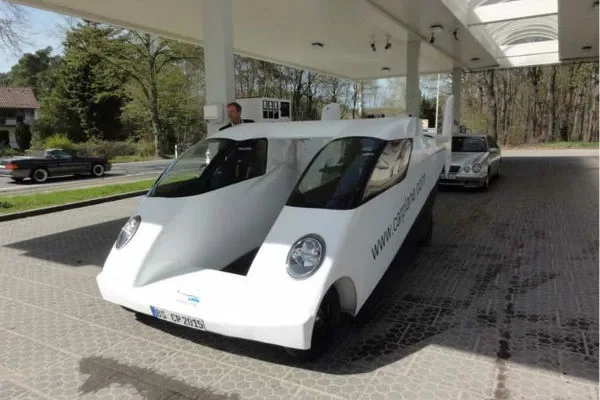
But not all seven gears are used specifically for driving the wheels. Five gears are needed for movement (four forward and one reverse) on the ground, the sixth transmits torque to the propeller, and the seventh simultaneously drives the propeller and wheels. This is needed for a quick takeoff. The length of the takeoff strip must be at least 80 meters.
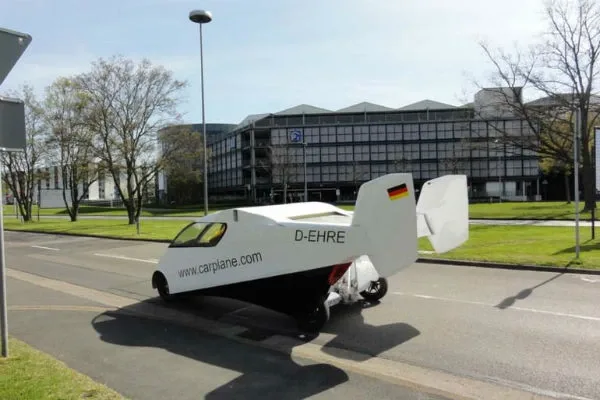
In the publication Gizmag, data is clarified that the flight range of the flying car is about 800 kilometers, and the practical ceiling is 4570 meters. The estimated cruising speed is 200 km/h, on the ground the "maximum speed" will be 176 km/h.
For now, the wings have to be folded manually, but soon a mechanism will appear that does this automatically.

Let us remind you that the development of such a car is financed by the European Union and the government of Lower Saxony. According to engineers' calculations, the working version will be ready by July. Then work will begin on certifying the car and attracting private investors.