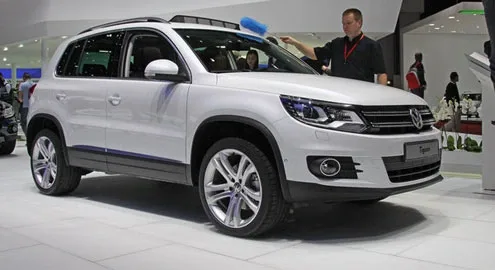
The image change can be considered expected. The previous unpretentious appearance of the compact crossover did not suit everyone. The updated version has become noticeably closer to the older Touareg — both in the front and rear. LED elements resembling "garlands" were added to the headlights.
In essence, the Germans prepared two restyling options. The key feature of the Tiguan remains — the buyer can choose "off-road" bumpers (Track&Field) with more restrained contours or "asphalt" ones (Sport&Style), the lower edge of which is lowered closer to the ground.
In the interior, the changes are much more modest. If the current Golf and Jetta have acquired new interiors, the Tiguan continues to rely on the design of the already aging Golf Plus, built on the platform of the previous Golf. Among the noticeable innovations — only a fresh steering wheel.
It remains a mystery whether the engine lineup will be updated on our market (currently three engines with power from 140 to 170 hp are available for the Tiguan), while in Europe the range of units will be revised. The assortment will include four petrol engines from 122 to 210 hp and three diesel engines — from 110 to 170 hp. A seven-speed robotic gearbox GSG will be offered optionally.
Abroad, the Tiguan is experiencing a peak in demand. Over three and a half years of production, the total circulation has exceeded the half-million mark. However, in our market, even despite assembly in Russia, the Tiguan can hardly be called a budget option. Therefore, in terms of sales volumes, it is surpassed by the imported Toyota RAV4 and Suzuki Grand Vitara.