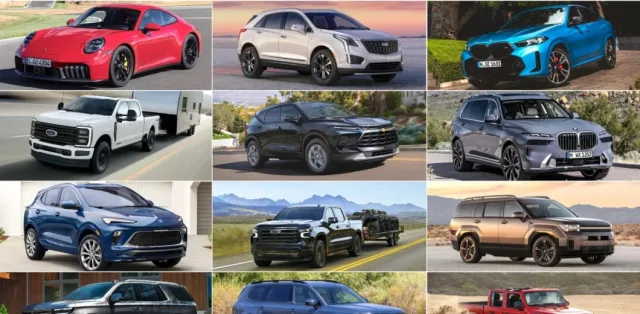
Survey participants were asked questions about various aspects of car usage: from engine and transmission operation to infotainment systems, interior, and overall ownership experience. The results are presented using the Problems Per 100 Vehicles (PP100) index, i.e., the number of problems per hundred cars, where a lower score indicates higher reliability.
Leaders of the reliability rating
Among luxury brands, Lexus showed the best result with 166 PP100. Next came Jaguar (175 PP100) and Genesis (183 PP100). In the mass-market segment, Nissan took the lead with 169 PP100, followed by Hyundai (173 PP100) and Chevrolet (178 PP100).
The full list of the most reliable brands looks like this:
-
Lexus — 166 PP100
-
Nissan — 169 PP100
-
Hyundai — 173 PP100
-
Jaguar — 175 PP100
-
Chevrolet — 178 PP100
-
Honda — 179 PP100
-
Dodge — 180 PP100
-
Kia — 181 PP100
-
Buick — 183 PP100
-
Genesis — 183 PP100
-
Jeep — 186 PP100
-
Subaru — 187 PP100
-
Porsche — 188 PP100
Models and manufacturers that received awards
General Motors collected the most awards among individual models — five cars were recognized for high quality, including Buick Encore GX, Cadillac XT5, Chevrolet Blazer, Silverado, and Tahoe. Next is Ford Motor Company with four awards, including Ford Escape, F-150, Mustang, and Super Duty. Honda Motor Company has three awards, including Acura Integra, Acura RDX, and Honda Odyssey.
The best result among all participants was achieved by the Porsche 911 Carrera GTS — only 116 PP100, making this model the most reliable in the study.
Achievements of manufacturing plants
As part of the study, factories were also evaluated: the platinum award went to BMW AG's Austrian plant in Graz, where the BMW Z4 is produced. Among regional winners are Toyota's Canadian plants (producing Lexus RX) and American ones (Lexus ES), as well as Toyota's Tahara Lexus plant in Japan, which assembles the Lexus IS, LS, and NX.
Key findings of the study
-
Premium cars more often have problems than mass-market ones. This is especially noticeable in exterior quality: luxury models have on average 4.2 more problems per 100 cars.
-
Plug-in hybrids (PHEVs) turned out to be the most problematic: they have 237 problems per 100 cars, which is even more than pure electric vehicles (BEVs) with 212 PP100. The best indicators are for gasoline engines (184 PP100) and conventional hybrids (196 PP100). Tesla significantly improved its result, reducing the number of problems by 62 points.
-
New models have more shortcomings than refreshed ones: 2025 cars scored 203 PP100 — the highest level since 2020. Models with minor updates have 190 PP100. Of the 18 new cars, only two showed quality better than average.
-
Cup holders continue to cause complaints due to unusual shapes and sizes of reusable bottles and cups that are difficult to place.
-
Large touchscreens in cars are often criticized for being difficult to use and distracting the driver, as you have to go through several menus for basic functions. Experts advise leaving physical buttons for main options — this will improve safety and convenience.
Luxury brands and their reliability
Although premium brands are usually associated with high quality, not all of them show good results. For example, Audi ended up at the bottom of the rating with 269 PP100, and Volvo also placed near the bottom — 258 PP100. Infiniti, Nissan's luxury division, also has a high level of problems — 242 PP100.
Among mass-market brands, Nissan became one of the most reliable, while premium brands often have more defects. Overall, the market average in 2025 is 192 problems per 100 cars, which is slightly better than the 2024 figure (194 PP100).