
These are mostly semi-legal or outright illegal enterprises with a minimal level of oil refining, which in Ukraine have already been dubbed "samovars". It was they who, until recently, flooded the market with low-grade fuel. How did this affect the quality of gasoline in general? Specialists from the Institute of Consumer Expertise dealt with this issue.
For the analysis, researchers purchased samples of A-95 gasoline from the largest national chains (WOG, SOCAR, OKKO, ANP, PRIME, AVIAS, MARSHALL, AMIC, SHELL), as well as from prominent regional operators (Kyiv's KLO and AVANTAGE 7, Zaporizhzhia's ZOG and PARALLEL, Poltava's BVS, Dnipro's NEFTEK, Kharkiv's OVIS, as well as the CHIPO and U.GO chains). They did not ignore small chains operating in district centers and small towns (24/7, KRAFT, LN ENERGY, DNIPRO OIL GROUP). They also separately checked the "premium" varieties of A-95 in large chains: SOCAR NANO, WOG MUSTANG, OKKO PULLS, KLO VENTUS, SHELL V-POWER.
The laboratory results were divided by experts into three categories – green, blue, and red. In the first category were chains whose indicators met Euro-5 standards. In the blue category were samples without violations, but without a margin of safety, i.e., close to the maximum permissible values. The red category consisted of chains whose fuel did not meet the requirements of the relevant DSTU. The samples were analyzed according to key parameters: octane number, sulfur content, volume fraction of aromatic hydrocarbons and benzene.
Green zone (premium A-95). In this category, there were no surprises, as befits high-class fuel. All samples received an "excellent" rating. Specialists recorded a minimum sulfur content in SOCAR NANO – only 3 mg/kg. WOG MUSTANG demonstrated the largest margin in octane number (96.7 units), and the lowest benzene level was found in OKKO PULLS (0.42%).
Green zone (regular A-95).
In the green zone, as many as 9 chains became leaders – this is the best indicator in recent years of research. They included WOG, SOCAR, OKKO, KLO, PRIME, AVANTAGE 7, CHIPO, ZOG, and OVIS. The parameters of gasoline from these chains significantly exceeded the requirements of DSTU. First, they checked the octane number – the main indicator for engine operation. The norm requires at least 95 units. The highest values were recorded in WOG (97.6 units) and SOCAR (97.5). Next come OKKO (96.6) and PRIME (96.5). In KLO, CHIPO, ZOG, and OVIS, this indicator also exceeded 96 units. With such characteristics, the engine operates more efficiently, and fuel consumption decreases. Then they measured the sulfur content – an important indicator of engine durability and its service life. The lowest values were found in gasoline from SOCAR, ZOG, and AVANTAGE 7 – 6 mg/kg each. This is significantly lower than the permissible Euro-5 standards. As for aromatic hydrocarbons, all samples fit within the norm, with the best results in OKKO (24.6%) and CHIPO (24.5%). Finally, they checked the benzene content. This toxic substance should be minimal, because its excess destroys the catalyst, can reduce engine life several times, and increases the risk of oncological diseases in pedestrians. The cleanest gasoline was found in KLO (0.38% with a norm of up to 1%), OKKO and WOG (0.40% each). Overall, the results of the green zone indicate that this is a high-quality product from European plants with deep oil refining.
Blue zone
A significant part of gas stations, mainly the so-called discounters, fell into the blue zone. These chains usually keep prices lower than market leaders. A-95 gasoline from BVS, MARSHALL, AMIC, SHELL, NEFTEK, PARALLEL met the Euro-5 standard, but its indicators were close to the limit values. A notable feature: chains that were previously consistently in the red zone moved to this group. A coincidence? Experts are sure that no, and the explanation for this transformation is given below.
Red zone
This time, the red zone mostly included small regional chains and single stations operating in small towns and villages. The only exceptions are the national ANP and AVIAS, but these companies have also suffered from instability before, so such results were not a surprise. The octane number turned out to be significantly below the norm in only one sample – from the 24/7 gas station in the Dnipropetrovsk region, where it was 92 units. This is a clear sign of artisanal fuel production. But the sulfur content, harmful to the environment and air, was exceeded by 35 times at the KRAFT gas station (352 mg/kg with a norm of no more than 10). However, this turned out to be only a weak echo of the real "record holders": in the DNIPRO OIL GROUP sample, sulfur was 70 times higher than the norm – 706 mg/kg. This is already beyond common sense. The volume fraction of toxic benzene in these samples was also off the charts. At the KRAFT gas station, it was found almost four times higher than the norm (3.82%), and in DNIPRO OIL GROUP – more than seven times! Let us remind you that this dangerous compound causes the formation of carbon deposits and engine overheating. With such a level of benzene, health problems for drivers and pedestrians are practically inevitable, as is a practically guaranteed car breakdown.
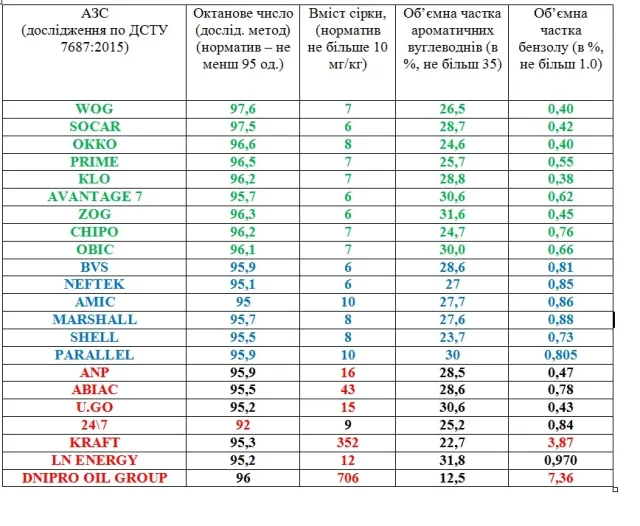
Summarizing, the study revealed several important trends. First, the volume of adulterated fuel on the market has significantly decreased. Experts directly associate this with a reduction in the number of artisanal productions – the so-called mini-refineries. The largest of them were destroyed by Russian strikes, others reduced volumes due to difficulties with raw materials and logistics. That is why many chains from the red zone moved to the blue zone – now they have to trade imported fuel. And the rest of the artisanal fuel has settled mainly in small regional chains, since they do not need large volumes. Therefore, experts advise drivers from small towns and villages to drive an extra few dozen kilometers to a large gas station to avoid problems.
Vadym Kryvenko