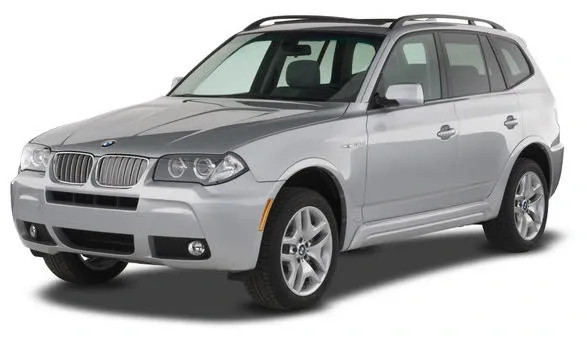
BMW X3: prices and specifications
5 generations Country of origin: Germany

The BMW X3 became the second crossover in the Bavarian brand's lineup after the larger X5. The letter "X" in the name indicates its crossover class, while the number "3" means the model belongs to the European D-segment.
First generation
Inspired by the success of the X5 and the growing popularity of crossovers worldwide, BMW decided to release a more compact model. The Austrian company Magna Steyr was brought in for development, and the first generation X3 was subsequently produced at its facilities. Additionally, assembly of this version was established in Russia. A prototype called xActivity was shown in 2003 at the Detroit Auto Show. In the fall of the same year, the production version was presented at the Frankfurt Motor Show. The car was based on a modified platform of the "fourth" 3 Series. With smaller body dimensions than the X5, it retained similar off-road capabilities. In 2005, the model was updated: engines and transmissions were revised, and the suspension was retuned to be softer. In 2007, a facelift was carried out — the car received a new grille, different front and rear bumpers, updated headlights and taillights, as well as a revised interior.
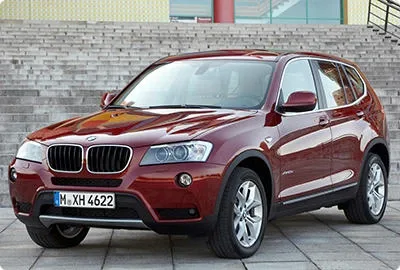
Second generation (F 25)
In 2010, the second and currently last generation of the BMW X3 with the index F 25 was introduced. The car became larger and moved to a new "F" platform. Production was moved from Germany and Austria to the USA, where the X5 and X6 were already being produced. Also, CKD assembly of the X3 was organized in India.
In Ukraine, sales of the second generation started in 2011. The car is offered with three gasoline engines (2.0 and 3.0 liters) and three diesel engines (2.0 and 3.0 liters). They are paired with a six-speed manual or an eight-speed automatic transmission. Drive is all-wheel drive.