Tire Types
Almost all modern tires for passenger cars are tubeless (no inner tube inside) and have a radial carcass construction.
In a radial tire, the carcass cords are placed parallel to each other, unlike the diagonal design where they intersect.
The tread pattern can be directional, non-directional, or asymmetric.
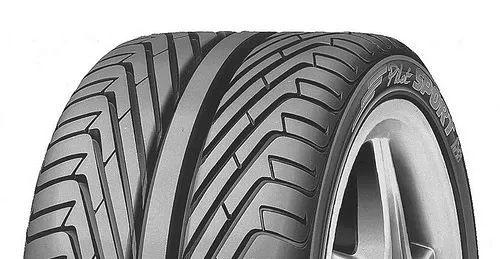
A directional tread effectively evacuates water from the contact patch of the wheel with the road, which significantly reduces the risk of aquaplaning — the tire floating on a water film.
Tires with a directional tread always have a mark in the form of an arrow and the inscription Rotation, indicating the correct direction of rotation. Such wheels cannot be swapped between the right and left sides of the car without remounting. If installed incorrectly, the car will start to "float" even at low speed in rainy weather.
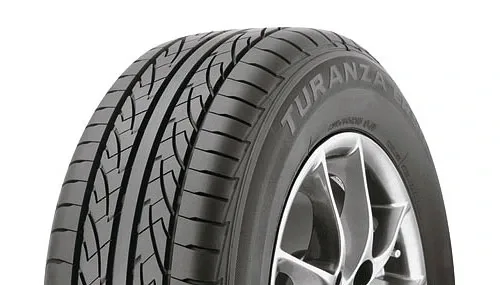
A non-directional tread is considered universal and does not require special mounting. Such tires are usually the cheapest and, due to their versatility, are often installed directly on the factory assembly line.
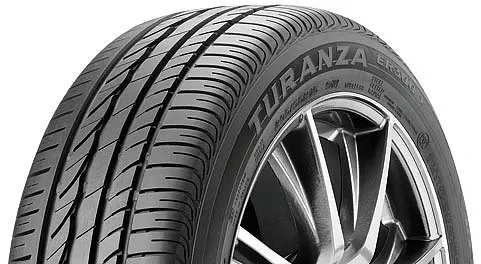
Asymmetric tires are divided into two zones with different tread patterns: one part is "rain," the other is "dry." The sidewalls of such tires have different stiffness. Since the outer side experiences increased loads (especially in corners), the difference in stiffness helps the asymmetric tire hold the road more confidently.
Such rubber necessarily has the designations Outside and Inside (or Side Facing Out and Side Facing Inwards), indicating which side is outer and which is inner. After correct installation, only the inscription Outside or Side Facing Out is visible from the outside. Asymmetric tires can have both directional and non-directional treads.
Low-Profile Tires
Motorists who prefer an aggressive driving style often choose low-profile tires. In such tires, the ratio of profile height to width (series) is no more than 55% (for example, 195/55, 205/50, 225/45).
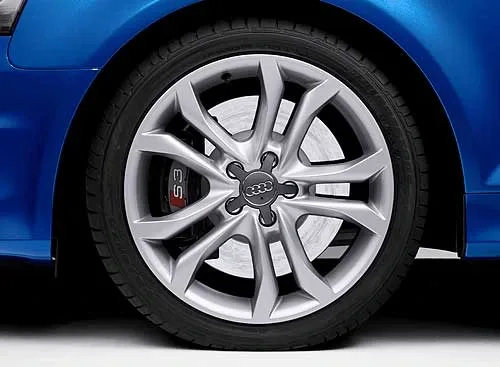
A low profile improves handling due to better road grip. It allows reducing the braking distance and accelerates acceleration. However, you have to pay for this with increased noise, stiffness, and a greater tendency to aquaplaning.
In addition, such rubber requires a smooth surface: when hitting potholes or unevenness, the risk of damaging the wheel increases. It is worth avoiding high curbs and off-road conditions on such tires.
Run-Flat Tires
The number of cars equipped with Run Flat (Run on Flat) tires is growing every year. The Run Flat technology allows driving 100–150 km on a punctured wheel at speeds up to 80 km/h. Such tires use a reinforced sidewall that prevents the tire from collapsing even with a complete loss of pressure.
The BMW Group is the most active in implementing this technology, installing such tires as standard equipment on most of its models, including MINI cars.
Off-Road Tires
Enthusiasts of regular trips on serious off-road terrain usually choose special off-road tires. They are distinguished by a high profile and a deep, sparse tread pattern. This helps the tire grip the ground and confidently overcome climbs.
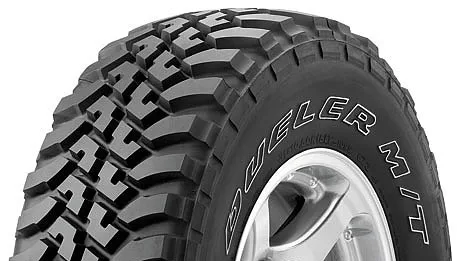
However, on a smooth highway at high speed, such tires feel uncertain: the deep tread holds the road worse and wears out quickly. The braking distance also increases significantly.
Seasonal Tires
One of the main differences between tires is their seasonality.
Tires are divided by season into summer, winter, and all-season. Just as we don't wear sandals in winter and boots in summer, a car should not drive on summer tires in winter and vice versa. It is worth remembering: in winter, a car will behave better even on inexpensive winter tires than on the most expensive summer ones.
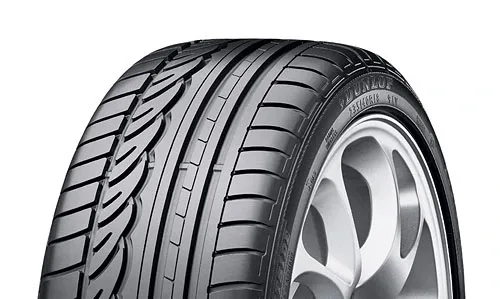
The main task of a summer tire is to provide maximum grip with the road and, accordingly, safety. Such tires have a high speed index and are characterized by good wear resistance. But when the air temperature drops below 7 degrees, summer rubber begins to "harden" and loses its grip properties. This leads to a noticeable increase in braking distance and deterioration of handling. And here winter tires come to the rescue.
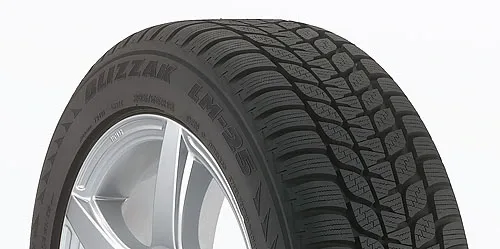
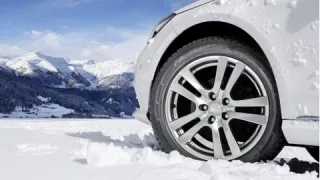
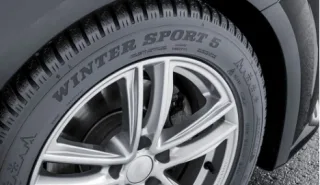
Winter rubber is made from a softer compound and does not harden in frost. The tread of a winter tire is noticeably softer to the touch than a summer one. The key feature of a winter tire is the large number of sipes, i.e., narrow slits in the tread pattern. Thanks to them, the wheel maintains contact with the road even on snow and ice. But on dry asphalt at temperatures above 9 degrees, winter rubber begins to wear out quickly. Therefore, in spring, you should not delay changing to summer tires.
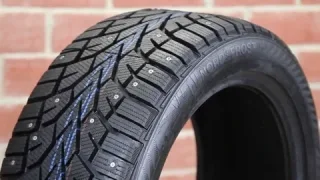
There are also studded winter tires for harsh winters. However, they should only be used in truly difficult conditions. In many European countries, studs are prohibited because they damage the road surface. Moreover, modern expensive winter tires cope well with snow even without studs. In Ukraine, it makes sense to install studded tires only for those who drive to snowy regions with uncleared roads, for example, to the Carpathians.
On particularly difficult snowy sections, snow chains can come to the aid of winter tires, which are worth carrying with you when traveling to the same Carpathians. Chains are put on the wheels only to overcome a difficult section at low speed (up to 40 km/h).
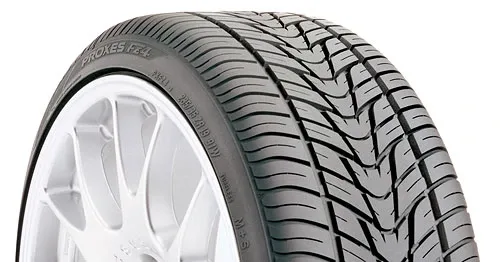
All-season tires are a compromise for countries with mild winters. Roughly speaking, such a tire has one half of the tread winter and the other summer. In terms of their characteristics, they are inferior to both summer and winter tires.
Marking
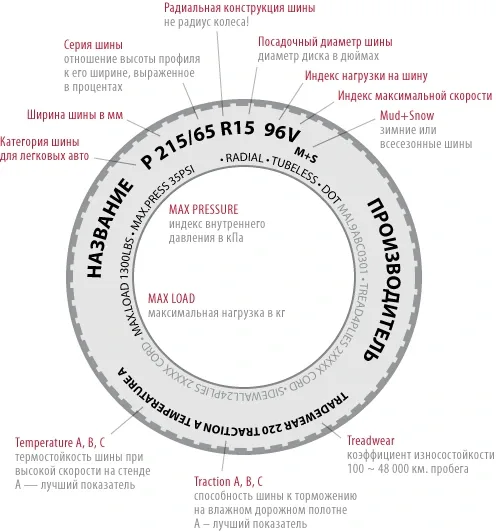
P195/55 R15 84 H — tire size
P — tire category for passenger cars.
195 — tire width in millimeters.
55 — series, i.e., the ratio of profile height to width as a percentage.
R — radial construction (and not the wheel radius at all!).
15 — rim diameter (R15 wheel diameter).
84 — load index, a conventional designation corresponding to a certain maximum load in kilograms. See the table:
| 60.......250 | 74.......375 | 88........560 | 102........850 | 116.......1250 |
| 61.......257 | 75.......387 | 89........580 | 103........875 | 117.......1285 |
| 62.......265 | 76.......400 | 90........600 | 104........900 | 118.......1320 |
| 63.......272 | 77.......412 | 91........61 | 105........925 | 119.......1360 |
| 64.......280 | 78.......425 | 92........630 | 106........950 | 120.......1400 |
| 65.......290 | 79.......437 | 93........650 | 107........975 | 121.......1450 |
| 66.......300 | 80.......450 | 94........670 | 108.......1000 | 123.......1500 |
| 67.......307 | 81.......462 | 95........690 | 109.......1030 | 124.......1550 |
| 68.......315 | 82.......475 | 96........710 | 110.......1060 | 125.......1600 |
| 69.......325 | 83.......487 | 97........730 | 111.......1090 | 126.......1650 |
| 70.......335 | 84.......500 | 98........750 | 112.......1120 | 127.......1700 |
| 71.......345 | 85.......515 | 99........775 | 113.......1150 | 128.......1750 |
| 72.......355 | 86.......530 | 100.......800 | 114.......1180 | 129.......1800 |
| 73.......365 | 87.......545 | 101.......825 | 115.......1215 | 130.......1850 |
H — maximum speed index, a conventional designation corresponding to a certain maximum speed. See the table:
| N...140 | U...200 |
| P...150 | H...210 |
| Q...160 | V...240 |
| R...170 | W...270 |
| S...180 | Y...300 |
| T...190 | ZR...over 240 |
Tire model — for example, Pilot, Potenza.
Brand — Toyo, Dunlop.
Trademark of the manufacturer.
Name of the country of manufacture.
Date of manufacture — four digits in an oval: the first two are the week of manufacture, the next two are the year (1808 means April 2008).
Conventional symbols on tires:
MAX PRESSURE — maximum permissible internal pressure in the tire, in kPa.
MAX LOAD — maximum load in kilograms.
REINFORCED — reinforced tire with increased load capacity.
TUBE TYRE — tube-type tire.
TUBELESS — tubeless tire.
REGROOVABLE — possibility of deepening the tread pattern by cutting.
ALL STEEL — tire with steel cord breaker and carcass.
RADIAL — radial tire.
E — sign of official approval of the certificate of conformity to UNECE regulations.
TWI, DSI or another symbol indicating the location of wear indicators.
M&S (Mud + Snow) — winter or all-season tires.
All Season — all-season tire for year-round use.
Rotation — directional tire, the direction of rotation is indicated by an arrow (do not confuse this arrow with the logo on Dunlop tires).
Outside and Inside (or Side Facing Out and Side Facing Inwards) — asymmetric tires, when installing which it is necessary to strictly follow the mounting rules on the wheel.
Left or Right — tires of this model are left and right. They must be installed strictly on the corresponding side of the car: left ones on the left, right ones on the right.
RAIN, WATER, AQUA (or the "umbrella" symbol) — tires specially designed for rainy weather, with a high degree of protection against aquaplaning.
E (in a circle) — the tire meets European ECE (Economic Commission for Europe) requirements.
DOT — compliance with US safety standards.
Temperature A, B, C — heat resistance of the tire at high speed on a test bench (A is the best indicator).
Traction A, B, C — the tire's ability to brake on a wet road (A is the best indicator).
Treadwear — wear resistance coefficient (a value of 100 approximately corresponds to 48 thousand kilometers of mileage).
Operation and Storage of Tires
It is important to monitor the internal pressure in the tires and check it every two weeks. The norm should match the recommendations in the vehicle's operating manual; it is often duplicated on the inside of the fuel filler flap. Pressure should be measured only on a "cold" tire, i.e., before starting a trip, not after.
It is also worth inspecting the external condition of the tire: there should be no cuts, hernias, or cracks on the sidewall. It is necessary to control the tread depth — according to traffic regulations, it should not be less than 1.6 mm. However, it is better to change tires already when worn to 2 mm, and winter tires at 4 mm.
Each tire has a wear indicator — a bridge between the tread grooves or numbers showing the remaining depth in millimeters. The location of the indicator is indicated by the symbols "TWI" or "DSI". On Michelin, the indicator is indicated by the brand emblem (Bibendum) or a snowflake on winter tires.
Tires should be stored in a cool (from 10 to 25 degrees), dry, and dark room. There should be no gasoline or other chemicals nearby. After removing the wheels, it is worth marking where each one was (front right, rear left) so that later each can be returned to its place.
Tires without wheels are stored only vertically; they cannot be stacked on top of each other or hung. About once a month, the tires should be slightly rotated so that the load point does not remain constant.
Tires on wheels, on the contrary, should be stored in a suspended or horizontal (lying) position — they cannot be placed vertically.
The ideal option is to give the tires for seasonal storage to a specialized company. There they will be in an equipped room and stored according to all the rules. This is convenient and practical.
A Difficult Choice
Tire technologies are constantly evolving. Even ten years ago, it was hard to imagine that you could calmly continue driving on a completely punctured tire without significantly reducing speed. Or that on non-studded winter tires you could drive quite confidently on snow and ice.
A tire is not just a piece of rubber on a wheel. It is a high-tech product on which the quality of your life may depend.
The choice of new tires for a car should be approached carefully — fortunately, today there is plenty to choose from. Follow the installation and operation rules, do not neglect seasonal changes — and the wheels will hold the road with all their might.
Andrey Ivanenko