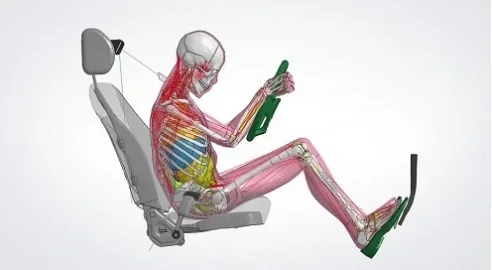
Toyota representatives claim that their new-generation dummy can replicate the poses taken by drivers and passengers who have realized the inevitability of a collision. They note that in such a situation, half of drivers begin to brake and steer the car to the side, while most passengers try to brace themselves for protection. A person's particular pose significantly affects the movement of the body inside the vehicle during a crash, which fundamentally influences the nature and severity of injuries.
Interestingly, the body model is designed down to the smallest detail. The developers have digitized bones, skin, internal organs, and even the brain. Among other things, the program provides a detailed analysis of all possible injuries that may occur in an accident.
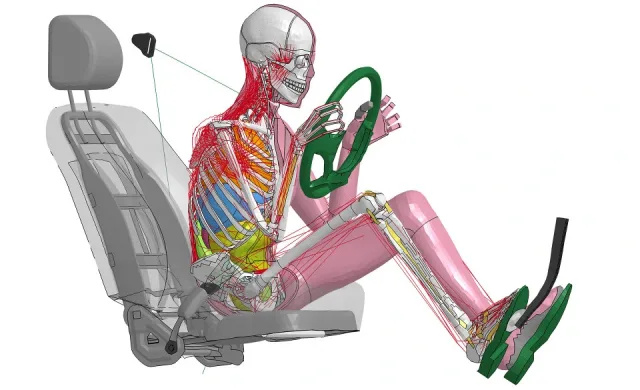
By the way, Toyota has been developing this project, called THUMS (Total Human Model for Safety), since 1997. Now it has shown the fifth generation of this virtual system. The previous program (from 2010) could simulate the poses of people in a vehicle after an accident. The new one can model the reflexive behavior of the driver and passengers in the moment before an inevitable collision.