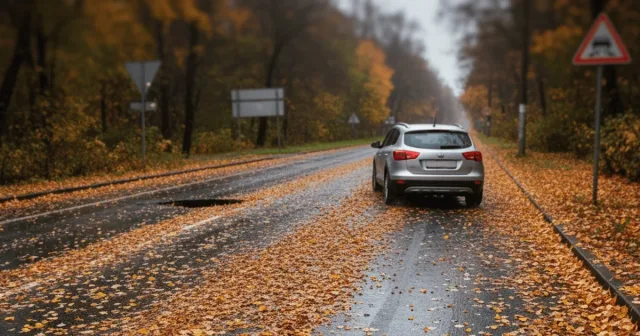
In autumn, fallen leaves on the road can pose a serious danger to drivers. After rain, they form a slippery layer that worsens tire grip on the asphalt. Areas under trees, where leaves accumulate after precipitation, are especially dangerous.
Autoportal experts warn that wet leaves, compacted by car wheels, can create a surface with grip similar to ice. In addition, potholes and road unevenness often remain unnoticed under the leaves.
Wet leaves on the road: 5 rules for safe driving
To reduce the risk of the car skidding, drivers are advised to change speed and driving style on slippery sections.
1. Reduce speed in advance. Before sections covered with leaves, you should smoothly slow down the car. Lower speed leaves more time to react to danger.
2. Avoid sudden braking. On a slippery surface, the wheels can lose grip with the road. It is better to brake early, without sharply pressing the pedal.
3. Turn the steering wheel smoothly. A sharp change of direction can provoke a skid. You need to take turns especially carefully on shaded sections of the road.
4. Do not accelerate sharply. Excessive traction on a slippery surface can cause the drive wheels to spin. You need to press the accelerator gradually.
5. Increase the distance. Wet leaves can lengthen the braking distance. Therefore, the distance to the car ahead should be greater than on dry asphalt.
Autumn driving: why it is important to check tires

The condition of tires directly affects the car's handling. In autumn, it is necessary to check the tread depth, pressure, and the presence of damage. Worn tires drain water worse and provide less grip on a wet road.
“The most dangerous mistake in autumn is to drive a car on asphalt covered with wet leaves the same way as on a dry road. Sharp braking, turning the steering wheel, or accelerating can lead to loss of grip,” notes the author of the material, Oleksii Astapov.