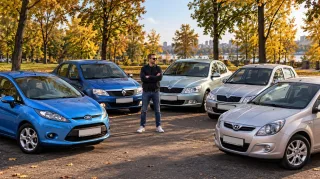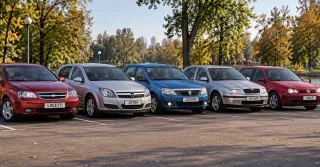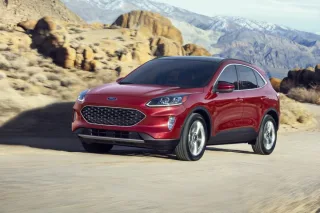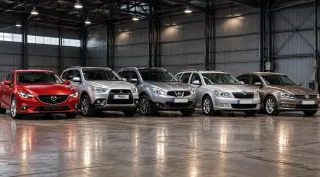
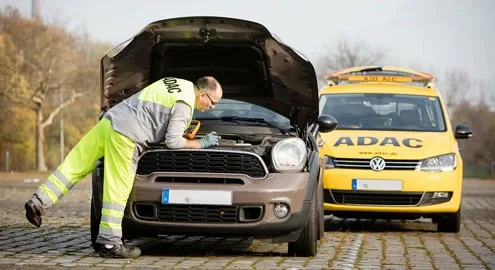
The ADAC study was based on breakdown data for 109 car models (20 brands) aged 3 to 10 years that occurred on German roads in 2020. Absolutely any malfunctions were taken into account, except for stops due to incorrectly refueled fuel or an empty tank – such “breakdowns” are solely the responsibility of drivers. And here are the results that came out.
The first place in unreliability was taken by a golf-class car: the 10-year-old Kia Ceed showed a breakdown rate of 52.7%. ADAC noted that newer Kias run almost without complaints, but older models have many problems. Most often, malfunctions are related to the battery, alternator, fuel pump, timing chain, and spark plugs.
A similar breakdown pattern is shown by the Hyundai i20 (42.2%). In addition to spark plugs, problems were caused by the starter and door locks. The same breakdowns are typical for the model that closed the top 3 of the anti-rating – the Kia Sportage (38.6%).
In addition, problems were noted in cars such as the Seat Alhambra, VW Sharan, Opel Insignia, Nissan Qashqai, Ford S-Max, and Renault Kangoo (the reason is the same battery, electronics, alternator, locks, etc.). All these cars have a breakdown rate in the range of 32-30%.

But the models that showed good reliability are representatives of German premium: the Audi A3, A4, A5, Q3, and Q5 turned out to be “extremely reliable,” and the BMW 1, 2, 3, 4, X1, X3, as well as Mini – “very reliable.” Right behind the models of these two brands come the Mercedes A-Class, CLA, GLA, as well as C-Class, GLC, and GLK.
However, there were also surprises: budget cars such as the small FIAT Punto and Dacia Sandero also showed reliability.
Overall, ADAC noted that in 2020, 3.386 million breakdowns occurred on German roads. The figure is impressive, but it is 10% less than what was recorded in 2019. Such a large drop is due to the fact that Germans simply began to drive less – obviously, due to the pandemic and quarantine restrictions. At the same time, the number of malfunctions caused by the battery (which accounts for the largest share), interestingly, increased – to 46.3% in 2020 versus 41.8% in 2019.
Finally, as for electric vehicles, according to ADAC statistics, they have the same main problem as conventional cars – most failures (as much as 54%) are associated with a small 12-volt battery (not to be confused with the traction battery). But the main battery, as well as the power unit and charging system, account for a small number of breakdowns (only 4.4%).